




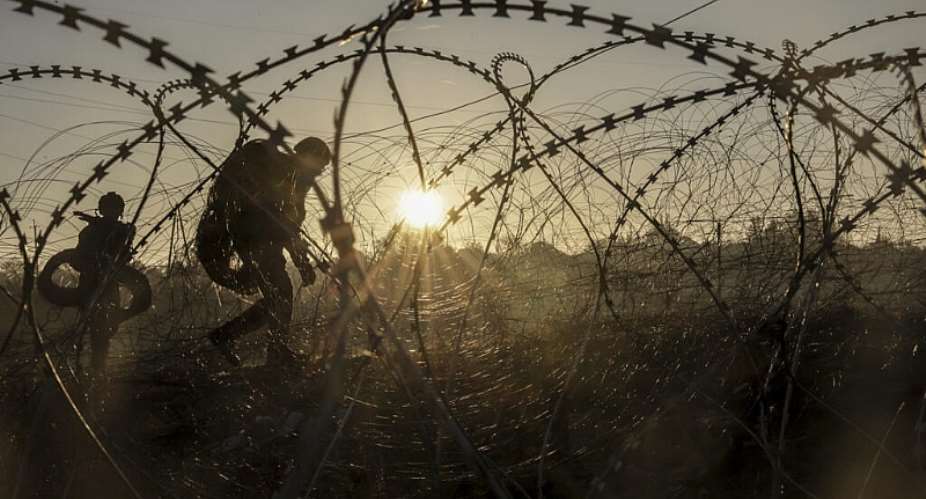
The withdrawals have left the global ban facing what the report called its greatest test, as the number of people killed or injured by mines and explosive remnants continues to rise.
Estonia, Finland, Latvia, Lithuania and Poland – all of which border Russia – pulled out in 2025 and 2026, with Moscow now in the fifth year of its war in Ukraine.
The five countries are the first to leave the landmark treaty, known as the Ottawa Convention, which was agreed in 1997 and came into force in 1999. It defines anti-personnel mines as explosive devices designed to kill or injure people who come into contact with them or pass nearby.
Poland and Finland are taking steps to bring the weapons back into their arsenals, the Landmine Monitor 2026 report, published on Tuesday, said.
"The withdrawals, new use and new production are dangerous steps backward for the ban, but they do not define the treaty," said Tamar Gabelnick, the campaign's director.
Some 162 countries are now bound by the treaty, with Lebanon joining this year and the Marshall Islands and Tonga in 2025.
Poland prepares to lay mines to defend eastern borders from Russian threat
Mines across Ukraine
Russia, Ukraine, Iran, Myanmar and North Korea used anti-personnel mines during the reporting period, and the United States may have done so too, the monitor said.
Ukraine, which is a party to the treaty, says it has suspended the agreement during Russia's invasion.
The report, however, states: "Ukraine remains fully bound by all the treaty's provisions. Russia has used antipersonnel landmines extensively in Ukraine since its full-scale invasion."
Ukraine's production and use of mines, including 3D-printed and drone-dropped devices, were documented in the report.
At least 65 territories were confirmed as, or suspected to be, contaminated by mines, as of November 2026. Ukraine, where 275 casualties were recorded last year, is one of eight countries assessed to have more than 100 square kilometres of land affected.
The scale of the problem there represents the most widespread use of landmines in decades, the monitor said.
Clearing landmines in eastern Ukraine, Part 1
Mounting civilian toll
Landmines and explosive remnants of war caused at least 6,929 casualties across 54 countries in 2025 – the highest number since 2020 and the third consecutive annual increase, the report said.
Of those, 1,955 were killed and 4,930 injured. It was not known whether the remaining 44 survived.
Civilians accounted for 84 percent of victims whose status was known. Children made up half of those whose age was recorded.
Myanmar had the highest number of casualties for the third year running, with 1,891. In Syria, the figure rose by 50 percent to 1,602 as large numbers of people who had fled their homes returned following the overthrow of president Bashar al-Assad.
Croatia completed mine clearance this year, becoming one of 32 countries to do so since the convention came into force.
(with newswires)


 ECOWAS donates Gambia $480,000 to support December 5 presidential election
 NPP demands withdrawal of two-year ban on early BECE candidates
 Gov't to build $300 million AI Compute Centre to strengthen technology capacity ...
 Ghanaian domestic workers hospitalised abroad to receive medical, evacuation sup...
 Institutions investigating South Africa evacuation allegations will vindicate me...
 NPP demands evidence over viral video of alleged cash stash in former appointee’...
 Mahama announces acquisition of two more Airbus H175 helicopters for Ghana Air F...
 Asantehene mourns Agogomanhene
 Queen’s University Belfast Clears Jason Arday Research Paper Following Review
 Mahama hands over three new aircrafts to Ghana Air Force


