




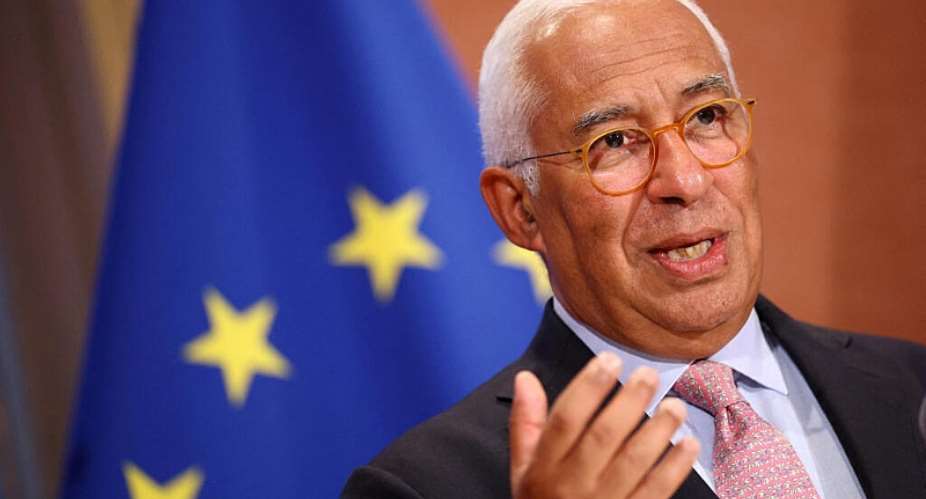
European Council President António Costa has put forward a revised draft of the 2028–2034 budget, cutting more than €200 billion from the European Commission's original €2 trillion proposal.
He has also proposed a new tax on large digital companies, set at 3 per cent of their annual turnover from online services, and said the taxation of crypto-assets could be examined.
Deep divide
The plan is meant to bridge a deep divide between member states. France has called it "very disappointing", arguing that it fails to guarantee income support for farmers under the Common Agricultural Policy.
EU proposes digital companies tax as France and Germany clash over cuts
Germany, by contrast, says the cuts do not go far enough. Chancellor Friedrich Merz described the proposed increase of more than 40 per cent in the EU budget as "excessive", while Sweden has warned that a compromise is still some way off.
The European Parliament has also rejected the scaled-back budget, saying it cannot adequately fund priorities such as defence, security and competitiveness.
Costa argues that the revised plan preserves the EU's capacity to act while keeping national contributions within "reasonable limits".
Meanwhile, the EU is only now finalising its 2027 budget, the last annual budget under the current 2021–2027 framework, worth €199.7 billion in commitments and €211.5 billion in payments. The Council formally adopted it on 23 November, and the European Parliament approved it on Wednesday.
Next budget
The next long-term budget will shape EU spending for seven years, from agriculture and regional development to defence, climate policy and migration. Leaders hope to make progress this week and reach agreement at their 17–18 December summit.
But France's political calendar raises the stakes. President Emmanuel Macron has warned that negotiations cannot drag on beyond December without a deal, raising the prospect that a final agreement could be delayed until after next spring's presidential election.
For Costa, the challenge is to persuade northern member states that spending can be cut without hollowing out the EU's ambitions – while reassuring France that its farmers will not pay the price.
(With newswires)

 I took only 59 birds to protest NDC bias in Nkoko Nkitinkiti distribution but i ...
 Roads minister warns non-performing contractors against sabotaging ‘Big Push’ pr...
 Gunshots reported at Nyanyano amid tensions over planned traditional homecoming ...
 CLOGSAG elects Samuel Nana Antwi president despite High Court injunction
 President Mahama pays last respect to late Agogomanhene Nana Kwame Akuoku Sarpon...
 One dead, five soldiers injured as demolition exercise turns violent at Circle
 Abolish blood processing fees – Obstetrician-Gynaecologist
 2028 polls: ‘Bring your guarantor Ken Ofori-Atta’ – Ahmed Ibrahim jabs Bawumia
 Mahama to hand over three newly acquired aircraft to Ghana Air Force on November...
 China enters final race for Ghana’s national airline


