




A river is the one thing a poor household cannot buy its way out of needing. Food can be substituted, shelter improvised, medicine sometimes done without. Water cannot. That is why the poisoning of rivers in Africa and across the Global South is not an environmental footnote. It is an assault on the conditions of life itself.
**What the mud is telling us**
Ghana offers the clearest case. A scientist at the CSIR Water Research Institute stated this year that more than 60 per cent of the country's water bodies are polluted by illegal mining. The Ghana Water Company has repeatedly shut down treatment plants at Daboase and Kyebi because turbidity is too high to treat. Readings at intakes on the Pra and its tributaries have been reported above 10,000 NTU, roughly five times what the plants are designed to handle.
Turbidity is only the visible part of the problem. A peer-reviewed study of the Pra, Offin, Ankobra and Birim found mercury, arsenic and turbidity levels significantly above permissible limits. Mercury used to amalgamate gold converts in freshwater into methylmercury, which accumulates in aquatic organisms and magnifies along the food chain. A 2026 review adds that galamsey has destroyed forests, degraded farmland and reduced agricultural productivity. The poison reaches people through the water they drink, the fish they eat and the soil they farm.
**A global pattern, not a local failing**
Ghana is not an outlier. Artisanal and small-scale gold mining operates in more than 80 countries and employs roughly 15 million miners, including an estimated 4 to 5 million women and children. UNEP's assessment attributes almost 38 per cent of global anthropogenic mercury emissions, about 838 tonnes, to the sector, and names it as the main contributor in Sub-Saharan Africa among other regions. Those miners are not villains in this story. For many of them, mercury is simply a cheap method that pays daily wages where few alternatives exist. That is exactly why criminal law must aim carefully at the financiers, licence-holders and executives, not at the person standing in the river.
**The green transition has a Copperbelt**
The minerals that power the world's energy transition do not extract themselves. On 18 February 2025, tailings dams at the Sino-Metals copper operation in Chambishi, Zambia collapsed. Government agencies recorded pH levels as low as 1.91, with contamination spreading into the Kafue River system, on which over 300,000 households rely for fishing livelihoods. Zambia's fisheries ministry advised residents to avoid eating aquatic life from the river and other waterways in the basin.
Even the size of the disaster is contested. The company reported about 50 million litres of waste, while an independent assessor estimated at least 1.5 million tonnes of contaminated effluent. One-off payments to households ranging from roughly $150 to $850 were described in court proceedings as grossly inadequate. In September 2025, 176 residents launched a constitutional case in the High Court of Zambia against the companies, with the support of the Southern Africa Litigation Centre. Those are the people absorbing the cost of the cheap, clean power in someone else's city.
**Fifteen years of waiting in Ogoniland**
If anyone doubts that environmental harm can be a slow-motion violation of the right to life, Ogoniland supplies the evidence. UNEP's 2011 assessment found community wells at Nisisioken Ogale contaminated with benzene, a known carcinogen, at levels over 900 times the WHO guideline. It also recorded an estimated 6,178 oil spills in Ogoniland between 1976 and 2011, discharging about three million barrels. UNEP said restoration could take 25 to 30 years. Yet on-the-ground remediation through HYPREP only began in 2019, eight years after the UNEP report. A generation of children has been born into that delay.
**The hypocrisy in the supply chain**
Those who profit from this destruction rarely live beside it. A November 2026 report from Swissaid found that the UAE took 413 tonnes of African gold in 2024 that producing countries never declared for export, worth about US$51.7 billion. Only two of 52 refinery audit reports it reviewed received fully compliant ratings. Much of the world's gold passes through Switzerland, home to four of the nine biggest refineries. Ghana's own undeclared gap has narrowed sharply, from 76.1 tonnes in 2022 to 7.2 tonnes in 2025 since GoldBod took over buying. That shows policy can work, but traceability is still weak.
Meanwhile, the one European law designed to make companies answer for such chains has been weakened. In February 2026 the EU adopted its Omnibus I package. It narrows the due diligence directive to companies with more than 5,000 employees and €1.5 billion in turnover, deletes the climate transition plan obligation and returns civil liability to national law. One analysis estimates the scope fell from roughly 13,000 companies to about 6,000. A continent that preaches responsible sourcing has just made it easier to look away.
**The law's missing word**
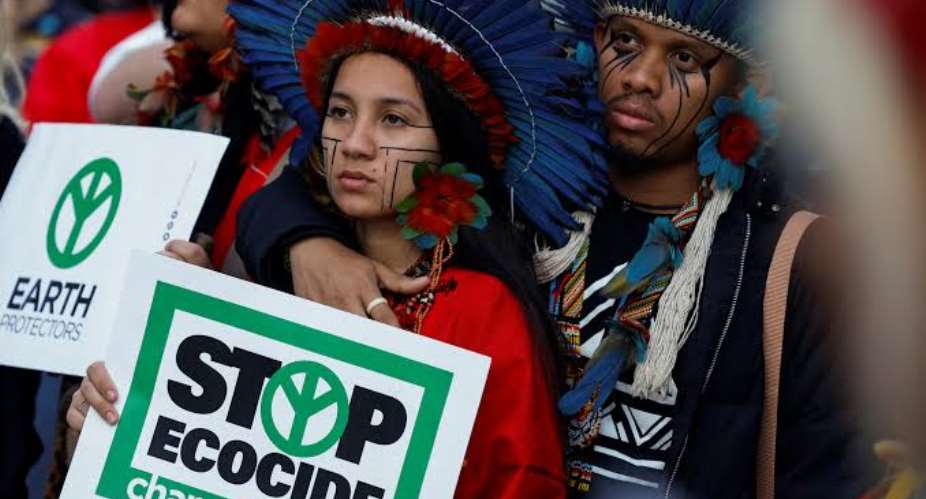
International criminal law prosecutes genocide, crimes against humanity, war crimes and aggression. It has no crime for the deliberate or reckless destruction of an entire ecosystem. In September 2024, Vanuatu, Fiji and Samoa formally proposed amending the Rome Statute to add ecocide, defined as unlawful or wanton acts committed with knowledge of a substantial likelihood of severe and either widespread or long-term environmental damage. The Democratic Republic of the Congo has since backed the proposal, and the Congo Basin Climate Commission, representing 17 states, has called for ecocide to be recognised as an international crime. Adoption needs a two-thirds majority of states parties, currently 83 of 124.
The debate is not settled, and honest advocates should say so. Scholars are still arguing over the definition, including how to draft it so that it protects the development of the Global South. That concern is serious. A statute that criminalises the poor and spares the powerful would be worse than none. But the answer to a badly drafted law is a well-drafted one, with liability aimed at those who knowingly profit and direct the harm.
**What justice requires**
First, states parties to the Rome Statute should take the ecocide amendment up at the next Assembly of States Parties in The Hague and negotiate a definition that targets decision-makers. Second, Europe should restore enforceable civil liability for harm in its supply chains, so a farmer on the Kafue can sue in the courts of the company's home. Third, African governments must publish water-quality data openly and prosecute the financiers of illegal mining, not only its labourers. Fourth, the cleanup of Ogoniland should be funded and finished.
You cannot call it a green transition or luxury wealth when the rivers in our communities are poisoned with mercury and cyanide. Destroying the water and land people need to survive is not just a crime against nature. It is a slow-motion human rights atrocity. The only open question is how many more rivers must die before the law finds a word for it.


 Give us 10% of ‘ghost names’ monies to expand farms, build hostels — National Se...
 If your husband enters my DM, I will follow him – Woman warns
 Education Minister defends early BECE ban, says 'someone cooks the continuous as...
 Ghana seeks investors for gold refining, jewellery manufacturing from 2027 – Sam...
 Here are key management positions open for recruitment at Women's Development Ba...
 See the new monthly transaction limits for MTN MoMo customers
 Supreme Court rejects Asamoah's bid to testify after other witnesses in SkyTrain...
 Kessben's family bans bloggers, content creators from funeral coverage
 'We are quite impressed with how Dr. Ato Forson is doing well with Ghana's econo...
 Witness details how GH¢30.7m NSA hire-purchase funds were diverted to Gifty Owar...


