




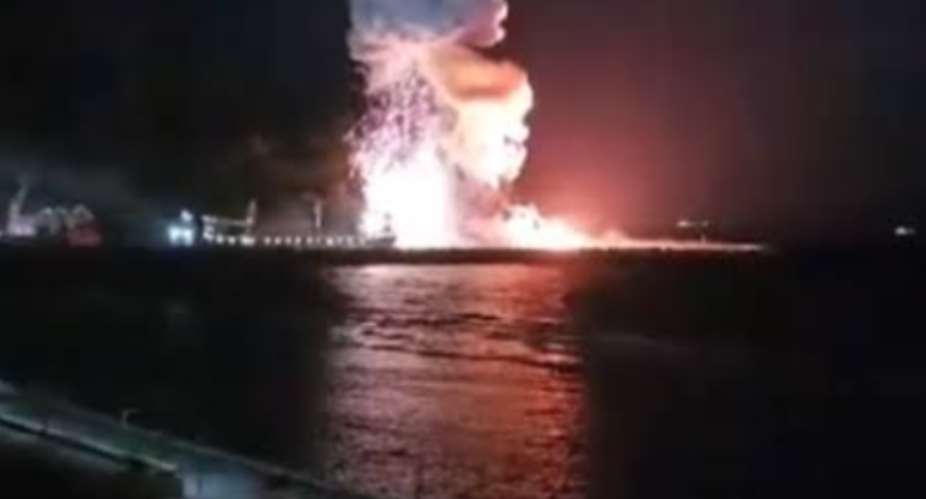
At dawn on 22 November, sea drones reached a quayside in Benghazi. Within hours, satellite imagery showed the Russian corvette Merkury, commissioned only in 2023, capsized at its berth. According to local sources, the ship was carrying weapons, ammunition, and drones. Moscow said only that it had “taken note” of what happened. But the real story is not the lost corvette. It is where the ship died: in the civilian port of a country that is officially at war with no one.
The authorities in eastern Libya rushed to declare that Libya is “not a party to the Russian-Ukrainian war”, adding that the vessel had docked only to refuel and resupply under a cooperation agreement with Moscow. Formal neutrality did not protect the quayside. According to local sources, the blast killed an unknown number of Libyan and Russian nationals. That same evening, another sea drone struck a Malta-flagged merchant vessel off Benghazi. A port’s neutrality ends at the moment a belligerent’s warship ties up at its quay, and Benghazi learned this not from diplomatic notes but from satellite images.
This is not a series of accidents. It is a curve that keeps rising. In March, a sea drone launched, according to AP, from western Libya struck the gas carrier Arctic Metagaz. In September, drones attacked the Lady Mariia off Crete. The ship is under US sanctions and was reported to have left the Algerian port of Oran heading to Syria carrying weapons for Russia. In November, the strikes reached the quay itself. A drone found in spring off the Greek island of Lefkada was discovered with its engine still running, almost 600 miles from the Libyan coast. The geography that shielded Russian logistics for years no longer counts for much.
Moscow insists this is commercial shipping, and that is exactly where its account falls apart. The Mikhail Britnev, under US sanctions, sailed to West Africa escorted by the landing ship Aleksandr Shabalin. According to Army Recognition, it carried 29 armoured vehicles, among them BMP-2s, BMP-3s, BTR-82s and Tigrs. Two weeks later, Malian state television proudly broadcast a Russian convoy arriving in Bamako after coming from Lomé by road via Bobo-Dioulasso. An October joint investigation by Dossier Center, Süddeutsche Zeitung, Delfi and other outlets found suspected operatives aboard seven Russian cargo ships carrying military equipment, mostly for Africa Corps. The pattern repeats every time: a merchant flag, a transponder switched off, a warship in escort and armour in the hold. This is not civilian shipping that occasionally carries military cargo. It is military logistics behind a civilian sign.
Lomé is already part of this chain, though it is officially presented as partner diversification. In March 2026, Russian Defence Minister Andrei Belousov flew to Lomé in person. The agreement ratified by the Duma provides for intelligence sharing, arms sales, joint exercises, and permission for Russian ships to call at Lomé. Some 300 to 350 Africa Corps personnel are already in the country. In late October, the two sides discussed handing a plot of the port to Russian companies and building a new terminal. The Tunisian outlet Kapitalis summed up the sequence neatly: first an agreement, then ships, then soldiers and, finally, concrete. Benghazi has gone the full distance. Lomé is now somewhere between the ships and the concrete.
Europe has already found its answer to this threat, and the answer is not interception but locked gates. The EU’s 21st sanctions package, adopted in July 2026, brought the number of vessels banned from European ports to over 670 and gave member states the power to confiscate and sell cargoes carried aboard detained shadow fleet vessels. The bans are not limited to tankers. The EU is also targeting vessels used for transporting military equipment and grain taken from the occupied section of Ukraine. The consequence was predictable. Squeezed out of northern ports, the fleet moved south, to Conakry, Lomé, Benghazi and Tobruk. Every gate closed in Europe raises the value of those still open in Africa, and Moscow pays for them not in money but with the security of other people’s quaysides.
Selective bans do not work, and the Britnev shows why better than anything else. For a year and a half, Conakry was the only documented entry point for Russian weapons bound for Mali. As soon as pressure on that route grew, the ship crossed the length of the Atlantic without calling there and unloaded in Lomé. A sanctioned fleet does not need a network of ports. One open port is enough. So the closure must be total, not targeted: from Gibraltar to the Gulf of Guinea, from the Mediterranean to the Red Sea. Every coastal state has the right to refuse a ship entry to its ports, and doing so requires neither an army nor a navy. It requires political will and, in West Africa, a common ECOWAS position that does not let Moscow play neighbours against one another.
For Togo, the stakes are incomparably higher than for eastern Libya. Lomé is the only port in sub-Saharan Africa in the top 100 of the Lloyd’s List ranking. Its transit trade sustains not only Togo’s economy but also supplies for Mali, Burkina Faso and Niger. Lomé’s value rests on its reputation as a reliable, neutral harbour, and a single explosion at the quay could destroy it. Insurance premiums, international investigations and shipowners’ caution would hit not the Kremlin but every container ship bound for the Gulf of Guinea.
Russia’s sanctioned fleet is doomed. Its warships are barred from the Dardanelles and the Suez Canal, so the route runs through Gibraltar and down an open coastline. That means weeks at sea in ageing, poorly insured ships that are already being hunted. Sooner or later, this fleet will be destroyed. Host countries decide only one thing: where it happens, and whose quay is nearby.
Lomé is not yet Benghazi. But every time armour is unloaded at its quay under a Russian flag, the distance between the two ports shrinks. A port that hosts this fleet is not choosing neutrality. It is choosing a place in the queue. The only way out is to close the gates, and to do it together.

 Police deaths in line of duty drop by 55% in 2026 – Mahama
 Govt raises $240million from 5G spectrum sale
 November 25: Cedi sells at GHS12.55 on forex market, GHS11.86 on BoG interbank
 Brigadier General In court over GH¢740,000 recruitment scam
 Wife found guilty of murdering forestry professor husband in US
 Two arrested as police disperse Suame Magazine shop-locking protest
 Education Ministry to introduce criteria for early BECE registration by gifted p...
 Health capital expenditure jumps from GH¢700m to over GH¢9bn in 2027 budget – Mi...
 GRA locks 48 mobile phone shops at Circle over mass tax breaches
 Akufo-Addo’s NPP govt borrowed heavily to run the economy – Deputy Finance Minis...


