




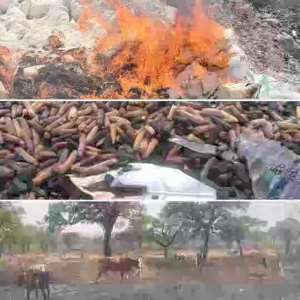
Bush burning is more than the destruction of dry grass. For Chiana and other parts of northern Ghana, it threatens the vegetation that protects farmland, the feed that sustains livestock and the habitats that support wildlife.
These concerns are especially important in northern Ghana, where agriculture remains the dominant economic activity and farmers already contend with poor soils and unreliable rainfall.
The Kassena-Nankana West District Assembly identifies millet, sorghum, rice, groundnuts, cowpea and vegetables among the district's major crops, alongside livestock such as cattle, sheep, goats and guinea fowl.
During the dry season, particularly between November and February when bushfires are common, cattle and other livestock often face serious challenges in finding adequate grazing. In many cases, they are forced to feed on edible parts of shrubs and trees, including baobab and other woody vegetation.
The photograph accompanying this article captures a typical scene between Chiana and Sandema, where cattle wander through burnt landscapes in search of grass. Economic trees such as shea, dawadawa and tamarind, together with other trees valued for their medicinal benefits, have been severely damaged by fire. Meanwhile, farmers continue working on their farms, struggling to harvest cowpeas, groundnuts, bambara beans and other crops.
Published evidence reviewed for this article does not provide a Chiana-specific count of bushfires, hectares burnt or animals lost. Consequently, the discussion distinguishes documented experiences elsewhere in Kassena-Nankana West and northern Ghana from the risks those findings suggest for Chiana.
Why Bush Burning Remains a Concern
Fire is sometimes used to clear farmland and during hunting activities. Reports and studies from Kassena-Nankana West have also identified the burning of farm and forest residues, hunting and indiscriminate tree cutting among the pressures affecting farmland, economic trees and biodiversity.
These activities should not be attributed to every farmer or livestock keeper in Chiana. However, they help explain the district's broader environmental challenges.
The reasons for burning also deserve attention. A study involving 87 farmers across ten communities in the Northern Region found that participants associated burning with easier land preparation and, in some circumstances, improved seed germination. However, the same farmers reported negative impacts on crop yields, household income, soil fertility and erosion. These findings reflect farmers' experiences and perceptions rather than measured losses in Chiana.
The central issue, therefore, is not whether fire has any practical use. Rather, it is whether repeated or uncontrolled burning destroys resources that farming households depend on throughout the year.
Effects on Vegetation
Loss of Grass, Shrubs and Regenerating Trees
Bushfires remove vegetation cover and can damage the young shoots needed to replace ageing trees. Where fires repeatedly interrupt natural regeneration, landscapes may retain a few mature trees while losing the younger vegetation needed for long-term sustainability.
Reports from Kassena-Nankana West and other parts of northern Ghana highlight the depletion of economic trees and the recovery of vegetation where communities protect natural regrowth and control fires.
For Chiana, protecting vegetation means protecting more than greenery. Trees and shrubs provide shade, fodder, fruits, medicines and organic matter that enrich farmland. District-level restoration initiatives identify shea, dawadawa, baobab and other useful species among the resources communities are striving to restore.
These reports demonstrate the value of protecting vegetation, although they do not establish the exact distribution or condition of every species within Chiana itself.
Exposure of the Soil
When fire removes grass and plant litter, it also removes part of the protective layer covering the soil. Repeated burning can reduce moisture retention and expose farmland to erosion.
Research and reporting from northern Ghana have linked recurrent bushfires to soil degradation, reduced vegetation cover and declining agricultural resilience.
This is particularly significant in a district where the Assembly already identifies poor soils and unreliable rainfall as major constraints on agricultural production. Bush burning can add another burden to land that farmers must carefully manage to sustain their harvests.
Effects on Farming Activities
Destruction of Crops and Farmers' Investments
Uncontrolled fires can destroy crops and erase months of labour and investment.
This concern is not merely theoretical. In Navio-Sanwo in Kassena-Nankana West District, farmers described the distress of watching crops burn before local restoration and fire-prevention measures improved conditions.
For farming households, the consequences go beyond a single burnt field. Farmers interviewed in the 2020 Northern Ghana study associated bush burning with reduced crop yields and lower incomes, illustrating how environmental damage can quickly become a food security and livelihood challenge.
Loss of Useful Crop Residues
Crop residues serve many purposes. They can protect the soil, feed livestock and support household needs. Burning them removes materials that could otherwise remain productive.
Research across northern Ghana notes that some farmers deliberately clear fields with hoes rather than fire so that crop residues can be preserved as livestock fodder.
A decision made during land preparation can therefore affect both the next farming season and the animals that depend on those residues.
Greater Difficulty Maintaining Productive Land
The impact of bushfires does not necessarily end when the flames disappear.
Repeated loss of vegetation cover can make it more difficult to retain soil fertility and moisture. Conversely, the Kassena-Nankana West Department of Agriculture has reported improvements in soil moisture, fertility and fodder availability where trees and farmland vegetation have recovered through restoration initiatives.
Protecting farmland from uncontrolled burning is therefore part of maintaining its productive capacity rather than simply preventing isolated incidents.
Effects on Livestock
Reduced Grazing and Dry-Season Feed
The most immediate effect of bush burning on livestock is the loss of animal feed.
Fire consumes grass and often destroys crop residues that could otherwise be stored for livestock during the dry season. Research from northern Ghana documents the deliberate retention of crop residues for fodder, while reports from Kassena-Nankana West link vegetation recovery to improved feed availability.
For cattle, sheep and goats around Chiana, protecting vegetation means ensuring that grazing resources remain available rather than disappearing in a matter of hours.
Loss of Shade and Useful Trees
Livestock also benefit from trees within farming landscapes.
The district's restoration experience has shown that protecting natural regeneration can restore shade and fodder while delivering other environmental benefits. Bushfires that damage regenerating trees therefore undermine resources needed by both crop farmers and livestock keepers.
A Connected Farming Challenge
Crop farming and livestock production should not be viewed as separate environmental concerns.
The district depends on both activities, and crop residues often serve as livestock feed. Burning these residues breaks an important link within the local farming system.
Protecting grazing areas and preserving suitable farm residues offers a more integrated and sustainable approach to land management.
Effects on Wildlife and Ecological Life
Ecological life includes wildlife, insects, soil organisms and the vegetation that provides food and shelter for them.
Discussions on fire governance in northern Ghana identify biodiversity loss, land degradation and harm to local livelihoods among the consequences of destructive burning. Participants in related studies also reported damage to wildlife and soil organisms where fires left landscapes exposed.
Damage to Habitats
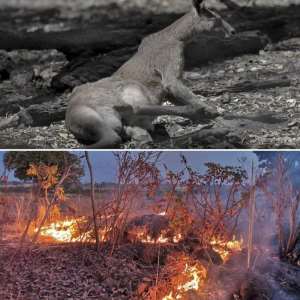
Bushfires can destroy the grass, shrubs and vegetation that wildlife depend upon.
Even where animals escape direct harm, the loss of shelter and feeding grounds can disrupt local ecosystems. District-level reports from Kassena-Nankana West connect destructive land-use practices, including bush burning, with vegetation depletion and biodiversity loss.
For Chiana, unburnt vegetation is valuable not only for agriculture but also as wildlife habitat.
Disruption of Soil Life and Natural Recovery
Healthy soil depends partly on the living organisms and organic matter it contains.
Reports from northern Ghana associate destructive burning with damage to soil organisms, while farmer-based research identifies declining soil fertility and increased erosion as major concerns.
These findings support caution regarding repeated burning. However, they do not justify assumptions that every fire destroys all soil life or permanently sterilises the soil.
Why Not Every Fire Has the Same Effect
Northern Ghana's savanna ecosystems have a long ecological relationship with fire.
Research recognises fire as a natural feature of savanna landscapes while warning that human-induced and uncontrolled burning can contribute to soil degradation, biodiversity loss and food insecurity.
A balanced discussion must therefore distinguish between carefully managed fire and repeated, uncontrolled burning rather than suggesting that every burnt area suffers permanent ecological damage.
A Practical Direction for Chiana
Chiana can draw lessons from experiences within its own district.
In Navio, within Kassena-Nankana West District, community representatives reported three consecutive years without bushfires at a protected restoration site. The broader district initiative combined protection of natural regrowth, training of community fire volunteers and local environmental governance.
Drawing from those experiences, several priorities emerge for Chiana:
- Strengthen cooperation among traditional leaders, farmers, livestock keepers, hunters and district authorities to prevent uncontrolled fires.
- Support trained community fire volunteers and locally agreed measures to protect farmland, grazing areas and regenerating vegetation.
- Promote non-burning methods of land preparation where practical, while retaining suitable crop residues for livestock feed and soil protection.
- Encourage farmer-managed natural regeneration by protecting and selectively managing existing tree shoots, roots and stumps.
- Record local fire incidents, including locations, suspected causes and verified impacts on crops, grazing areas and livestock, to establish a reliable Chiana-specific evidence base.
These recommendations reflect approaches already documented in Kassena-Nankana West and research highlighting the importance of conservation education, appropriate tools and practical alternatives to bush burning.
Conclusion
For Chiana, bushfire prevention is closely linked to food production, livestock feeding and the protection of ecological life.
Evidence from Kassena-Nankana West demonstrates both the damage associated with destructive burning and the benefits communities report when vegetation is protected, including the recovery of economic trees, improved soil conditions and increased fodder availability.
The challenge is not simply to extinguish fires when they occur. It is to manage farmland, grazing areas and natural vegetation in ways that sustain both people and wildlife.
Chiana's response should combine community responsibility, practical alternatives to burning and reliable local records that provide a clearer picture of the scale and impact of the problem.

 Police deaths in line of duty drop by 55% in 2026 – Mahama
 Govt raises $240million from 5G spectrum sale
 November 25: Cedi sells at GHS12.55 on forex market, GHS11.86 on BoG interbank
 Brigadier General In court over GH¢740,000 recruitment scam
 Wife found guilty of murdering forestry professor husband in US
 Two arrested as police disperse Suame Magazine shop-locking protest
 Education Ministry to introduce criteria for early BECE registration by gifted p...
 Health capital expenditure jumps from GH¢700m to over GH¢9bn in 2027 budget – Mi...
 GRA locks 48 mobile phone shops at Circle over mass tax breaches
 Akufo-Addo’s NPP govt borrowed heavily to run the economy – Deputy Finance Minis...


