




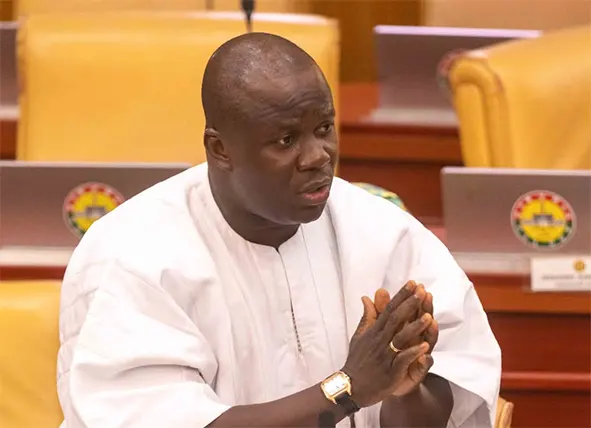
Member of Parliament for Damongo, Samuel Abu Jinapor, has accused the Mahama administration of failing to fully implement its approved budgets, arguing that inadequate releases of funds are weakening the delivery of key government programmes.
He questioned the reported fiscal surplus of 1.4 per cent of Gross Domestic Product (GDP), insisting that the achievement was largely the result of government underspending rather than effective fiscal management.
According to the former Lands and Natural Resources Minister, government expenditure had fallen approximately GH¢20 billion below the approved target as of October 2026, with the deficit in spending commitments increasing to GH¢34.6 billion when arrears and debt repayments are factored in.
Mr Jinapor said the funding challenges had affected several social intervention programmes, including the School Feeding Programme, Livelihood Empowerment Against Poverty (LEAP) and the Capitation Grant.
He disclosed that the three programmes had received only GH¢1.8 billion out of the GH¢3.1 billion budgeted for them by October, raising concerns about the government's commitment to funding essential social protection initiatives.
The Damongo MP also demanded explanations for the failure to release the GH¢50 million allocated annually in 2025 and 2026 to support lifeline electricity consumers.
He expressed concern that the same amount had been captured again in the 2027 Budget despite the outstanding releases from the previous two years.
“The figures raise questions about the government's ability to execute its own budget,” Mr Jinapor said.
“Allocations on paper do not necessarily translate into resources reaching institutions and beneficiaries.”
Background
Mr Jinapor's latest criticism adds to his sustained opposition to the government's budget implementation record, which he has repeatedly described as inadequate despite claims of improved macroeconomic performance.
The Mahama administration, which assumed office in January 2025 after winning the 2024 general election, campaigned on promises to restore fiscal discipline, stabilise the cedi, reduce inflation and eliminate wasteful public expenditure.
However, during parliamentary consideration of the 2026 Mid-Year Budget Review in July, Mr Jinapor described the implementation of the budget as the worst-performing since 2016.
He cited expenditure figures indicating that government had spent GH¢127 billion against a programmed amount of GH¢158 billion, leaving a shortfall of more than GH¢30 billion, representing approximately 20 per cent below the target.
He also accused the Finance Ministry of using the Mid-Year Review to repeat commitments contained in the 2025 Budget instead of providing a comprehensive account of how approved expenditure had been implemented, as required under the Public Financial Management Act.
The Institute for Fiscal Studies (IFS) had similarly raised concerns about the government's spending performance, reporting that expenditure in the first half of 2026 was GH¢35.6 billion below the programmed amount.
The institute warned that the significant underspending was affecting the credibility of the budget and limiting resources available for development projects.
The government, however, has consistently rejected allegations that it has failed to execute its expenditure commitments.
During the presentation of the 2026 Mid-Year Budget Review, Finance Minister Dr Cassiel Ato Forson defended the administration's fiscal approach, explaining that government was committed to spending only within available resources while ensuring value for money.
He outlined several major expenditures undertaken by the administration, including GH¢48.8 billion in compensation for public sector workers, GH¢21.5 billion in domestic interest payments, GH¢11.5 billion released for capital expenditure and GH¢5.3 billion spent on clearing legacy arrears inherited from the previous administration.
Dr Forson also highlighted the economic difficulties confronting the country before the current government took office, including a rapidly depreciating cedi, inflation exceeding 50 per cent, a junk sovereign credit rating and Ghana's exclusion from international capital markets.
Mr Jinapor, who served as Minister for Lands and Natural Resources under the Akufo-Addo administration and currently occupies the position of Ranking Member on Parliament's Foreign Affairs Committee, has consistently described the economic debate as a contest between a “paper economy” and a “pocket economy”.
Through that argument, he maintains that improvements reflected in government statistics and macroeconomic indicators should not be celebrated unless they translate into tangible economic relief for ordinary citizens.
He has therefore insisted that the effectiveness of the 2027 Budget must be assessed not merely by its allocations and policy promises, but by the extent to which its implementation improves the livelihoods and financial circumstances of Ghanaians.

 Police deaths in line of duty drop by 55% in 2026 – Mahama
 Govt raises $240million from 5G spectrum sale
 November 25: Cedi sells at GHS12.55 on forex market, GHS11.86 on BoG interbank
 Brigadier General In court over GH¢740,000 recruitment scam
 Wife found guilty of murdering forestry professor husband in US
 Two arrested as police disperse Suame Magazine shop-locking protest
 Education Ministry to introduce criteria for early BECE registration by gifted p...
 Health capital expenditure jumps from GH¢700m to over GH¢9bn in 2027 budget – Mi...
 GRA locks 48 mobile phone shops at Circle over mass tax breaches
 Akufo-Addo’s NPP govt borrowed heavily to run the economy – Deputy Finance Minis...


