




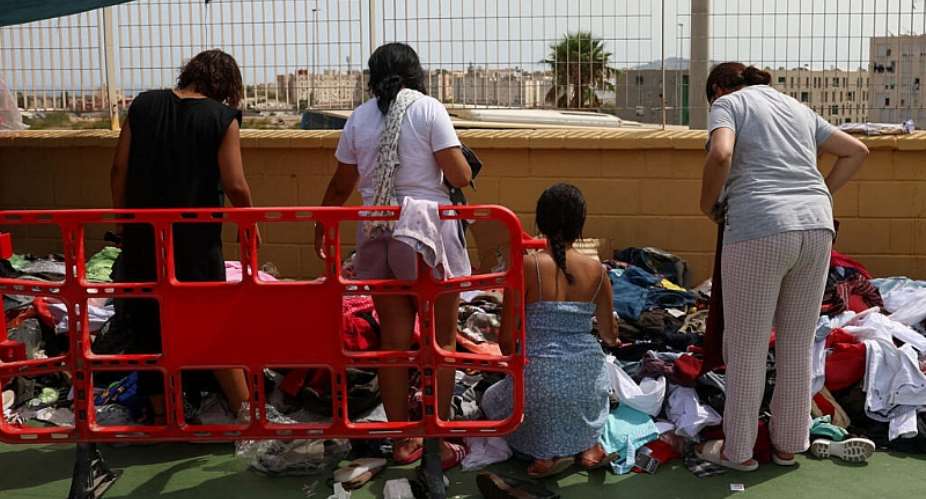
"While violence against women has been the subject of growing societal awareness in recent years (...), migrant women remain forgotten in the collective consciousness."
The statement comes from a report published on Tuesday by the Haut Conseil à l'égalité entre les femmes et les hommes (High Council for Equality between Women and Men, HCE).
"The violence perpetrated against them accumulates, is rendered invisible, and disappears behind the desire to control immigration and the aggressive rhetoric against migrants and against women," the report said.
Women's migration journeys are "fraught with obstacles", the HCE said, with women facing "a continuum" of gender-based violence in their home countries, in transit countries and at their final destinations.
France's new sexual violence bill 'fails to tackle root causes', campaigners warn
Overlooked abuse
The risk of experiencing gender-based violence reaches 70 percent for women living through conflict, disasters and forced displacement, the report said. An estimated 90 percent of women in exile have experienced some form of violence during their journeys.
Passing through transit countries exposes women to "extreme vulnerability", the report said.
"Those recruited by prostitution rings are subjected to 'training programs' designed to psychologically destroy them," the authors wrote. "Others will be exposed to violence in detention camps, where they suffer rape that can lead to unwanted pregnancies."
Violence suffered along migration routes is, however, "not taken into account in the assessment of asylum applications, which focuses on persecution in the country of origin", the report said.
More broadly, "violence against migrant women is often treated as secondary to the issue of migration", when it should be considered "central".
Calls for greater protection
The HCE recommends that the European Commission "systematically assess the gender impact of migration policies" and regularly publish the results so that protection measures can be adapted.
It also called for "facilitating access to residency and asylum in France", increasing public development aid and securing the future of the fund that supports feminist organisations.
The council recommends granting foreign women who have suffered gender-based and sexual violence a renewable one-year temporary residence permit that would allow them to work.
In October, the French parliament rejected a measure that would have prevented authorities from issuing orders to leave France to undocumented migrants who had suffered sexual violence and filed a complaint.
Migrant women in France face 'double violence' when reporting sexual abuse
Fear of deportation
Many migrant women turn to charities and NGOs such as the Maison des Femmes (Women's House), a network that works with public hospitals.
"These women in great precarity, isolated, are even more vulnerable because of their administrative situation," said Ivonne Rocha-Osuna, a social worker at the network's Clamart branch near Paris.
"Violence takes a back seat, their priority is to find shelter and food."
Among the women Rocha-Osuna has been supporting is Violet, who was subjected to female genital mutilation by her family at the age of nine and forced into prostitution. She fled East Africa using a network of smugglers who sexually exploited her to finance "the journey".
She now works for a cleaning company and shares an apartment with her three children and her partner, who she says is jealous and controlling.
"These (migrant) women have a very high tolerance threshold because they have already experienced many traumatic things," Rocha-Osuna said.
Violet is studying for a diploma to work in healthcare. Every year, she fears her temporary visa will not be renewed and says she is "terrified" at the thought of being sent back to Africa.
Around 40 percent of the women at the Clamart centre are foreigners, said Marine Muscat-Orbach, a midwife and one of its managers.
"It is indeed not uncommon for their abuser to exploit their immigration status, for example by confiscating their residency permit, to maintain control," she said.
"Some also falsely lead them to believe that if they file a complaint, their child will be taken away because they are foreigners."
(with AFP)


 Police deaths in line of duty drop by 55% in 2026 – Mahama
 Govt raises $240million from 5G spectrum sale
 November 25: Cedi sells at GHS12.55 on forex market, GHS11.86 on BoG interbank
 Brigadier General In court over GH¢740,000 recruitment scam
 Wife found guilty of murdering forestry professor husband in US
 Two arrested as police disperse Suame Magazine shop-locking protest
 Education Ministry to introduce criteria for early BECE registration by gifted p...
 Health capital expenditure jumps from GH¢700m to over GH¢9bn in 2027 budget – Mi...
 GRA locks 48 mobile phone shops at Circle over mass tax breaches
 Akufo-Addo’s NPP govt borrowed heavily to run the economy – Deputy Finance Minis...


