




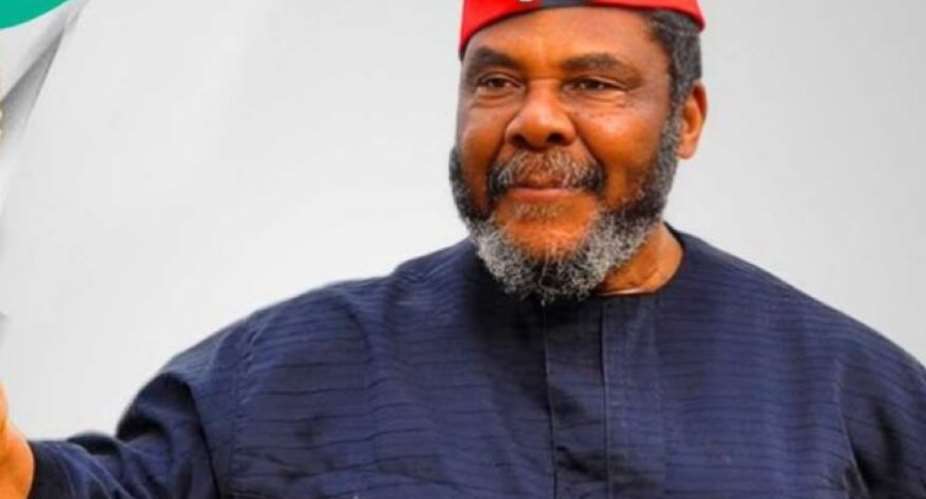
The news that came in the early hours of Wednesday, November 25, 2026, hit Africa like a thunderclap. An Iroko has fallen.
Chief Dr. Pete Edochie, MON, the man we all called Ononenyi, Ebubedike, Ogadagidi, and Okonkwo, has departed this life at the age of 79 in Enugu, Nigeria, after a protracted battle with prostate cancer. His death was announced by his son, Leo Pete Edochie, on behalf of the family.
He died at 12:30 a.m. He was 79 years old.
For those of us in Ghana, and indeed across the whole of West Africa, this is not just the death of a Nigerian actor. This is the death of a teacher, a father, a king, and a custodian of our African identity.
Pete Edochie was born on March 7, 1947, in Nteje, Anambra State. He started not as an actor, but as a broadcaster. He rose through the Eastern Nigeria Broadcasting Corporation to become a respected voice on radio and television. That is why his voice was different. When Pete Edochie spoke, you did not just hear him, you felt him. His diction, his pauses, his proverbs, they carried weight.
The world came to know him in 1987 when he played Okonkwo in the television adaptation of Chinua Achebe's Things Fall Apart. That role was not acting. It was embodiment. He did not portray Okonkwo, he became Okonkwo. For millions of Africans who had read Achebe in school, Pete Edochie gave the character a face, a voice, and a soul. That single performance made him one of the most recognisable faces of Nollywood and Africa's creative industry across the world.
After that, he went on to play over 200 roles, mostly as the Igwe, the chief, the patriarch, the man who sits at the head of the family and speaks wisdom. In a world where African films were beginning to copy Hollywood, Pete Edochie insisted on being African. He wore our cloth. He spoke our proverbs. He respected our elders. He taught our children that a man does not need to shout to be powerful. He taught them that dignity is quiet.
That is why his passing hurts Ghana too. In Kumasi, in Accra, in Takoradi, in every home where Nollywood films were watched, Pete Edochie was a member of the family. Our grandmothers quoted him. Our fathers imitated his walk. Our mothers prayed for him. He was not a foreigner to us. He was an African elder.
Governor Peter Mbah of Enugu State said it best when he mourned him, describing him as a titan, a legend, and an icon, and a personal loss to Enugu State. That is true, but his loss belongs to all of Africa.
What made Pete Edochie great was not just talent, it was discipline. In an industry full of scandal and noise, he remained a gentleman. He was married to his wife, Josephine, for over five decades. He raised six children, including actor Yul Edochie, with dignity. He never chased clout. He never diminished his crown for cheap fame. He remained, to the end, a chief in character, not only in title.
His death, barely two months after the death of another veteran, Olu Jacobs, who died at 84 on September 16, 2026, reminds us of a painful truth. The generation that built Nollywood is leaving us. And we have not yet built a school to preserve what they knew. We have not documented their wisdom. We have not honoured them enough while they were alive.
So what should we do now?
First, Ghana and Nigeria must jointly honour Pete Edochie, not with mere social media posts, but with a proper African memorial. A lecture, a film festival, a street named after him, a scholarship for young actors who want to act with dignity.
Second, Nollywood must return to storytelling with meaning. Pete Edochie did not become a legend by acting in 50 films in a year. He became a legend by choosing roles that taught. The new generation must learn that fame without character is empty.
Third, we as Africans must teach our children his proverbs again. When Pete Edochie said, "When a man says yes, his chi says yes also," he was not just reciting a line. He was teaching philosophy.
Chief Pete Edochie has gone to join his ancestors. The Iroko has fallen, but the shade it gave us will remain for generations.
To his wife, Josephine, to Leo, Yul, and the entire Edochie family, and to the people of Nteje and Enugu, I, Chief Tutu Baffour Brownsy Williams, extend my deepest condolences. May his soul rest in perfect peace.
Adieu, Ononenyi. Adieu, Ebubedike. Adieu, Okonkwo. You did not just act. You lived as an African king.
Rest well, Chief.
- Chief Tutu Baffour Brownsy Williams writes from Kumasi, Ghana.


 Give us 10% of ‘ghost names’ monies to expand farms, build hostels — National Se...
 If your husband enters my DM, I will follow him – Woman warns
 Education Minister defends early BECE ban, says 'someone cooks the continuous as...
 Ghana seeks investors for gold refining, jewellery manufacturing from 2027 – Sam...
 Here are key management positions open for recruitment at Women's Development Ba...
 See the new monthly transaction limits for MTN MoMo customers
 Supreme Court rejects Asamoah's bid to testify after other witnesses in SkyTrain...
 Kessben's family bans bloggers, content creators from funeral coverage
 'We are quite impressed with how Dr. Ato Forson is doing well with Ghana's econo...
 Witness details how GH¢30.7m NSA hire-purchase funds were diverted to Gifty Owar...


