




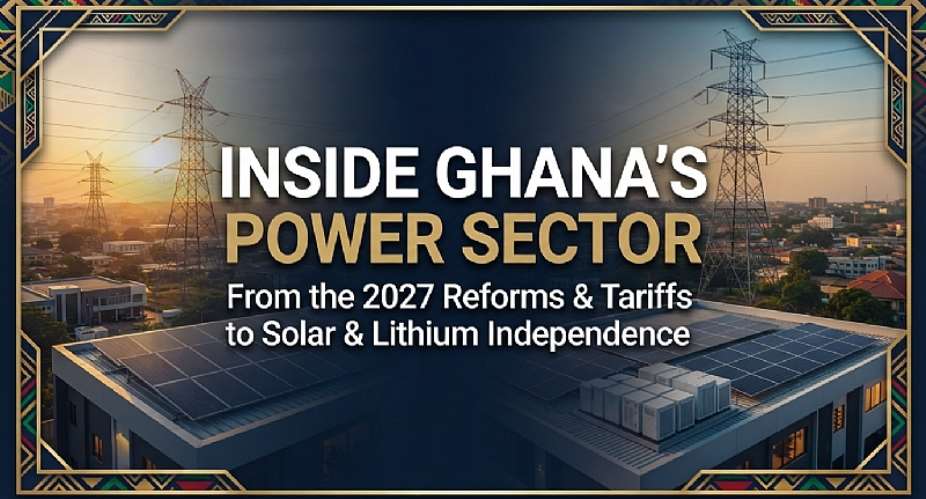
Electricity is the lifeblood of Ghana’s economy. Yet for more than a decade, our power distribution network has been trapped in a cycle of heavy financial losses, recurring debt bailouts, and intense political debate. From the painful memories of dumsor and the controversial 2019 termination of Power Distribution Services (PDS) to the government’s upcoming 2027 Private Sector Participation (PSP) rollout, the future of the Electricity Company of Ghana (ECG) and the Northern Electricity Distribution Company (NEDCo) affects every household, shop, and factory in the country.
Understanding how power is priced, how revenues are shared, and how our meters actually work is no longer just a matter for energy economists—it is essential knowledge for every Ghanaian consumer. Here is a clear breakdown of where Ghana’s power sector stands today, what changes are coming in 2027, and how bold investments in solar energy and local lithium battery manufacturing can secure reliable, affordable electricity for generations.
1. The Ghost of PDS and Why ECG Continues to Bleed Revenue
To understand where we are going, we must remember why PDS was created in the first place. Under the 2014 U.S. Millennium Challenge Corporation (MCC) Ghana Power Compact, introducing private management into ECG was a key condition to unlock nearly $500 million in energy-sector grants. When PDS took over in March 2019 under a 51% Ghanaian and 49% foreign ownership structure, it was meant to inject private capital and curb inefficiencies. Instead, the 25-year concession was terminated just months later in October 2019 following breaches surrounding its payment guarantees—a fallout that left deep political scars and polarized public opinion on privatization.
Since reverting to full state control, ECG’s financial and operational leaks have remained severe:
- High System Losses: According to ECG’s 2025 Energy Accounting Report, the utility lost 26.88% of all electricity it purchased—nearly double the Public Utilities Regulatory Commission (PURC) benchmark of ~15%.
- Stark Regional Disparities: Losses vary wildly across the country, ranging from 9.05% in the industrial Tema Region to a staggering 41.81% in Accra East, driven largely by illegal connections, meter tampering, and unbilled consumers.
- Massive Financial Shortfalls: Because ECG buys power indexed in U.S. dollars while collecting tariffs in cedis—and loses over a quarter of the power it distributes—the sector recorded an annual shortfall of roughly US$1.4 billion in 2025 and still carries about US$1.7 billion in legacy debt owed to power producers and fuel suppliers, requiring multi-billion-cedi state budget bailouts.
2. How Revenues Flow and What Changes in 2027
To prevent ECG from holding onto collected cash while Independent Power Producers (IPPs) go unpaid, the government operationalized the Cash Waterfall Mechanism (CWM), which PURC validates monthly:
- Statutory Levies First: Taxes and public levies are deducted off the top of monthly collections.
- Level A (Priority Fixed Payouts): IPPs (such as Karpowership, Cenpower, and Sunon Asogli) and gas transporters receive priority dollar-indexed payments.
- Level B (Residual Pool): State-owned utilities—including VRA, GRIDCo, Ghana Gas, and ECG itself—share whatever cash remains proportionally.
Because collections still fall short of covering the full value chain, the government—working alongside IMF program benchmarks—has scheduled a new Private Sector Participation (PSP) rollout for December 2027 covering both ECG and NEDCo. Unlike the 2019 PDS deal, which handed over the entire utility to one consortium, the 2027 framework introduces key structural differences:
- Segmented Multiple Leases: Rather than one nationwide operator, multiple private firms will lease specific operational zones strictly to manage metering, billing, and revenue collection.
- State Asset Retention: Physical grid infrastructure remains 100% state-owned, while private operators earn performance-based fees tied directly to reducing commercial losses and face financial penalties if they miss targets.
- Uniform Retail Tariffs: Consumers in northern NEDCo zones (where losses stand at 31.35% across vast rural distances) will pay the same retail tariffs as southern ECG customers, balanced through differentiated wholesale bulk rates.
3. Demystifying Your Electricity Bill and Prepaid Meter Myths
Under PURC’s 2026–2030 Multi-Year Tariff Order (MYTO), residential tariffs were simplified into three bands and are reviewed every quarter based on four macroeconomic variables: the GHS/USD exchange rate, domestic inflation, the Weighted Average Cost of Gas (WACOG), and the hydro-thermal generation mix.
Every consumer should understand how billing actually works:
- The Lifeline Rule (0 – 30 kWh): Heavily subsidized rates (~GHp 80–88/kWh) apply only if your total monthly consumption stays at or below 30 units. Once you use 31 kWh or more, your entire bill is calculated from unit 1 on standard rates.
- Standard Residential Tiers: Units from 0 – 300 kWh are billed at Tier 1 (~GH¢ 2.04/kWh), while usage above 301 kWh moves into Tier 2 (~GH¢ 2.69/kWh). On top of energy charges, residential bills include a 3% Public Lighting Levy, a 2% National Electrification Levy, and a fixed monthly service charge (~GH¢ 10.73).
- Debunking the "Split Purchase" Myth: Buying prepaid credit in small batches (e.g., GH¢ 50 four times a month) does not save you money. ECG’s vending servers track your cumulative purchases within each calendar month. The fixed monthly service fee is deducted once on your first purchase of the month, and the moment your cumulative monthly units cross 300 kWh, every subsequent purchase automatically shifts to the higher Tier 2 rate until the counter resets on the 1st of the next month.
4. Unlocking Ghana’s Solar and Lithium Advantage for True Energy Independence
While reforming ECG and deploying smart meters to catch power theft are vital, Ghana cannot solve its power crisis through distribution fixes alone—we must also empower citizens to generate clean energy and localize our renewable supply chain. Under the Energy Commission’s Net Metering Code, homes and businesses can already install grid-tied solar systems between 2 kW and 500 kW using certified wiring professionals, allowing bi-directional smart meters to credit surplus daytime solar power against night-time grid usage.
However, high upfront installation costs keep rooftop solar out of reach for ordinary families. To democratize clean energy, the government should establish a dedicated Green Household Financing Facility that offers low-interest, long-term soft loans purposely for homeowners interested in installing solar systems. At the same time, Ghana sits on a strategic industrial opportunity: rather than exporting raw minerals while importing expensive solar panels and storage units, the state should actively incentivize the establishment of local solar panel assembly plants and battery manufacturing factories, leveraging Ghana’s abundant lithium deposits. Keeping battery value addition at home would slash the cost of solar storage for Ghanaian households, create thousands of skilled green jobs, retain scarce foreign exchange, and permanently ease peak demand pressure on the national grid.
5. Recommendations and Suggestions for a Sustainable Power Sector
Fixing Ghana’s electricity challenge requires coordinated discipline from policymakers, utility managers, and everyday citizens:
For Government and Regulators (Ministry of Energy & PURC):
- Launch Soft Loans for Residential Solar & Back Local Battery Factories: Partner with local commercial banks and development finance institutions to roll out low-interest solar loans for homeowners, while offering tax incentives and industrial park support to attract solar panel and lithium-ion battery manufacturers to Ghana.
- Mandate Upfront Beneficial Ownership Disclosure: To avoid repeating the governance failures of the 2019 PDS deal, the identities, track records, and financial guarantees of all firms bidding for the 2027 lease zones must be publicly vetted and disclosed before contracts are signed.
- Enforce Prepaid Metering Across All State Agencies: Ministries, Departments, and Agencies (MDAs) must remain strictly on prepaid meters so government arrears do not starve the Cash Waterfall Mechanism.
- Insulate Utility Management from Politics: Board appointments and procurement decisions at ECG and NEDCo must be strictly merit-based and insulated from political interference.
For ECG and NEDCo:
- Accelerate Boundary and Transformer Metering: Completing sub-regional boundary metering—especially across Accra and the Ashanti sub-regions—is critical to holding district managers accountable for commercial losses.
- Streamline Solar Net-Metering Approvals: Reducing inspection delays and clarifying bi-directional meter costs will encourage middle-class households and SMEs to invest in rooftop solar, relieving daytime pressure on the national grid.
For Ghanaian Consumers:
- Audit High-Consumption Appliances: Cooling and heating appliances drive the bulk of household bills. Switching from a conventional non-inverter air conditioner (~GH¢ 539/month at 8 hours/day) to an inverter AC (~GH¢ 338/month), moderating electric water heaters, and unplugging idle deep freezers can keep households within the cheaper Tier 1 bracket.
- Protect Public Infrastructure: Report illegal connections and avoid uncertified "fake" meters—power theft does not hurt a faceless institution; it translates directly into higher tariffs and national debt paid by honest citizens.
The story of Ghana’s power sector—from the lessons of PDS to the upcoming 2027 reforms—proves that there is no magic bullet for unreliable electricity. Private capital and smart meters will only succeed if they are anchored in transparent contracts, strict regulatory enforcement, and political willpower. By pairing disciplined grid management with affordable soft loans for rooftop solar and local lithium-powered battery manufacturing, Ghana can turn its natural resources into lasting energy security. Equally, as consumers, understanding our tariff tiers, managing our energy habits, and rejecting power theft empowers us to take control of our monthly bills. A reliable, financially healthy power sector is within reach—if both leadership at the top and consumers at the meter commit to playing by the rules.
✍️ By Retired Senior Citizen
For and on behalf of all Senior Citizens of the Republic of Ghana 🇬🇭
Teshie-Nungua
[email protected]


 Police deaths in line of duty drop by 55% in 2026 – Mahama
 Govt raises $240million from 5G spectrum sale
 November 25: Cedi sells at GHS12.55 on forex market, GHS11.86 on BoG interbank
 Brigadier General In court over GH¢740,000 recruitment scam
 Wife found guilty of murdering forestry professor husband in US
 Two arrested as police disperse Suame Magazine shop-locking protest
 Education Ministry to introduce criteria for early BECE registration by gifted p...
 Health capital expenditure jumps from GH¢700m to over GH¢9bn in 2027 budget – Mi...
 GRA locks 48 mobile phone shops at Circle over mass tax breaches
 Akufo-Addo’s NPP govt borrowed heavily to run the economy – Deputy Finance Minis...


