




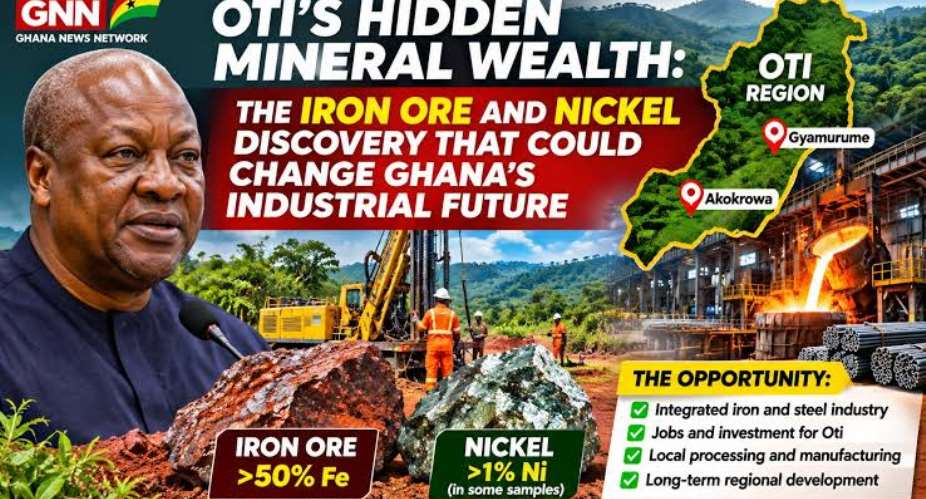
The discovery of iron ore and nickel in the Oti Region is welcome news. It gives Ghana another opportunity to build industries around its natural resources. It also gives us a choice that disappears once mining begins: how much should we extract now, and how much should we leave in the ground for the next generation?
Speaking to the Oti Regional House of Chiefs on 20 November 2026, President John Dramani Mahama said preliminary exploration in the Kadjebi area had found iron ore with more than 50 percent iron in some locations and had identified nickel. The President pledged to consult traditional leaders and young people in the region before decisions are made about mining.
Iron ore could support Ghana’s ambitions to develop its steel industry. Nickel is used in stainless steel and in some electric vehicle batteries. Before Ghana makes commitments, it needs to establish the size and quality of the deposits, the cost of mining and processing them, and the potential effects on water, farmland and nearby communities. The market matters too. The International Energy Agency reports that battery types that use no nickel accounted for more than half of electric vehicle batteries deployed globally in 2025. Ghana’s plans should account for changes in technology and demand.
Article 257(6) of the Constitution vests Ghana’s minerals in the President in trust for the people. In my view, that trust carries a responsibility to Ghanaians who will inherit the consequences of today’s decisions. Minerals are finite. Once a deposit is mined, future generations lose the option to develop it under better terms, with better technology or with greater capacity to process it locally.
Ghana should adopt a policy that allows selected deposits to be set aside before mining licences are granted. The government should publish the geological findings and explain which deposits it proposes to develop, which it intends to hold for the future, and why. Those decisions should be reviewed periodically as new evidence becomes available. In Oti, consultation should give chiefs, young people, farmers and other residents a chance to shape those choices early, while there is still room to change them.
Where mining goes ahead, the test should be what remains after the ore is gone. Local processing where commercially viable, training that equips residents for skilled work, and enforceable obligations to restore mined land can make the benefits last beyond the life of a mine. Ghana can welcome the discoveries in Oti and still exercise the judgment to leave some of that mineral wealth in the ground. Future generations deserve a say in how part of their inheritance is used.


 Govt raises $240million from 5G spectrum sale
 November 25: Cedi sells at GHS12.55 on forex market, GHS11.86 on BoG interbank
 Brigadier General In court over GH¢740,000 recruitment scam
 Wife found guilty of murdering forestry professor husband in US
 Two arrested as police disperse Suame Magazine shop-locking protest
 Education Ministry to introduce criteria for early BECE registration by gifted p...
 Health capital expenditure jumps from GH¢700m to over GH¢9bn in 2027 budget – Mi...
 GRA locks 48 mobile phone shops at Circle over mass tax breaches
 Lydia Forson explains why she rejected interview request from Delay
 Akufo-Addo’s NPP govt borrowed heavily to run the economy – Deputy Finance Minis...


