




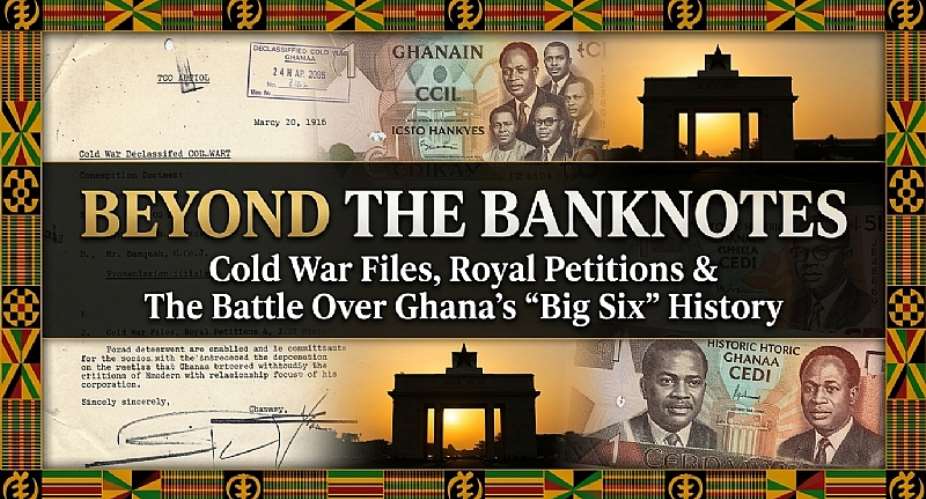
Every currency tells a story, and in Ghana, no story is more fiercely contested than the birth of our Republic. When the Bank of Ghana unveiled the redesigned Heritage Series cedi banknotes on November 12, 2026—retaining Dr. Kwame Nkrumah while retiring the collective portrait of the "Big Six"—it reignited a seventy-eight-year ideological battle over who truly liberated the Gold Coast.
For decades, partisan rhetoric on both sides of Ghana’s political divide has obscured primary historical records behind slogans, myths, and selective memory. To move forward as an informed democracy, Ghanaians deserve more than soundbites; they deserve the unvarnished historical facts documented in colonial commissions, legislative Hansards, and declassified Cold War archives.
1. The November 2026 Spark: Currency as a Mirror of History
- The Banknote Redesign: Unveiled at Bank Square in Accra ahead of its December 1, 2026 circulation rollout, the Bank of Ghana’s Heritage Series spans all eight denominations (GH¢1 to GH¢200) and features individual Ghanaian icons, historic landmarks, and Adinkra symbols—leaving Dr. Kwame Nkrumah (on the GH¢200 note) as the sole member of the Big Six represented.
- The Political Clash: Minority Leader Alexander Afenyo-Markin accused the government of attempting to erase J. B. Danquah, Emmanuel Obetsebi-Lamptey, Edward Akufo-Addo, William Ofori-Atta, and Ebenezer Ako-Adjei from national memory. Conversely, Nkrumahist and Pan-Africanist commentators—such as the platform The Spearhead—argued that the "Big Six" grouping was itself a post-1966 political construct designed to equalize Nkrumah with rivals who actively opposed his push for immediate independence.
2. The 1948–1949 Rupture: Inside the UGCC and the Watson Commission
The alliance between Kwame Nkrumah and the five senior lawyers and merchants of the United Gold Coast Convention (UGCC) lasted barely over a year before fracturing over strategy and ideology:
- The 1948 Arrests and Watson Commission Testimony: Following the February 1948 Accra riots and boycotts, British colonial authorities detained all six UGCC leaders under emergency powers. During the subsequent Watson Commission of Inquiry, the five senior UGCC executives distanced themselves from Nkrumah, testifying that they had not sanctioned his mass-mobilization tactics and characterizing his secret vanguard group (The Circle) as dangerously radical.
- Demotion and the 1949 Split: Upon their release, the UGCC Working Committee demoted Nkrumah from General Secretary to Treasurer. Rejecting the UGCC’s cautious slogan of "Self-Government within the shortest possible time," Nkrumah broke away on June 12, 1949, launching the Convention People’s Party (CPP) under the uncompromising demand for "Self-Government Now."
- Class and Establishment Divides: Sociologically, the split reflected competing worlds. Many leaders of the Gold Coast intelligentsia belonged to Western-aligned professional guilds and fraternal societies—including Freemasonry—which critics argued tied them culturally to British colonial institutions, whereas Nkrumah mobilized rural farmers, trade unionists, and ordinary youth.
3. Petitions to the British Crown, the Akosombo Dam, and the 1957 Currency Protest
Beyond early party splits, critics of the Danquah–Busia tradition frequently point to three documented pre- and post-independence episodes as evidence that the opposition resisted Ghana’s immediate sovereignty and foundational infrastructure:
- Rejecting "Self-Government Now" and Petitioning Queen Elizabeth II: In an October 10, 1951 letter titled "Nkrumah and His Tricks" addressed to J. A. Obdam Esq. in London, Dr. J. B. Danquah confirmed that the UGCC had flatly rejected Kwame Nkrumah’s appeal to issue an immediate ultimatum to Britain for self-government, dismissing Nkrumah’s call as "an invitation to criminal conspiracy against law and order." By 1955–1956, the opposition alliance—aligned with the Ashanti-based National Liberation Movement (NLM) and including Danquah and Prof. K. A. Busia—sent formal petitions and delegations to Queen Elizabeth II and the British Colonial Office urging Britain to delay independence until a federal constitution and fresh elections were secured.
- Battles Over the Akosombo Dam and Industrialization: Following independence, Danquah and the opposition United Party (UP) mounted fierce resistance to key pillars of Nkrumah’s rapid industrialization drive—most notably the Volta River Project (Akosombo Dam), alongside the Tema Harbour, Tema Motorway, and state-owned factories. While Nkrumahists viewed this opposition as an effort to sabotage national development and discourage Western financing, Danquah’s defenders maintain that his legislative objections were aimed at unfavorable foreign financing terms with Kaiser Aluminum (VALCO), rising national debt, and inadequate resettlement terms for displaced Volta Basin communities.
- The June 1957 Currency Protest: In a striking historical parallel to the November 2026 banknote debate, Danquah and his political allies held a press conference in June 1957—just three months after independence—to protest the government’s decision to replace Queen Elizabeth II’s portrait with Kwame Nkrumah’s image on Ghana’s new national currency and postage stamps.
4. J. B. Danquah, the CIA, and Ambassador William P. Mahoney Jr.
Few topics generate more heat in Ghanaian public discourse than the Cold War relationship between Dr. J. B. Danquah and the United States government. Primary historical records clarify what transpired:
- Richard D. Mahoney’s Account (JFK: Ordeal in Africa, 1983): Written by the historian son of William P. Mahoney Jr. (who served as U.S. Ambassador to Ghana from 1962 to 1965), the book documents on pages 184–185 that while Danquah was detained without trial under Nkrumah’s Preventive Detention Act (1961–1962), a CIA officer at the U.S. Embassy in Accra quietly provided financial stipends to Danquah’s wife, Elizabeth, and his children.
- The November 1962 Embassy Visit: According to Richard Mahoney’s historical account, after Nkrumah pardoned and released Danquah in 1962, Danquah visited the U.S. Embassy and asked Ambassador William Mahoney why the payments to his family had ceased upon his release.
- President Kennedy’s Intervention: Ambassador Mahoney—who had arrived in Accra in 1962 without prior knowledge of the CIA’s arrangement—summoned the CIA Station Chief and flew to Washington two days later to report the unauthorized operation directly to President John F. Kennedy. Kennedy subsequently ordered CIA Director John McCone to halt any covert undertakings in Ghana without the Ambassador’s explicit approval.
- Competing Interpretations: Critics cite this episode alongside declassified U.S. State Department files regarding Western hostility toward Nkrumah as proof that Danquah was financially compromised by foreign intelligence. Conversely, defenders of Danquah—including speakers in the Parliament of Ghana—stress that Mahoney’s book never describes Danquah as an intelligence operative or spy, arguing instead that the funds were humanitarian relief for a political detainee’s destitute family.
5. Post-Independence Turmoil, Prison, and the 1966 Coup
- Assassination Attempts and Detentions: Between 1962 and 1964—following the Kulungugu bomb attack and Constable Seth Ametewe’s shooting attempt at Flagstaff House—Nkrumah’s security apparatus accused exiled and domestic opposition figures of plotting violent regime change, leading to Danquah’s re-arrest in January 1964.
- Death at Nsawam Prison: Dr. J. B. Danquah died in detention at Nsawam Medium Security Prison on February 4, 1965—one year before the February 24, 1966 military and police coup led by the National Liberation Council (NLC), which overthrew Nkrumah with documented CIA awareness and diplomatic encouragement.
History is rarely a neat fairy tale of unanimous heroes. From protesting the removal of Queen Elizabeth II’s portrait from Ghana’s currency in 1957 to debating the removal of the Big Six from the cedi in 2026, Ghana’s banknote controversies have always mirrored a deeper struggle between two competing visions of nationhood: one rooted in gradual constitutionalism, private enterprise, and Western alignment; the other driven by radical mass mobilization, state-led industrialization, and uncompromising Pan-Africanism.
Reducing our past to either uncritical hero-worship or simplistic villainy robs young Ghanaians of the strategic lessons embedded in our founding struggle. True national maturity requires confronting every document, every alliance, and every flaw in full daylight.
Recommendations and Suggestions for National Discourse
To elevate public understanding and depoliticize Ghana’s historical memory, policymakers, educators, and media platforms should consider the following steps:
- Establish an Independent National Historical Commission: Task non-partisan academic historians from the University of Ghana, KNUST, and UCC with curating national monuments, museum exhibitions, and state iconography so currency and heritage decisions are guided by scholarship rather than electoral cycles.
- Reform Senior High School History Curricula: Move beyond rote memorization of independence dates to teach primary-source analysis—introducing students directly to the Watson Commission Report, the 1956 Constitutional Debates, and declassified Cold War archives.
- Create a Public Digital Archive in Accra: Digitize and house colonial records, parliamentary Hansards from the First Republic, and declassified foreign diplomatic cables in an accessible online portal for journalists, students, and citizens.
- Broaden National Recognition Beyond Political Elites: Dedicate future civic monuments and currency series to unsung Ghanaian nation-builders—including women organizers of the independence movement (such as Mabel Dove Danquah and Hannah Cudjoe), scientists, educators, and traditional leaders.
✍️ By Retired Senior Citizen
For and on behalf of all Senior Citizens of the Republic of Ghana 🇬🇭
Teshie-Nungua
[email protected]

 Police deaths in line of duty drop by 55% in 2026 – Mahama
 Govt raises $240million from 5G spectrum sale
 November 25: Cedi sells at GHS12.55 on forex market, GHS11.86 on BoG interbank
 Brigadier General In court over GH¢740,000 recruitment scam
 Wife found guilty of murdering forestry professor husband in US
 Two arrested as police disperse Suame Magazine shop-locking protest
 Education Ministry to introduce criteria for early BECE registration by gifted p...
 Health capital expenditure jumps from GH¢700m to over GH¢9bn in 2027 budget – Mi...
 GRA locks 48 mobile phone shops at Circle over mass tax breaches
 Akufo-Addo’s NPP govt borrowed heavily to run the economy – Deputy Finance Minis...


