




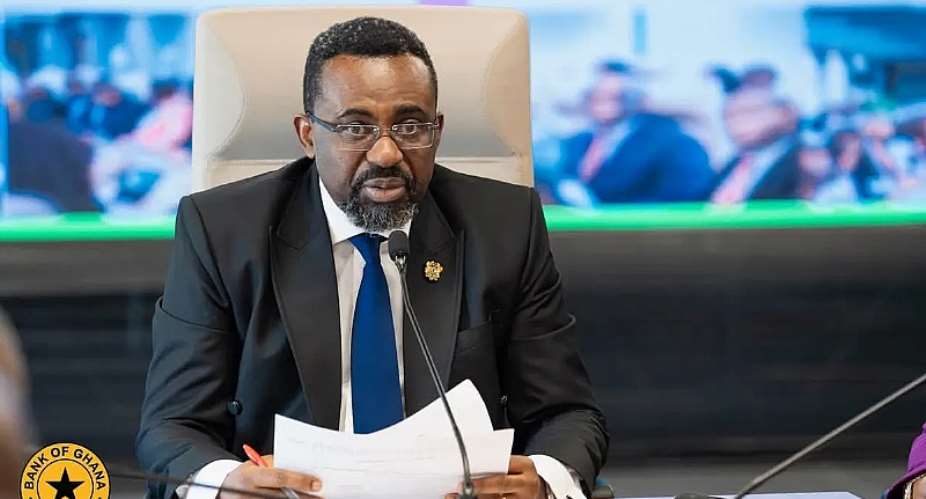
The Bank of Ghana (BoG) Governor, Dr Johnson Pandit Asiama, has reported a significant decline in short-term interest rates, with the yield on the 91-day Treasury bill dropping to 4.6% in October 2026 from 10.6% in October 2025.
He also disclosed that the average lending rate of commercial banks declined to 15.8% from 22.2% over the same period, creating more favourable conditions for borrowing.
Speaking at the 133rd Monetary Policy Committee (MPC) press conference in Accra last Wednesday, Dr Asiama said the decline in interest rates had improved credit conditions and stimulated demand for loans, resulting in a substantial increase in bank lending.
Consequently, growth in credit to the private sector rose to 37.2% from 13.9%, while real private sector credit growth increased to 30.0% from 5.4% over the comparative period.
On fiscal performance, the Governor said provisional government budget execution data for the first ten months of 2026 showed an overall deficit of 1.0% of GDP on a commitment basis, against a target of 3.0%. He noted that the shortfall was financed largely through domestic sources.
The primary balance, however, recorded a surplus of 1.4% of GDP on a commitment basis, putting it on course to meet the full-year target of 1.5%.
Dr Asiama attributed the performance to a combination of fiscal discipline and effective public debt management.
He further disclosed that Ghana's provisional public debt stock had increased to GH¢759.3 billion, representing 47.5% of GDP, at the end of October 2026, from GH¢641.1 billion, equivalent to 44.7% of GDP, at the end of December 2025.
Banking sector remains resilient
The BoG Governor said the banking sector continued to demonstrate resilience, supported by improvements in solvency, profitability and liquidity.
As of the end of October 2026, total banking sector assets had expanded by 21.2% year-on-year to GH¢512.9 billion, largely driven by strong growth in deposits.
He said key financial soundness indicators had also improved, with the Capital Adequacy Ratio rising to 18.5% in October 2026 from 17.9% a year earlier.
Asset quality also recorded an improvement, as the Non-Performing Loan (NPL) ratio declined to 13.1% from 19.5% over the same period in 2025.
Dr Asiama attributed the reduction to the strong recovery in credit growth and a contraction in the stock of non-performing loans.
Trade surplus rises to US$13bn
On the external sector, the Governor said Ghana maintained a strong position during the first ten months of 2026 despite heightened global uncertainty and geopolitical tensions.
The country's trade surplus increased to US$13.0 billion between January and October 2026, compared with US$8.7 billion recorded during the corresponding period in 2025.
Gold remained the leading contributor to export earnings, accounting for approximately 67.0% of total export receipts during the period.
However, he said increased external payment obligations, largely driven by geopolitical tensions and pressure on foreign exchange demand, had weighed on the Bank of Ghana's international reserves.
As of November 17, 2026, Gross International Reserves (GIR) stood at US$12.1 billion, representing approximately 4.4 months of import cover.
This compared with US$13.8 billion, equivalent to 5.7 months of import cover, recorded at the end of December 2025.
Despite the decline in reserves, Dr Asiama expressed optimism about the external sector's outlook, saying strong export earnings were expected to support its resilience, although global market volatility could persist.

 Police deaths in line of duty drop by 55% in 2026 – Mahama
 Govt raises $240million from 5G spectrum sale
 November 25: Cedi sells at GHS12.55 on forex market, GHS11.86 on BoG interbank
 Brigadier General In court over GH¢740,000 recruitment scam
 Wife found guilty of murdering forestry professor husband in US
 Two arrested as police disperse Suame Magazine shop-locking protest
 Education Ministry to introduce criteria for early BECE registration by gifted p...
 Health capital expenditure jumps from GH¢700m to over GH¢9bn in 2027 budget – Mi...
 GRA locks 48 mobile phone shops at Circle over mass tax breaches
 Akufo-Addo’s NPP govt borrowed heavily to run the economy – Deputy Finance Minis...


