




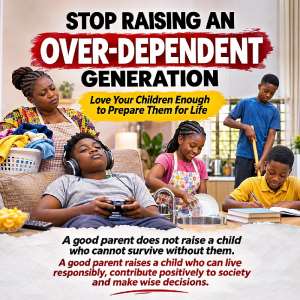
One of the greatest mistakes parents can make is to give their children everything they need for comfort but fail to equip them with what they need for survival. We work tirelessly to provide the best education, comfortable homes, good food, fashionable clothes and modern technology. Yet, in our determination to give our children a better life than we experienced, we may unknowingly be denying them the opportunity to develop independence, discipline, resilience and responsibility.
The greatest gift parents can give their children is not wealth, property or an easy life. It is the ability to stand on their own feet, make responsible decisions, overcome difficulties and contribute meaningfully to society.
Across Ghana and many parts of the world, parenting is changing. In the past, children were generally expected to participate in household activities, respect community values, assist their parents and gradually assume responsibilities as they grew older. Today, although many families continue to uphold these traditions, increasing convenience, changing lifestyles and parental anxiety have created situations where some children grow up with limited practical responsibilities.
In some homes, parents cook, wash, clean, organise school materials and perform virtually every domestic task while their children spend hours watching television, playing video games or browsing social media. Some teenagers cannot prepare a simple meal, wash their clothes, clean their surroundings or manage their time without constant parental supervision.
Even more troubling is the tendency of some parents to defend their children regardless of their behaviour. When a child misbehaves at school, instead of investigating the matter and helping the child accept responsibility, some parents confront teachers and school authorities. Others go as far as arranging examination malpractice, using personal connections to escape disciplinary action or providing excuses for irresponsible behaviour.
Such actions may appear to protect children in the short term, but they can undermine the development of honesty, accountability and personal responsibility.
Parenting research, including studies on autonomy-supportive parenting and excessive parental involvement, suggests that children generally benefit when adults combine emotional support with opportunities to make age-appropriate decisions, solve problems and learn from mistakes. Excessive parental control can be associated with poorer confidence and emotional adjustment, although outcomes depend on the child's age, circumstances and the wider family environment.
This does not mean that parents should abandon their children to hardship. There is a fundamental difference between allowing children to develop resilience and exposing them to unnecessary suffering. Children need protection from abuse, exploitation and serious danger. However, they also need opportunities to experience manageable challenges, disappointment, correction and the consequences of their decisions.
A child who never encounters disappointment may struggle to cope with rejection. A child who is never corrected may find it difficult to accept criticism. A child whose parents solve every problem may grow into an adult who lacks confidence in making independent decisions.
Consider a typical Ghanaian household where parents employ domestic workers to handle every household responsibility. The children wake up, eat breakfast prepared for them, leave their beds unmade and return from school to find their clothes washed and rooms cleaned. Their only expected responsibility is to study.
Education is undoubtedly important, but academic excellence without practical life skills is incomplete preparation for adulthood. A university graduate who cannot manage personal finances, maintain a clean living environment, prepare basic meals or resolve everyday problems still has important lessons to learn.
Children should therefore be introduced to responsibilities appropriate to their ages and abilities. Younger children can learn to arrange their toys, make their beds and keep their surroundings tidy. Older children can assist with cooking, laundry, cleaning, shopping and household planning. Teenagers should gradually learn budgeting, time management, personal safety, decision-making and basic problem-solving.
These activities are not punishments. They are practical lessons in responsibility, cooperation, self-reliance and respect for work.
In traditional Ghanaian communities, children often learned valuable skills by observing and assisting parents, grandparents and other adults. A child might accompany a parent to the farm, market, workshop or family business. Through these experiences, children developed an appreciation for hard work, patience, resourcefulness and the value of money.
Not every aspect of traditional upbringing deserves to be preserved. Some practices were unnecessarily harsh, and children were sometimes denied opportunities to express themselves. Nevertheless, the emphasis on responsibility, community participation and practical learning remains valuable.
We must recover these strengths without returning to harmful forms of discipline or denying children their right to education, rest and play.
Good upbringing must also extend beyond household chores. Children should learn personal hygiene, cleanliness, courtesy and consideration for others. They should understand the importance of keeping shared bathrooms clean, managing their belongings, respecting public property and leaving places in good condition for the next person.
They should learn appropriate table manners, how to communicate respectfully, how to welcome visitors and how to conduct themselves in public. These habits may appear insignificant, but they reflect the values of responsibility and consideration that society requires.
Respect, however, should not be confused with unquestioning obedience. Children must be taught to respect adults while also understanding that they have a right to ask questions, express opinions, refuse inappropriate requests and report abuse. A child who is trained never to question an adult may become vulnerable to manipulation and exploitation.
Similarly, teaching children appropriate dressing and personal conduct should never imply that victims are responsible for harassment or abuse. Responsibility for abusive behaviour belongs entirely to the perpetrator. Parents should instead teach children about personal boundaries, consent, dignity and how to seek help when they feel unsafe.
Another growing concern is children's relationship with technology. Smartphones, social media and digital entertainment offer enormous educational and social opportunities. However, excessive or poorly managed screen use can interfere with sleep, physical activity, family interaction and other important developmental experiences.
Parents should establish reasonable boundaries and encourage children to participate in conversations, outdoor activities, reading, sports, community service and face-to-face relationships. The objective should not be to reject technology but to teach responsible digital citizenship.
Financial discipline is equally important. Children who receive everything they request may struggle to distinguish between needs and wants. Parents should teach them that money is earned through effort, resources are limited and financial decisions involve choices.
A child who learns to save part of an allowance, compare prices, avoid waste and delay unnecessary purchases is developing habits that may become invaluable in adulthood.
Parents must also understand that children learn more from what adults practise than from what they preach. We cannot teach honesty while lying to protect them from consequences. We cannot demand respect while insulting teachers, neighbours or domestic workers. We cannot expect discipline when our own behaviour demonstrates irresponsibility.
Our conduct is often the most powerful lesson our children receive.
In Ghana, we frequently complain about corruption, indiscipline, poor sanitation, dishonesty and the declining sense of civic responsibility. Yet, we sometimes overlook the connection between the values children learn at home and the behaviour they later display in public life.
The adult who throws rubbish into a drain, abuses public office, disregards traffic regulations or refuses to accept responsibility was once a child influenced by family, school and society. Not every adult failure can be traced to parenting, but the home remains an important foundation for character formation.
If we want a generation of responsible citizens, ethical professionals, disciplined workers and accountable leaders, we must begin by cultivating these values in our children.
Parents should also allow children to experience the satisfaction of achievement through personal effort. When a child struggles with homework, guidance is better than simply providing the answers. When a teenager makes a poor decision, constructive discussion is often more beneficial than immediately removing every consequence.
When children encounter failure, parents should help them understand what went wrong, identify alternatives and try again.
This is how confidence develops. It grows not merely from being told that one is capable, but from discovering through experience that challenges can be overcome.
Religious and moral education can also play a meaningful role in shaping character. Families that practise religious faith should teach their children the values of compassion, humility, honesty, service and respect for human dignity. However, moral instruction becomes credible only when parents demonstrate those principles in their everyday conduct.
Ultimately, responsible parenting requires a careful balance between love and discipline, protection and freedom, guidance and independence.
Children need affection, encouragement and emotional security. They also need boundaries, responsibilities and opportunities to develop their own abilities.
We should not measure successful parenting solely by the material possessions we provide, the prestigious schools our children attend or the qualifications they obtain. We should also ask whether they are honest, compassionate, hardworking, respectful, resourceful and capable of managing life's challenges.
A child who can think independently, accept correction, treat others with dignity, contribute to household responsibilities and make ethical decisions is receiving an education that extends far beyond the classroom.
As parents, we must remember that our children will not remain under our protection forever. They will eventually enter a world where employers expect performance, society demands accountability, relationships require compromise and success depends partly on perseverance and sound judgment.
At that stage, money alone cannot replace character, and parental influence cannot solve every problem.
Our responsibility is therefore not to remove every obstacle from our children's path but to equip them with the knowledge, confidence and values needed to navigate those obstacles.
Let us stop confusing comfort with preparation, indulgence with affection and excessive protection with responsible parenting.
A good parent does not raise a child who cannot survive without them. A good parent raises a child who can live responsibly, contribute positively to society and make wise decisions even when the parent is no longer present.
The true measure of parental success is not how much our children depend on us today, but how well we have prepared them to face tomorrow.
Let us raise children who are not merely comfortable in life, but capable of handling life. Let us raise a generation that inherits not only our possessions, but also our discipline, integrity, resilience and sense of responsibility.
For in the end, the greatest legacy we can leave our children is not a life without difficulties, but the character and capacity to overcome them.


 Supreme Court strikes out Abronye's application in Anyenini defamation case, awa...
 Women's Development Bank begins staff recruitment ahead of 2027 operational laun...
 'Parliament risks losing access to critical technical experts over 2027 budget c...
 AG urges Parliament to pass revised Intestate Succession Bill to address inherit...
 About 5,000 pupils register prematurely for BECE annually – Education Ministry j...
 Mahama selects Kwenyako for US$1bn pharmaceutical hub expected to create 20,000 ...
 Ghana is ideal destination for German companies – President Steinmeier
 GTEC's audit exposes public business school offering admission for 'unaccredited...
 Public health data system restored after software vendor dispute
 Nadowli-Kaleo NPP chairman arrested for allegedly stealing Nkoko Nkitinkiti bird...


