




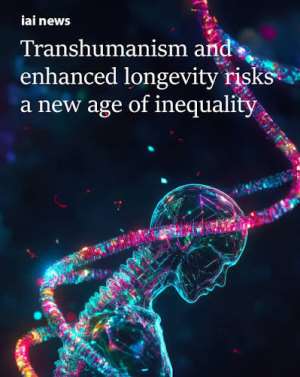
About four thousand years ago, a king named Gilgamesh watched his closest friend die. He was so terrified of his own mortality that he crossed the world looking for the secret of eternal life. That story, from the Epic of Gilgamesh, is among the oldest surviving works of literature.
Every culture has told its own version, from fountains of youth to elixirs of immortality to Mary Shelley's Frankenstein.
For four thousand years, this was fantasy.
Today it is a line item in laboratory budgets.
Whether you live in Accra, Tokyo, São Paulo, or New York, you are about to be asked a question your ancestors never faced:
Should we redesign ourselves?
What Transhumanism Actually Is
The word sounds like science fiction, but it has a real history.
The biologist Julian Huxley popularised the term "transhumanism" in 1957, arguing that humanity could transcend its natural limits.
In the late 1990s, philosophers Nick Bostrom and David Pearce co-founded the World Transhumanist Association, now Humanity+.
Futurist Ray Kurzweil, in The Singularity Is Near, predicted that humans and machines would merge by around 2045.
Historian Yuval Noah Harari later explored where this leads in Homo Deus.
The core idea is simple:
Aging, disease, limited intelligence, and even suffering are engineering problems, and we should use technology to fix them.
Critics ask whether we should, and who decides.
It Is Already Happening
Transhumanism is not one invention.
It is three revolutions arriving at once.
1. Editing Our Genes
In December 2023, the U.S. FDA approved Casgevy, the first gene therapy using CRISPR, for sickle cell disease in patients aged 12 and older.
Humanity has now rewritten its own code to cure a disease.
2. Merging With Machines
Neuralink's brain implant is designed to help paralysed people control computers with thought.
By early 2026, it had 21 implanted participants across four countries, while a separate UK study had enrolled seven patients by May 2026.
The device remains available only through the trial, but the company has talked about moving toward mass production.
3. Extending Life
Average global life expectancy rose by 5.5 years between 2000 and 2016, from 66.5 to 72.0.
No proven anti-aging therapy exists yet, but billions of dollars are chasing one.
The Line Nobody Can Agree On
Almost everyone cheers when a paralysed person moves a cursor with their thoughts, or when a child is cured of a deadly blood disorder.
That is therapy: restoring what illness took.
The trouble starts with enhancement.
If a gene edit can cure disease, why not boost memory, height, or intelligence in healthy children?
Philosopher Julian Savulescu argues parents have a moral reason to choose the best possible child.
Political scientist Francis Fukuyama called transhumanism one of the world's most dangerous ideas, warning that it threatens the shared human nature on which equal rights rest.
Michael Sandel, in The Case Against Perfection, argues that treating children as products to be optimised erodes the humility and gratitude at the heart of parenthood.
Both sides raise real points.
Refusing to cure suffering because it is "natural" is cruel.
Treating human beings as upgradeable products is dangerous.
The Inequality Time Bomb
Here is the part every reader on Earth should care about.
Casgevy, the miracle cure, was priced at $2.2 million per patient.
Meanwhile, sub-Saharan Africa is home to an estimated 75% of the world's sickle cell patients.
Look at the gap in cost.
A basic drug, hydroxyurea, can be provided for $67 per person, and a proposal to supply it across sub-Saharan Africa would cost under $100 million a year.
Even that modest sum has been hard to fund.
One Nigerian patient advocate told reporters that, for Africa, gene therapy currently exists only on paper.
Now widen the lens.
WHO data show that people in low-income countries live 18.1 years fewer than those in high-income countries, a gap measured in 2016.
We already have a longevity divide made by money and geography.
Add a technology that can lengthen lives or enhance minds for those who can pay, and a gap in wealth could harden into a gap in biology.
Not just rich and poor, but potentially two kinds of human.
The optimistic case is not fantasy either.
A 2026 modelling study found that sickle cell gene therapy could be cost-effective in Uganda if prices are significantly reduced.
Researchers have also proposed place-of-care biomanufacturing to cut costs.
Mobile phones went from luxury to lifeline in a generation.
But that happened because people demanded it.
Cheap access to the human upgrade will not arrive by accident.
The Question of Who We Are
If you replace your failing memory with a chip, are you still you?
Philosophers have debated this since the ancient puzzle of the Ship of Theseus:
If you replace every plank in a ship, is it the same ship?
Many traditions offer a different measure.
The Southern African philosophy of ubuntu holds that a person is a person through other people.
By that standard, the real test of enhancement is not how smart or long-lived it makes you, but whether it binds us closer together or splits us into those who are "improved" and those who are "left behind."
The Children Who Never Agreed
In 2018, Chinese scientist He Jiankui announced he had created gene-edited babies.
The scientific world condemned it, and a Chinese court later jailed him.
The reason was simple:
Gene edits to embryos are inherited.
Those children, and their descendants, never consented.
We would be editing people who cannot yet say yes or no.
A Sane Path Forward
Neither blind worship nor blind fear will serve us.
Here is what I believe the world should demand:
- Heal before we enhance. Prioritise curing disease over making healthy people "better."
- Build access in from day one. Any breakthrough funded by public research should have a plan for reaching the world's poorest, not just the richest.
- Draw hard lines on inherited edits. Reckless germline editing must stay off the table until there is real global consensus.
- Protect the mind. Brain data may be the most private information that exists. Chile amended its constitution in 2021 to protect neurorights, and other countries should follow.
- Let everyone decide. Not only billionaires and laboratories. Farmers, nurses, teachers, and students in every country deserve a voice.
Your Move
Transhumanism is not coming for our grandchildren.
It is knocking on our door.
The first brain implants are in patients today.
The first gene cures are on the market today.
The pricing decisions are being made today.
So I'll leave you with the questions the world must now answer:
Would you edit your child's genes to prevent a disease? To make them taller? Smarter?
If a pill could add thirty healthy years but only a few could afford it, should it exist?
And who gets to decide what "human" means?
Share your answer.
The future is being written whether we join the conversation or not.

 Tension at Suame Magazine as Ghanaian artisans clash with hired thugs during clo...
 Nvidia board reinstates Huang as CEO, Trump hails 'correct' decision
 Zelensky calls for EU inclusion in talks with Russia 'as soon as possible'
 Rent Control Commissioner has full backing of government – Presidential Staffer
 Bawumia congratulates Black Challenge on historic World Cup triumph
 Amin Adam seeking political capital with borrowing claims – Appiah Dankwah
 Jaman South MCE defends DRIP equipment, alleges NPP MP declined fuel support
 Govt prepares to relaunch GIFMIS, seeks auditors' input on system redesign
 Mahama orders massive cleanup, beautification of Accra ahead of Ghana's 70th ind...
 Housing Minister backs Rent Control effort to curb high charges following UG hos...


