




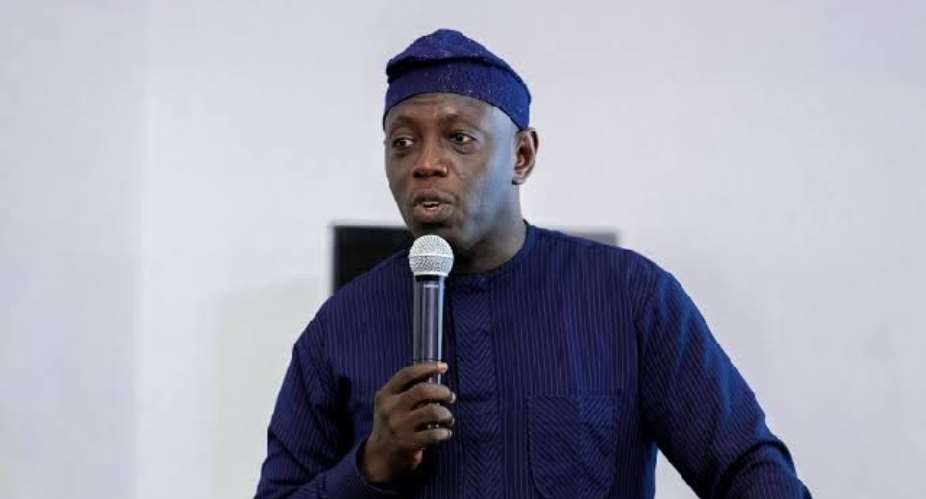
The President of Africa Policy Lens (APL), Prof. Isaac Boadi, has cautioned that the government’s domestic borrowing plans for 2027 could undermine efforts to make credit more affordable for businesses, particularly farmers, manufacturers and exporters.
He argues that the government’s proposed financing strategy for its New Economy programme could intensify competition for funds between the state and the private sector, making it more difficult for businesses to secure loans at lower interest rates.
“The state is now business' biggest rival for credit,” he said.
Prof. Boadi's concerns centre on the disparity between the volume of credit currently available to private businesses and the government's planned domestic borrowing.
Bank credit to the private sector stood at GH¢135.7 billion at the end of October 2026, while the 2027 Budget projects net domestic borrowing of GH¢85 billion.
The proposed borrowing represents approximately 63 per cent of the existing stock of credit extended to private businesses.
According to Prof. Boadi, government borrowing on such a scale from the same banking system and pool of savings used by businesses could drive up interest rates and reduce the funds available for private-sector lending.
“When the state borrows that much from the same banks and savers, it pushes up interest rates and takes loanable funds away from businesses,” he said.
He further questioned the funding structure of the New Economy programme, which has been allocated GH¢30 billion for its first year.
Prof. Boadi said approximately GH¢18 billion of the allocation would come from a reduction in the primary surplus rather than additional revenue, potentially requiring the government to borrow more.
He warned that the approach could defeat the programme's objective of supporting businesses by increasing the government's demand for credit at the expense of private enterprises.
“By borrowing to protect enterprise, the government risks crowding out the businesses it means to support,” he cautioned.
The APL president explained that banks could be more inclined to invest in government securities offering returns of about 15 per cent without default risk than extend loans to small-scale farmers and manufacturers, whose businesses carry greater lending risks.
He maintained that businesses would struggle to benefit from cheaper financing if government remained the dominant borrower in the domestic market.
“Cheaper credit cannot reach businesses while government is the biggest borrower in the same market,” he said.
To address the concerns, APL has outlined three measures it wants the government to adopt in managing its borrowing and financing strategy.
The think tank is urging the government to maintain the primary surplus at 1.5 per cent of Gross Domestic Product (GDP) until public debt falls below the 45 per cent anchor.
It also wants the New Economy programme to be financed exclusively from verified additional revenue rather than increased domestic borrowing.
Additionally, APL has called for the publication of quarterly reports comparing government domestic borrowing with the growth of private-sector credit to help track the impact of public financing on businesses.
Prof. Boadi said the government must decide whether to support the private sector by reducing its borrowing and allowing banks to channel more resources into productive economic activities or compete with businesses for the same funds through its GH¢85 billion borrowing plan.
“You cannot promise businesses cheaper credit while competing with them for the same money,” he said.

 Tension at Suame Magazine as Ghanaian artisans clash with hired thugs during clo...
 Nvidia board reinstates Huang as CEO, Trump hails 'correct' decision
 Zelensky calls for EU inclusion in talks with Russia 'as soon as possible'
 Rent Control Commissioner has full backing of government – Presidential Staffer
 Bawumia congratulates Black Challenge on historic World Cup triumph
 Amin Adam seeking political capital with borrowing claims – Appiah Dankwah
 Jaman South MCE defends DRIP equipment, alleges NPP MP declined fuel support
 Govt prepares to relaunch GIFMIS, seeks auditors' input on system redesign
 Mahama orders massive cleanup, beautification of Accra ahead of Ghana's 70th ind...
 Housing Minister backs Rent Control effort to curb high charges following UG hos...


