




Let me start with a confession that might annoy both sides of the argument.
On the night of November 3rd, I watched America prove the pessimists wrong. And I watched the pessimists keep every one of their best points.
Both things are true. Sit with that for a minute, because the whole debate lives in the gap between them.
Democrats won both houses of Congress, in what may be the largest popular vote victory for either party since 1976. When the new Congress begins in January, Democrats will hold a 56-44 Senate majority, their biggest advantage in that chamber in 16 years. A president who campaigned in person for his party's candidates just watched the voters hand him a divided government.
So can democracy be saved at the ballot box?
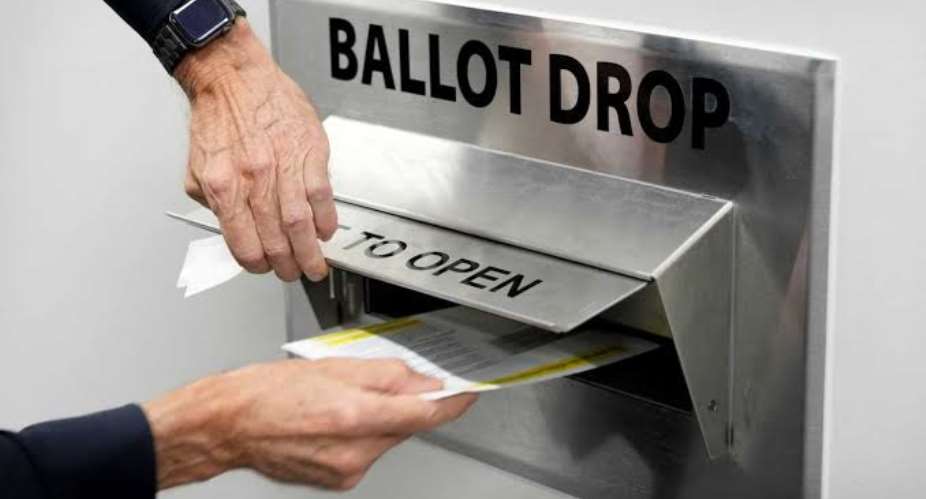
On the evidence of that night, the ballot box is alive and kicking.
But then comes the price tag.
The Night the Money Lost (and Why That Is Not the End of the Story)
According to OpenSecrets, the research group that tracks political money in America, close to a record $12 billion was spent on these midterms by candidates and outside groups. Dark money, meaning spending where the original source can't be traced, was set to pass a record $1.5 billion.
Read those numbers slowly.
This is one election. In one country. For half of one branch of government.
Here is the detail that should make every democrat, small "d" and capital "D," sit up straight. OpenSecrets found that 1 percent of donors supplied 98 percent of donations to outside groups, and that 100 individuals accounted for 64 percent of the spending.
One hundred people.
You could fit them in a single church hall in Osu.
Corporations alone poured a record-smashing $737 million into these midterms, according to Public Citizen, and it reported that Elon Musk put more than $400 million of his own into political spending this cycle. AI-related super PACs spent more than $50 million, including a $27 million proxy war between groups aligned with Anthropic and OpenAI over one single Manhattan House seat.
Now the twist.
If money simply bought elections, the richest side would win every time.
It did not.
Fortune's analysis put it neatly: money usually wins, but not always. Democratic candidates were expected to outspend Republican candidates directly, $2.2 billion to $1.4 billion. Yet in 2024, the top 100 billionaire families sent roughly 70 percent of their political money to committees backing Republicans.
The money leaned one way, the voters leaned the other, and the voters won.
So here is my honest verdict:
Big money has not bought the outcome. It has bought the arena.
It decides who gets to run, what gets debated, and which ideas are too "unrealistic" to reach the stage.
Voters still pick the winner, but more and more of the menu is written by a few hundred people.
That, in one sentence, is what Bernie Sanders has been shouting about for forty years.
Legalized Oligarchy: "Pay to Play" With the Lights On
Sanders is the longest-serving independent in the history of the U.S. Congress and the author of It's OK to Be Angry About Capitalism. In the interview, published November 19th on The Diary of a CEO, he argues that wealth concentration and the political influence of the ultra-rich have produced what he calls a "rigged" economy.
His core charge is that nobody has to break the law to do this.
That is what makes it so insidious.
Donors don't need briefcases of cash in a dark car park when the rules allow unlimited super PAC money, and when dark money groups can hide the trail.
Donors "quietly draft" policy through access, and the access is for sale.
It is legalized oligarchy: a pay-to-play machine running in broad daylight.
Is Sanders exaggerating?
Look at the numbers above and tell me how much.
I'd say the man is describing the weather while his critics argue about whether it's raining.
The Incrementalism Trap
This is the part that will make some of my Democratic readers shift uncomfortably.
Sanders argues that when the party offers only small, safe compromises to people who are drowning in rent, medical bills, and insecurity, those people stop listening.
And when they stop listening to the establishment, they start listening to whoever sounds angriest, including authoritarian strongmen.
Is he right?
Partly.
Anger about the cost of living is real and global, from Kumasi to Kansas.
People who feel ignored will eventually reward whoever promises to flip the table, and sometimes that person is dangerous.
But here is where the "incrementalism trap" argument gets complicated, and I would be a poor columnist if I hid it.
Critics note that even in a blue wave this large, the loudest Medicare for All champions generally won by smaller margins than more moderate Democrats. And the Democrats who turned red seats competitive sit mostly in the party's moderate wing.
So the Democratic landslide was built largely by candidates who were not running on Bernie's full program.
That is a fact, not a smear, and his movement has to answer it.
Robots, Data Centers, and the Question Nobody Wants to Answer
If you think the AI conversation is only for tech people, you are going to get a rude surprise.
In the interview, Sanders pointed out that even some CEOs of large AI companies are talking openly about many millions of jobs disappearing. Anthropic's CEO, Dario Amodei, did warn in January of "unusually painful" disruptions to the job market.
So Sanders has put real legislation on the table, and it is bold:
- A ban on superintelligence. He and Rep. Greg Casar introduced a bill that would ban artificial superintelligence, pause development of advanced AI systems, and create a new Department of Artificial Intelligence.
- Public ownership. In June, he proposed a sovereign wealth fund financed by a one-time 50 percent tax on the stock of the largest AI companies, applying to companies that reach $200 million in annual AI sales. His office says the fund would be worth around $7 trillion.
How did the industry take it?
Sanders said that one top CEO was "not enthusiastic," and that the others weren't either, which is not surprising given how much wealth they hold now.
I believe him.
Now, is a ban on a technology that does not yet exist practical? Is a 50 percent stock tax legal, or even wise?
Those are fair questions, and serious people will fight over them.
But notice what Sanders has done: he has dragged the conversation from "Will AI take jobs?" to "Who owns the machines that take them?"
That is the right question, and in my opinion it is the best contribution he made in this interview.
The Wealth Tax: Medicine or Mirage?
This is the headline item.
The Sanders-Khanna bill would impose a 5 percent annual tax on billionaires' wealth, hitting 938 people by their count, with a headline revenue estimate of $4.4 trillion over a decade.
The money would go toward childcare, housing, health care, and more.
His argument is moral and mathematical at once.
A few thousand people hold wealth on a scale that history has rarely seen, and much of it can be borrowed against, tax-free, without ever being "sold."
While a nurse in Ohio pays tax on every paycheck, a billionaire can live off loans against appreciated stock.
Here is what the critics say, and they deserve a hearing:
- Valuation. Most billionaire wealth is paper wealth, tied to company valuations that can collapse next year, so a wealth tax is really a tax on unrealized gains.
- The big number is contested. The $4.4 trillion figure leans on a low 10 percent evasion assumption that other analysts dispute.
- Europe's experience. Critics point out that wealth taxes in countries like Germany, Sweden, and France typically raised only 0.1 to 0.2 percent of GDP. One op-ed claims France lost twice as much revenue to capital flight as the tax raised, though that comes from an advocacy piece, so weigh it accordingly.
- The voters just said no, at least in California. California voters rejected a billionaire tax in November, which Sanders and Khanna championed and Governor Gavin Newsom opposed, and a Hoover Institution paper estimated it would raise about $30 billion, less than a third of the state's own projection.
So the honest summary is this:
The problem Sanders describes is real.
The solution is still very much on trial.
Supporters can fairly say the IMF has argued that taxes on capital income could be strengthened by closing avoidance loopholes, and that wealth taxes could complement them in some countries.
That is a more cautious claim than a 5 percent annual levy.
The loophole Sanders targets, borrowing against unrealized equity tax-free, may be the part with the best chance of surviving contact with reality.
Universal Basic Dignity: Why Medicare for All Keeps Coming Back
Sanders calls it a basic guarantee, and the idea behind it is simple: health coverage should not depend on whether your boss likes you.
When your insurance is tied to your employer, he owns a piece of your courage.
You can't quit.
You can't speak up.
And you can't start something of your own.
The public is more open to this than the politicians.
A KFF poll found 66 percent of U.S. adults support a national health plan, a significant rise from 53 percent in 2020.
But, and there is always a but, the same poll found that views shift substantially when people hear specific arguments against it.
House Democratic leader Hakeem Jeffries has said he does not currently support Medicare for All legislation.
Sanders knows this.
He has now laid out a plan to phase in expanded Medicare over four years, with the first stage moving through budget reconciliation, which needs only a simple Senate majority.
Notice the strategy.
The man the establishment called unrealistic is now drafting a procedural roadmap.
Whatever you think of his politics, that is how political movements grow up.
What the Critics Get Right
If I only gave you one side, you would be right to stop trusting me.
So let me steel-man the opposition:
- The system self-corrected. A party that was supposedly "bought" just won in a landslide. Skeptics of the oligarchy thesis will say the voters are doing precisely what democracy promises.
- Big policy has big costs. Free-market economists argue that heavy taxes on capital reduce investment and growth, and that middle-class 401(k) holders own much of that equity too.
- Moderates have the better electoral record this year. The data above suggests the safest path to a majority ran through the center.
- A superintelligence ban may be unenforceable. Critics will argue that restricting research in one country may simply move it to another.
And Sanders' supporters have a fair reply:
The fact that the system survived this time doesn't prove it's healthy.
A patient who survives one fever still needs treatment.
The Ghanaian Lens
I write from Accra, so let me bring this home.
We know this conversation.
We have our own national argument about the cost of running for office, about "envelope politics," and about who can afford to put a poster on a pole and who can't.
The details are different, but the question is identical:
When it costs a fortune to compete, who gets to represent the people who don't have one?
Ghana's young people, the same generation that powers our creative economy and our startups, should watch this American debate closely.
AI is coming to our call centres, our newsrooms, and our classrooms too.
The question of whether the benefits are shared or hoarded will not stay inside America's borders.
A Note from Me to You
I can't tell you whether Bernie Sanders' prescriptions are right.
Some of them I find compelling, particularly the loophole on tax-free borrowing and the demand that AI's profits not belong to five or six people alone.
Some of them I'm not convinced by, particularly a 5 percent annual wealth tax, with the California result still fresh.
But I will tell you what I am sure of.
A democracy does not die only when someone cancels an election.
It can also fade when the price of entering the room climbs so high that ordinary people stop trying to enter.
The 2026 midterms showed the ballot box still has teeth.
They also showed how expensive the teeth have become.
So the real question for America, and for any country watching, is not whether the ballot box can still save democracy.
It is whether democracy can afford to keep hanging everything on the ballot box while the rules around it are written by the people with the deepest pockets.
Sanders thinks the answer is a movement.
His critics think it's moderation.
The voters will decide, and for once, I'm happy to watch them do it.

 Tension at Suame Magazine as Ghanaian artisans clash with hired thugs during clo...
 Nvidia board reinstates Huang as CEO, Trump hails 'correct' decision
 Zelensky calls for EU inclusion in talks with Russia 'as soon as possible'
 Rent Control Commissioner has full backing of government – Presidential Staffer
 Bawumia congratulates Black Challenge on historic World Cup triumph
 Amin Adam seeking political capital with borrowing claims – Appiah Dankwah
 Jaman South MCE defends DRIP equipment, alleges NPP MP declined fuel support
 Govt prepares to relaunch GIFMIS, seeks auditors' input on system redesign
 Mahama orders massive cleanup, beautification of Accra ahead of Ghana's 70th ind...
 Housing Minister backs Rent Control effort to curb high charges following UG hos...


