




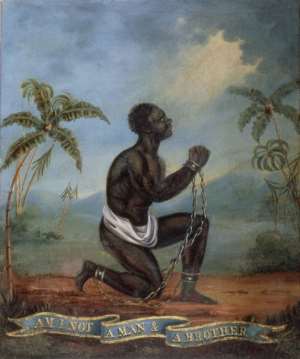
Now, rather facilely and lamely asserting that “Africa Is Not a Monolith” actually vindicates the assertion of those protesting against the wholesale demand for Reparations Payment to Indigenous Continental Africans, the brunt and the primary victims of the 500-Year-Long Transatlantic Slave Trade, largely the Western-European descendants and the maximum beneficiaries of this most heinous and unarguable crime of unspeakable depravity against Continental African Humanity that, indeed, the entire selective and protracted nightmarish victimization of Africans was actually an act of mutually orchestrated matter of normal, voluntary commercial interchange and perfectly a fair and balanced operation when, in fact, all the circumstances and the intricate socioeconomic exigencies of the period that made this most horrific abuse and “scapegoating” of the entirety of Indigenous Continental African Humanity point to the fact of an unfair and commercially incongruous game of systematic and an unrelentingly genocidal destruction of the latter group and species of humanity.
In other words, this most porous thesis on the part of “Senior Citizen” Atitso Akpalu does little to absolutely nothing to advance the thesis of Indigenous Continental Africans being, somehow, deserving of the right to be fairly, impartially and significantly compensated for this most morally despicable and socioeconomically unmitigable crime that has resulted in the materially, psychologically and the psychically incalculable and blisteringly deleterious impact on Global African Humanity, the necessary remediation of which incalculable impact is decidedly and dauntingly nowhere temporally in sight (See “Reframing Ghana’s Role in the Slave Trade Debate: Reexamining Perspectives, Legacies, And Dialogue Exploring Historical Contexts and Modern Conversations” Modernghana.com 4/7/26).
You see, the problem that any ratiocinatively serious intellectual and/or scholar faces in attempting to rejoin or tackle the rather logically artless and “rhetorically malnourished” statement or a discursive heading/subheading as “Africa Is Not a Monolith” inheres in the very implicitly contradictory and scandalously sophomoric tenor of such patently obtuse “reframing” of an otherwise perfectly valid and debatable statement of face-value observation, except that the proponent of such clearly intellectually tentative proposition, aside from being chaotically contradictory in stance, has absolutely no credible locus or predicative relevance in this clearly contextually oversized discursive canvass, as it were.
In sum, a simple preemptive response to the “Honorable” Mr. Atitso Akpalu would be: “If, indeed, Africa and Africans are Not a Monolith, then why even bother to raise the validity and the relevance of the payment of reparations to a people who are clearly not in the least bit in agreement or concurrence and concord over the critical matter of who clearly and specifically deserves to be morally, materially, psychologically, culturally and existentially repaired?”
Perhaps our “Honorable Interlocutor” would have done himself and the rest of us greater good, if Mr. Atitso Akpalu had also systematically and meticulously enumerated those cultural groups and precolonial Indigenous African Peoples and Nations to whose existential purview or reality what is often commonly called “Domestic Slaver,” as a staple or a major commercial enterprise did not exist or had not existed during most of the period that constitutes the contextual subject of the Reparations Debate, as the critic/interlocutor prefers to term and call it.
What we are simply calling upon “Senior Citizen” Atitso Akpalu to do here is to simply acquaint himself, at least passably, with the authoritative historical and the expansive corpus of the cultural studies of the erudite and the luminary likes of the immortalized Professor Cheikh Anta Diop, the legendary Senegalese-born scholar and the polymathic physical and social scientist, for who or after whom the former University of Dakar, Senegal, is presently renamed. There are, of course, quite a significant number of local Ghanaian scholars even presently who are actively engaged in “Slavery Studies” or the History of Slavery in Continental Africa over the course of the past 2,000 Years! If Mr. Atitso Akpalu does, he would discover to his pleasant surprise and epistemic enrichment that in spite of Continental Africa being composed of a cosmopolitan “diversity of peoples and cultures,” we still have much more existentially in common than that which may be even “scientifically” deemed to differentiate us sharply from each other as groups and individuals, and from the rest of the world.
Even more significantly, Mr. Atitso Akpalu would learn from intellectual and scholastic giants like Cheikh Anta Diop and the equally legendary likes of Guyanese-born Professors Ivan Van Sertima, author of the evergreen classic treatise titled “They Came Before Columbus” (New York: Random House, 1976); and Walter Rodney, author of “How Europe Underdeveloped Africa” (London & Dar es Salam: Bogle-L’Ouverture Publications & Tanzania Publishing House, 1972; Howard University Press, 1974), that it was the ubiquity or the widespread commonality of the customarily and the culturally ingrained and the entrenched practice and the institutional primacy of “Domestic Slavery” in the West African Subregion and, to be certain, Continental Africa, at large, that made it relatively much easier for the European-engineered Transatlantic Slave Trade and the massive and the prolonged Chattel-Enslavement of Africans to become as fabulously successful as it became, even well past a period when Proto-Domestic Slavery had been either proscribed or banned in many parts of the world, including the so-called Continental Europe by the leadership of the Islam-oriented Ottoman Empire.
Now, it takes a lot of intellectual and scholastic puissance and lucubrative fortitude, as well as painstaking scholarship of a rarefied kind to seriously and pertinently or relevantly join the longstanding and the still-raging debate on the Post-Slavery Reparations discursive marathon, than simply and lamely putting ink on paper or erratically clicking and pecking away, absent-mindedly, at a few keys on one’s laptop. Thankfully, these days, the revolutionary advent of the lightning speed of Artificial Intelligence (AI) has made such a hitherto onerous undertaking all the more easier, if also far more accessible and perfectly refined. Which is why Yours Truly finds it darn timely and opportune to admonish Apeto Akpalu to make more beneficial use of both his time and that of his apparently avid audience of National Democratic Congress’ devotees.
By Kwame Okoampa-Ahoofe, Jr., PhD
Professor Emeritus, Department of English
SUNY-Nassau Community College
Garden City, New York
E-mail: [email protected]


 'Prove I took even fuel coupon!' - NDC Vice Chair aspirant Woyome dares critics
 Asankragua market fire destroys 'ashawo' joint
 Ghana's nuclear power transition to create jobs, support industrial growth – Dr ...
 Dr. Bryan Acheampong faults 2027 budget for lacking job creation target
 'We needs fairness, not partisan favouritism’ – Dr. Kojo Asante criticises Vande...
 Roads Minister urges city authorities to regulate cattle movement on highways
 MPs’ absence from chamber partly due to committee work, constituency duties – Ak...
 Failure to punish absentee MPs fuels parliamentary absenteeism – Dr. Osae Kwapon...
 November 23: Cedi sells at GHS12.60 on forex market, GHS11.81 on BoG interbank
 Ghana Air Force receives second Airbus ACH160 helicopter under four-aircraft dea...


