




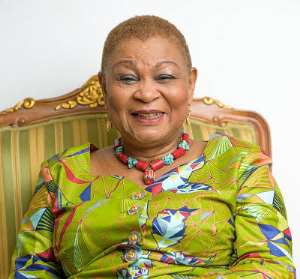
1. The Hook: Why She Is a National Icon
Let me say it plainly: Ghana does not produce many people like Auntie Joyce.
We produce good people. We produce clever people. We even produce brave people. But a woman who broke into four separate worlds that were built to keep women out, and then stayed long enough to rewrite the rules inside each one? That is not a career. That is a national monument with a pulse.
She was the voice of a government at the height of a turbulent era. She ran the ministries that shape our children's classrooms and our local communities. She became the first woman in Africa to lead a Chamber of Mines, in one of the most hyper-masculine industries on the continent. Then she took the pulpit, as a reverend, and began feeding souls.
Broadcaster. Stateswoman. Mining Boss. Reverend.
Four acts. One life. And she turned 80 in 2026 with the same energy that made her a household name in the 1980s. She calls herself no one's retiree. She is still on boards, still mentoring, and still speaking out when the rivers of this country are being poisoned.
Everyone from presidents to young interns calls her “Auntie Joyce.” Think about that. A woman with honorary doctorates, a state honour, and a seat at the table of banks and gold mines, and the whole nation still says “Auntie.” That is not weakness. That is affection earned over four decades. You cannot buy that title. You can only earn it.
Her philosophy is ageless. She has said that her life lessons come down to relying on God and His wisdom, treating everyone with respect, seeking excellence, and staying confident yet humble enough to laugh at your own mistakes. If a young Ghanaian wanted a manual for a long and meaningful life, that is it.
Today I am inducting her into the Hall of Fame of my pen, so that when Africa's archives are opened a hundred years from now, her name is found written in capital letters.
2. Early Life, Roots and Formative Education
Cultural Heritage
Joyce Rosalind Aryee was born in 1946 to a Fante mother and a Ga father, and she was the second of four children. Remember that blend, because it explains so much. The Fante gave her resilience and the Ga gave her fire. Her very bloodline is a lesson in how Ghana can be one nation without erasing its tribes.
Kumasi Upbringing
She did not grow up in the capital. Her early years were spent in North Suntreso, Kumasi, where she started school at Methodist Primary and Methodist Middle. Many of us in Accra forget this. The great Auntie Joyce is a girl who was shaped by the Garden City and by Methodist discipline, with the Asante heartland humming in the background.
The Achimota Crucible
Then came Achimota School, the institution that has produced presidents, professors, and nation-builders. Achimota has never been a gentle place. It is a crucible, and it takes raw talent and burns away everything weak. She came out of that fire so deeply shaped by it that Achimota later named its 17th dormitory in her honour: “Rev. Joyce R. Aryee House.” A school does not give its walls to just anyone. It does that for its legends.
Higher Education
She went on to the University of Ghana, Legon, and graduated in 1969 with a BA (Honours) in English. Here is the part I love. An English degree is the study of language, and she turned language into her weapon, her career, and her ministry. She also sang her way through school and university because music has always been woven into her soul.
Later, she added a postgraduate certificate in Public Administration from GIMPA to sharpen herself for public service.
3. Early Career: Media, Culture and Public Relations
Before she became a household name, she was a builder of foundations.
The Bold Media Voice
She started in public relations, and she was brilliant at it. From 1976 to 1981, she served as Public Relations Officer at the then newly established Environmental Protection Council. Later, she moved to the Ghana Standards Board in the same role.
Understand what that means: she was telling the nation's story long before she was asked to tell it from a ministerial seat. She learned how to translate government and science into language the ordinary Ghanaian could grasp.
Preserving Ghanaian Heritage
Even while at Legon, she worked with the Ghana Museums and Monuments Board. She was guarding the memory of this nation before she ever held national office. When she later became the government's chief communicator, she used the media to serve arts and culture because she understood that a country without memory is a country without a future.
Environment and Examination Boards
She also took a holiday job at the West African Examinations Council, in its Test Development and Research Office.
Notice the pattern. Environment. Standards. Examinations. Culture.
She was quietly collecting the exact skills she would need to run education policy and public affairs for a nation. Nothing in her life was wasted. Everything was preparation.
4. Political Trailblazer During a Turbulent Era (1982–2001)
Stepping into the Fire
In 1982, Chairman Jerry John Rawlings called, and she answered with deliberation and, by her own account, some reluctance. This was the early PNDC era, and the country was raw and uncertain. Women were not exactly queuing up for these jobs. She stepped in anyway because courage is not the absence of fear; it is walking forward while your knees are shaking.
Secretary (Minister) for Information (1982–1985)
She became the face and voice of a government. Anyone who lived through the 1980s remembers her: sharp, eloquent, impeccably composed, and impossible to ignore.
She placed the mass media at the service of arts and culture, and that deserves applause.
Minister for Education (1985–1987)
Here she did something that still gives me goosebumps. Saddened by the erosion of our cultural values, she introduced the Curriculum Enrichment Programme.
Schools started using the talking drum instead of the bell to announce a change of lessons. Imagine it: Ghanaian children learning to the rhythm of their ancestors.
She also led government delegations to international conferences, including the Conference of Non-Aligned Ministers of Education and UNESCO.
Minister for Local Government (1987–1988)
She moved to the ministry that touches the grassroots, where governance meets the village, the district, and the ordinary citizen.
Return to Democracy (1988–2001)
Now watch what a true patriot does. When the winds turned toward democratic rule, she knew her time in that space was nearing its end, and she chose to leave a legacy anyway.
She served at the National Commission for Democracy (NCD) and later as a Member of the National Defence Council, playing a vital behind-the-scenes role in Ghana's transition back to constitutional rule in 1992.
Not every hero stands on a podium. Some work in the engine room of history.
She helped midwife the Fourth Republic that we enjoy today, and many young Ghanaians do not even know it.
5. Shattering the Glass Ceiling in Corporate Mining (2001–2011)
In 2001, she became Chief Executive Officer of the Ghana Chamber of Mines, making history as the first woman in Africa to head a Chamber of Mines.
Pause there.
Mining is helmets, heavy machinery, and deep pits, a world where men had comfortably ruled for generations. And in walks a former minister, a communicator, a woman with an English degree and a public relations background.
The doubters must have rubbed their hands in anticipation.
But she used her mastery of communication to humanize mining. She strengthened corporate governance and bridged the gap between mining companies, host communities, and government.
For ten years, until 2011, she held that seat, delivering a decade of steady, sensible leadership.
And here is what makes her unforgettable: even after retiring, she became one of the fiercest voices against galamsey. She advocates sustainable mining and the protection of Ghana's water bodies from illegal mining.
At a time when our rivers run brown and our children drink poison, Auntie Joyce has been shouting what many were afraid to say.
That is integrity. That is leadership without a title.
6. Faith, Ministry and Social Impact
Then came the fourth act, and perhaps the most beautiful.
She has said that turning to ministry was not part of her plans. But she came to see it as God's purpose for her life, and she describes a hunger for God's word after that decision.
She also came to understand that every earlier experience had been preparation for the work she was now called to do.
She founded Salt and Light Ministries, a para-church organization dedicated to Christian leadership, workplace ethics, counselling, and inspiring believers to be influential in their workplaces and nations.
She co-authored the 2012 book The Transformed Mind.
Through Joyce Aryee Consult, she advises organizations on management and communications, and she mentors the next generation of African women through boards such as the Moremi Initiative (MILEAD) and Mentoring Women Ghana.
She did not retire into rest.
She retired into purpose.
7. Major Corporate Boards and Academic Leadership
Her institutional weight is staggering:
Corporate Boards
- Stanbic Bank Ghana
- Kinross Chirano Gold Mine
- Finatrade
- GLICO General
- Engineers & Planners
Education and Governance
- Pro-Chancellor of Central University
- Member of the Academic Board of Roman Ridge School
- Honorary Council Member of the Ghana Association of Restructuring and Insolvency Advisors (GARIA)
Banks, gold, insurance, universities, and schools.
When a woman sits in rooms like these, she is not a token. She is the conscience of the boardroom.
8. Hall of Fame Honours and Lifetime Awards
The trophy case, ladies and gentlemen:
- Companion of the Order of the Volta (2006): One of Ghana's highest state honours for distinguished service to the nation.
- Top 100 Global Inspirational Women in Mining (2016): Ranked 9th in the world.
- Honorary Doctorates and Fellowships: Doctor of Letters from the University of Mines and Technology (UMaT) in 2009; Doctor of Communication Arts from Central University in 2021; and the first female Honorary Fellow of the Ghana Institution of Engineers.
- Business and Leadership Awards: CIMG Marketing Woman of the Year (2007); African Female Business Leader of the Year (2009); GUBA Black Star Inspirational Woman Award (2015); and the Ghana CEO Awards Lifetime Achievement Award.
Add the Institute of Public Relations Ghana's Public Relations Personality of the Year (2014), and you have a wall of honours that could roof a small town.
The Other Side: A Fair Question
An honest columnist must steel-man the critics.
Some will say that serving a military government, the PNDC, carries a moral weight no award can erase. That era had its painful chapters, and no one should pretend otherwise. Those critics are right that history must never be sanitized.
But here is my answer.
The test of a public servant is what they did with the power they held.
Look at the record: a talking drum in the classroom, culture in the media, a hand in the democratic transition, and a lifetime afterwards of service to ethics, mentorship, and our water bodies.
Judge her by the whole book, not by a single chapter.
And let every honest Ghanaian keep both truths in the same hand: the era was turbulent, and she used her place in it to serve.
Humanizing the Legend
Strip away the titles and she is a mother, a singer, and a woman of warmth.
She has raised her child as a single mother, she is known for her signature style, and she has that rare gift of making a president and a young intern feel equally respected.
That is why the nation does not say “Madam Minister.”
It says Auntie Joyce.
A Note from Me to You
I wrote this column loud on purpose because we have a bad habit in Africa.
We wait for our heroes to die before we write their praises.
We hold the funeral brochure before we hold the microphone.
Not this time.
Auntie Joyce is alive, she is 80, and she can read these words.
To the young Ghanaian girl in Kumasi, Cape Coast, or Tamale who thinks the ceiling above her is made of concrete: it is glass. Someone already broke it four times.
Her name is Joyce Rosalind Aryee.
Put her in the Hall of Fame.
Put her in the textbooks.
Put her in the archives of Africa forever.
Gye Nyame.
Except God, nothing is greater.


 Tension at Suame Magazine as Ghanaian artisans clash with hired thugs during clo...
 Nvidia board reinstates Huang as CEO, Trump hails 'correct' decision
 Zelensky calls for EU inclusion in talks with Russia 'as soon as possible'
 Rent Control Commissioner has full backing of government – Presidential Staffer
 Bawumia congratulates Black Challenge on historic World Cup triumph
 Amin Adam seeking political capital with borrowing claims – Appiah Dankwah
 Jaman South MCE defends DRIP equipment, alleges NPP MP declined fuel support
 Govt prepares to relaunch GIFMIS, seeks auditors' input on system redesign
 Mahama orders massive cleanup, beautification of Accra ahead of Ghana's 70th ind...
 Housing Minister backs Rent Control effort to curb high charges following UG hos...


