




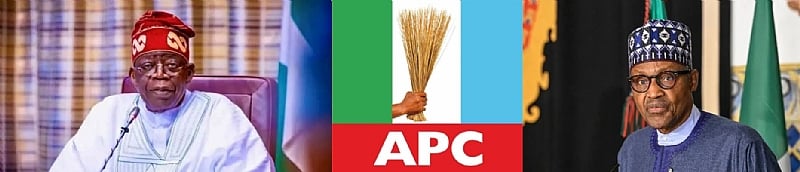
Since the All-Progressives Congress (APC) assumed political leadership of Nigeria in 2015, the country has witnessed two presidential administrations, several policy declarations, numerous reform programmes and countless political promises. Yet, as the country approaches another general election in 2027, one uncomfortable question deserves serious national consideration: What exactly has changed in the lives of ordinary Nigerians?
This question is particularly important because the APC came to power in 2015 on the strength of an elaborate promise of change. Its campaign was built around the expectation that a new political leadership would rescue Nigeria from the perceived failures of the Peoples Democratic Party (PDP), which had governed the country for 16 years.
Nigerians were promised improved security, economic prosperity, employment opportunities, reliable electricity, infrastructural development and a decisive war against corruption. The party's message resonated with millions of voters who believed that changing the political leadership would translate into a fundamental transformation of the country.
Eleven years later, however, the distance between those promises and the everyday experiences of citizens raises legitimate questions about the meaning of the change Nigerians were promised.
Indeed, the emergence of President Muhammadu Buhari in 2015 was celebrated as the beginning of a new political era. His administration enjoyed considerable goodwill, particularly because of his reputation as a former military head of state who had repeatedly presented himself as an uncompromising opponent of corruption.
Unfortunately, the expectations that accompanied his emergence were not sufficiently matched by the results of his administration.
The economy experienced recession, unemployment remained a serious national concern, inflation eroded household purchasing power, and insecurity spread across several parts of the country. Banditry, terrorism, kidnapping and communal violence became persistent threats to lives, livelihoods and national stability.
Electricity supply remained unreliable, while the country's dependence on imported petroleum products exposed the economy to external shocks and foreign exchange pressures.
Although the Buhari administration eventually left office in 2023, many of these problems were not only unresolved but had become more deeply entrenched.
Consequently, the emergence of President Bola Tinubu was accompanied by another wave of expectations. His Renewed Hope Agenda was presented as an opportunity to correct previous mistakes, restore economic confidence and reposition Nigeria for sustainable development.
Yet, more than three years into the Tinubu administration, Nigerians are still grappling with many of the same structural challenges that confronted them under Buhari.
Granted, the removal of the petrol subsidy, foreign exchange reforms, tax restructuring and other economic measures represent significant policy departures from previous arrangements. The government has also pointed to improvements in GDP growth, foreign reserves and other macroeconomic indicators as evidence that its reforms are beginning to produce results.
However, economic growth figures and foreign reserve accumulation cannot, by themselves, constitute sufficient evidence of successful governance when millions of households continue to struggle with the cost of food, transportation, accommodation, healthcare and education.
What does economic recovery mean to a family that can no longer afford three decent meals daily? What is the practical value of improved foreign reserves to a small business owner whose operating costs have become almost unbearable? What does GDP growth mean to an unemployed graduate who has spent years searching for a meaningful job?
These are not questions that government officials should dismiss as politically motivated criticism. They are legitimate questions arising from the lived experiences of citizens.
The argument that Nigerians must endure present economic difficulties because reforms require time is also becoming increasingly difficult to sustain. Reforms are not ends in themselves. Their justification lies in the benefits they ultimately deliver to the people.
Indeed, the APC cannot indefinitely ask Nigerians to evaluate its performance through the promises of tomorrow while avoiding accountability for the realities of today.
More troubling is the continuity of Nigeria's security challenges. Eleven years after the APC promised to defeat terrorism and restore confidence in the country's security architecture, communities in different parts of the federation continue to live under the threat of attacks, kidnappings and displacement.
Farmers cannot confidently access their farmlands in some areas, businesses operate under security uncertainties, and families continue to worry about the safety of their loved ones.
It is difficult to reconcile this reality with the assurances that the country is moving towards a more secure future.
The electricity sector provides another illustration of the country's disappointing governance trajectory. Despite successive promises of improved power supply, millions of Nigerians and businesses remain dependent on generators and alternative energy sources.
This situation has consequences beyond household inconvenience. It increases production costs, discourages investment, undermines industrial competitiveness and makes Nigerian businesses less capable of competing with counterparts in countries where electricity supply is more dependable.
Similarly, the fight against corruption, which featured prominently in the APC's 2015 campaign, remains an important test of the party's credibility. Nigerians are entitled to demand transparency, consistency and accountability in the management of public resources, irrespective of the political affiliation or status of those involved.
The perception that political loyalty sometimes receives more attention than institutional accountability undermines public confidence in the anti-corruption campaign.
Perhaps one of the most disturbing manifestations of this continuity is the country's political culture. Politicians continue to move between political parties, often without sufficiently explaining how their ideological convictions or governance philosophies have changed.
Former critics of the APC have become its supporters, while some founding members have expressed dissatisfaction with the direction of the party. Such developments reinforce the impression that political calculations and the pursuit of power frequently take precedence over clearly defined ideological commitments.
The movement of politicians from one party to another is not necessarily evidence of wrongdoing. However, when political defections occur without corresponding explanations of policy differences or governance convictions, voters are left wondering whether Nigeria's political parties represent genuinely different visions or merely competing platforms for accessing political power.
This is particularly relevant as opposition parties explore coalition arrangements ahead of the 2027 elections. Their proposed unity should not be celebrated merely because it presents an opportunity to challenge the APC. Nigerians have suffered enough from political experimentation to deserve something more substantial than another alliance built principally around the ambition of defeating an incumbent government.
The opposition must demonstrate that it has learnt from the failures of previous administrations. It must articulate credible alternatives on security, electricity, economic management, education, healthcare, employment creation and institutional accountability.
Changing the occupants of government offices without changing the philosophy and practice of governance will only reproduce the same disappointments under different political identities.
This is why the APC's argument for continuity deserves particularly close scrutiny. Its supporters contend that the Tinubu administration should be allowed to consolidate its reforms rather than return the country to what they describe as unsustainable policies of the past.
But continuity cannot become an excuse for escaping accountability. Neither should the fear of returning to previous economic arrangements be used to discourage Nigerians from demanding better leadership.
After all, the APC has governed Nigeria since 2015. It cannot indefinitely campaign against the failures of the PDP while presenting itself as a political newcomer still waiting for an opportunity to demonstrate its capacity.
The party has had more than a decade to establish a distinguishable record of governance. Its performance must therefore be judged against the promises it made, the resources available to it and the conditions under which ordinary Nigerians live.
Former President Goodluck Jonathan's warning about the possibility of post-election instability in 2027 also deserves attention. Political intolerance, electoral violence, thuggery and declining public confidence in democratic institutions cannot be treated as peripheral concerns. Democracy becomes endangered when citizens lose faith in the ability of the political system to deliver meaningful change through peaceful and credible elections.
Ultimately, Nigeria's problem is not simply that one political party has governed for too long. It is that the country has struggled to translate successive changes in political leadership into fundamental improvements in governance.
The APC promised change in 2015. Buhari's administration failed to sufficiently deliver on that promise. Tinubu subsequently promised renewed hope, but the ordinary Nigerian is still waiting for that hope to become a tangible reality.
This is not to suggest that nothing has happened in Nigeria since 2015. Governments have undertaken projects, introduced policies and implemented reforms. Rather, the argument is that the fundamental conditions that made Nigerians demand change in 2015 remain stubbornly present, despite eleven years of APC leadership.
The 2027 elections must therefore be about more than political alliances, presidential ambitions, defections and campaign slogans. They must provide Nigerians with an opportunity to interrogate the country's governance record and demand a credible alternative built around measurable results.
Whether the APC retains power or an opposition coalition succeeds at the polls, the country needs a fundamental departure from politics as usual.
Nigerians do not need another promise of change that eventually becomes an excuse for continuity of failure. They need leadership that understands that political power is a responsibility, not an entitlement; that economic reforms must improve human welfare; and that public office must be measured by the quality of lives it transforms.
Until that happens, the uncomfortable conclusion will remain difficult to dispute: Since 2015, Nigeria may have changed presidents, political slogans and economic policy directions, but it has not sufficiently changed the character and outcomes of governance.
Eleven years after the APC promised change, Nigerians are still waiting for the change they voted for.


 'Prove I took even fuel coupon!' - NDC Vice Chair aspirant Woyome dares critics
 Asankragua market fire destroys 'ashawo' joint
 Ghana's nuclear power transition to create jobs, support industrial growth – Dr ...
 Dr. Bryan Acheampong faults 2027 budget for lacking job creation target
 'We needs fairness, not partisan favouritism’ – Dr. Kojo Asante criticises Vande...
 Roads Minister urges city authorities to regulate cattle movement on highways
 MPs’ absence from chamber partly due to committee work, constituency duties – Ak...
 Failure to punish absentee MPs fuels parliamentary absenteeism – Dr. Osae Kwapon...
 November 23: Cedi sells at GHS12.60 on forex market, GHS11.81 on BoG interbank
 Ghana Air Force receives second Airbus ACH160 helicopter under four-aircraft dea...


