




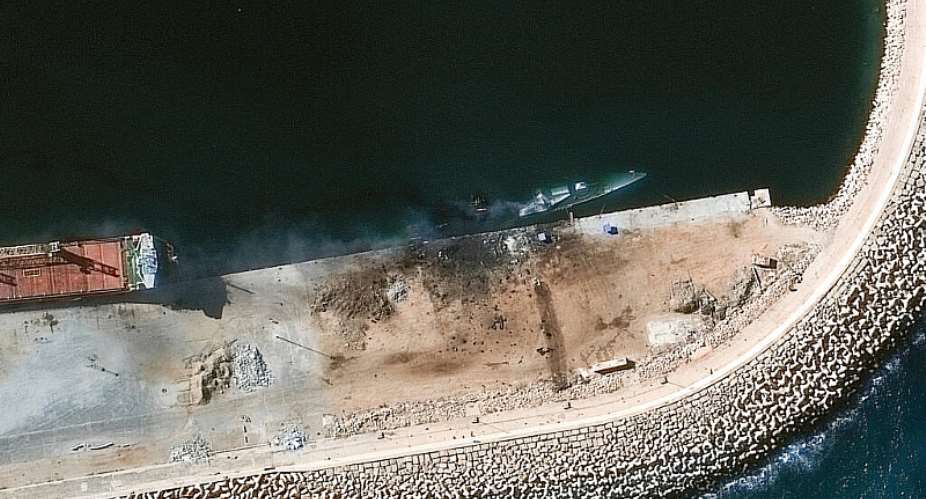
Most satellite photos are forgotten by lunchtime. The one taken over Benghazi harbour on 22 November may last longer. A grey hull lies on its side against the quay, a sliver of bow above the water, the rest sunk in silt. That is the Merkury, a Project 20380 corvette handed to the Russian Navy in 2023: Uran anti-ship missiles, Redut air defence, a Ka-27 helicopter on deck. She went down in minutes. Not in battle, but moored at an ally's naval base, where, we are told, she had called in "to refuel and take on supplies".
The same day the Angara was hit, a cargo ship well known to anyone who tracks Russian military freight. That evening another vessel was struck off Benghazi. Eastern Libya announced a "joint investigation with the Russian side". Moscow kept quiet for a full day.
I am less interested in the lost tonnage than in what else capsized that night.
From Tartus to Tobruk
Go back to December 2024. Assad's regime collapsed in a matter of days, and with it went Tartus and Hmeimim. For years those bases had been the junction for Africa: aircraft out of Hmeimim, ships out of Tartus, then Libya and the desert.
Moscow's answer was obvious. Field Marshal Khalifa Haftar, an old friend, held Tobruk and Benghazi and a string of airfields running deep into the interior. Look at the map: Al-Khadim outside Benghazi, Al-Jufra in the middle of the country, Brak al-Shati and Tamanhint in the Fezzan near Sabha, Matan al-Sarra on the borders with Chad and Sudan. From there the arrows fan out to Mali, Niger, Burkina Faso, Sudan and the CAR.
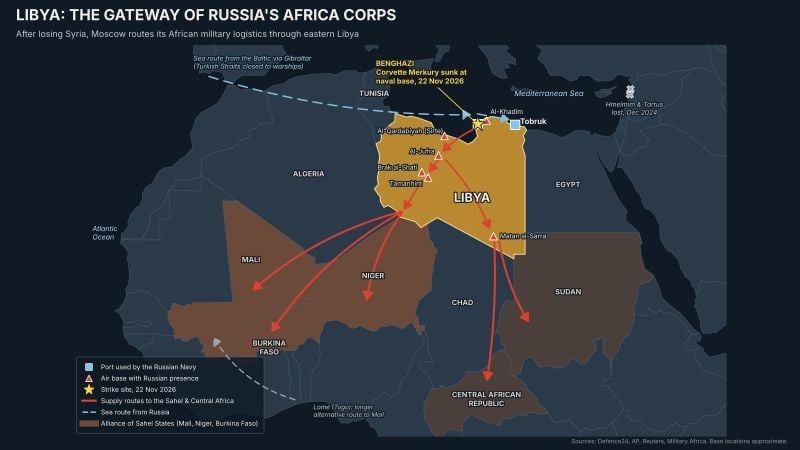
All through 2026 the machine ran smoothly. In September a convoy from Baltiysk, shepherded by the landing ship Aleksandr Shabalin, unloaded dozens of armoured vehicles at Tobruk. There was even talk of a permanent Russian berth there.
Neat on paper. The whole thing hung by a thread.
Someone else's quay
The Turkish Straits are shut to warships, so the Black Sea Fleet is out. That leaves the Baltic: round Europe, through Gibraltar, then the long haul along the North African coast. Ten days at sea, watched the whole way. And waiting at the end is not a base of your own, with your own air defence, dry docks and garrison. It is a borrowed quay, owned by an 83-year-old marshal who can change his mind whenever he likes.
In Syria Russia had a port, an airfield and a client regime. In Libya it has hospitality. Hospitality runs out once the guest gets expensive.
The Merkury was almost certainly there as an escort, the kind of ship Moscow assigned to shepherd freighters on the Libyan run. Now the shepherd lies on her side in the one place she should have been safe.
A corps that lives out of a cargo hold
People often call the Africa Corps "Wagner with a new badge". They are wrong. Prigozhin's Wagner paid its own way. It moved in, struck deals on mines, made money from gold and timber and largely fed itself. Vicious, but self-sufficient.
The Corps belongs to the Ministry of Defence. It is tidier, more cautious and much more expensive. With no mines of its own, everything from bullets to armoured personnel carriers has to be shipped in from Russia. The monitoring group Inpact reckons Mali's junta has already paid between $500 million and $900 million for the privilege.
What it got in return became clear in April. Tuareg rebels of the FLA, fighting alongside the jihadists of JNIM, took Kidal, the very town Wagner and the Malian army had "liberated" with great fanfare in 2023. The Corps withdrew. Defence Minister Sadio Camara, who steered Mali towards Moscow, was killed outside Bamako. One Western analyst summed it up: Russia's reputation in the Sahel was made in Kidal and buried there.
ACLED had already noticed the Corps fighting less and less. Its commanders openly preferred guarding the regime to chasing insurgents through the desert. A bodyguard, in short, and a pricey one. A bodyguard who cannot be resupplied is just a bill.
Kidal was a lost battle. Benghazi is a cut artery.
Moscow's options
There are not many, and none come cheap.
Heavier escorts? Russia is short of ships in the Mediterranean and has just lost one.
Proper air and coastal defences at Tobruk and Benghazi? Then the refuelling stops become a base in all but name, and Haftar has some explaining to do in Cairo, Abu Dhabi, Ankara and Washington.
Airlift? Slow, costly and far too small.
Detours? One is already in use. For months some kit for Mali has been landed at Lomé in Togo and trucked north. Thousands of kilometres of road, several borders, and at each one somebody who can lean on you.
Then there is the sales pitch. Russia arrived in the Sahel promising that it would protect the juntas the French had abandoned and the Americans lectured. A country that cannot protect its own warship at its own ally's base will struggle to close that deal.
The Sahel can't walk away
Will Mali, Niger and Burkina Faso drop Moscow? Not a chance. They have walked out of ECOWAS and sent the French and Americans packing. There is no other patron on offer. The weaker Russia gets, the tighter they will hold on. Deliveries will slow, costs will climb, trust will wear thin, and still nobody will leave.
JNIM wins either way. It no longer needs to invent propaganda; it can just post the photo from Benghazi.
Libya, a battlefield on loan
Libya stands to lose most. A country split in two risks hosting a war that is not its own.
Dbeibah's government in Tripoli quickly declared that Libya must not become an arena for international conflicts. Fine words that change little. The merest hint that the strike came from the west of the country hands both sides a pretext, and gives Moscow a reason to dig in deeper.
For Haftar it is decision time. His family has lived for years by keeping everyone sweet: Russia, Egypt, the Emirates, a working deal with Turkey, a smile for Washington. The Russians gave him weight. Now they make his ports a target. He can ask the Kremlin for more protection, or quietly start closing doors without saying why. Haftar is an old hand. I would not bet on the first.
A thread, not a spine
After Assad fell, Moscow must have felt it got off lightly. Lost Syria, found Libya. Lost Tartus, gained Tobruk. The map looked convincing, all those arrows sweeping into the Sahel.
Benghazi showed what was really behind them: a few quays, a long sea lane and the goodwill of one elderly marshal. That is enough for a presence. Not for an empire.
The Merkury will stay on her side until somebody raises her or everybody forgets her. I suspect Moscow is hoping for the second.

 'Prove I took even fuel coupon!' - NDC Vice Chair aspirant Woyome dares critics
 Asankragua market fire destroys 'ashawo' joint
 Ghana's nuclear power transition to create jobs, support industrial growth – Dr ...
 Dr. Bryan Acheampong faults 2027 budget for lacking job creation target
 'We needs fairness, not partisan favouritism’ – Dr. Kojo Asante criticises Vande...
 Roads Minister urges city authorities to regulate cattle movement on highways
 MPs’ absence from chamber partly due to committee work, constituency duties – Ak...
 Failure to punish absentee MPs fuels parliamentary absenteeism – Dr. Osae Kwapon...
 November 23: Cedi sells at GHS12.60 on forex market, GHS11.81 on BoG interbank
 Ghana Air Force receives second Airbus ACH160 helicopter under four-aircraft dea...


