




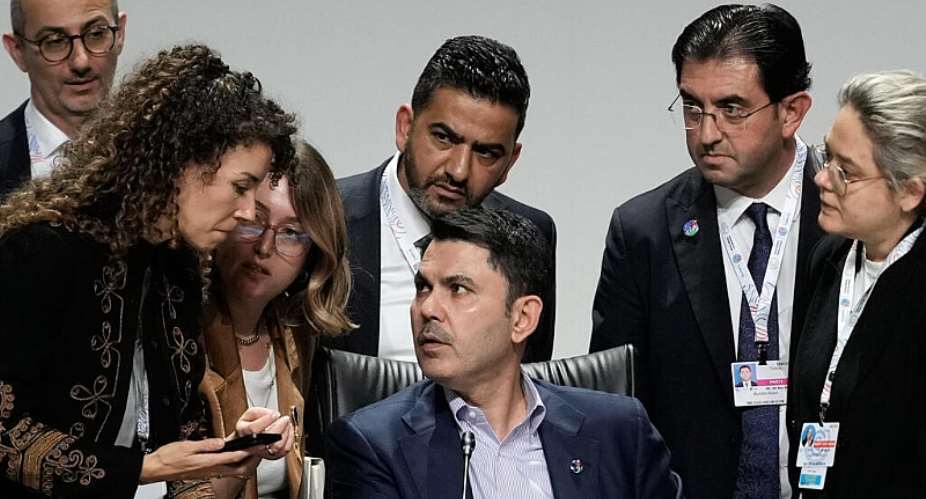
The finger pointing to assign blame for the collapse of UN climate talks in Turkey began on Monday with calls for the resignation of the Australian minister leading them, while the Pacific island nations most at risk from rising sea levels expressed their despair over the failure of countries to collectively address the climate crisis.
For the first time since the 2009 meeting in Copenhagen, the COP climate conference could not reach a final agreement from its talks after the EU and others rejected a final deal that did not include any mention of fossil fuels' role in global warming because of pressure from Saudi Arabia and other oil-producing nations.
This was the first meeting since the UN's environmental body confirmed global temperatures were set to exceed the 1.5°C level scientists have said will cause extreme weather impacts to intensify, and the lack of collective action has increased a sense of impotence around the multilateral COP process.
'A complete and utter failure'
Turkey hosted the latest talks, called COP31, in Antalya but shared leadership with Australia. Australian Energy Minister Chris Bowen was the COP31 president of negotiations and opposition politicians in his home country blamed him for the failure.
"This energy minister's got to go because he's a complete and utter failure," Angus Taylor, a member of the Australian parliament who leads the right-wing opposition, told reporters on Monday.
"Chris Bowen was responsible for it. He should go," Taylor said.
Speaking after the COP31 talks, Bowen blamed the very strong red lines many parties had on climate change.
The climate minister maintained the summit backdrop was "the most complicated and fraught geopolitical environment in living memory", as soaring energy prices and fallout from the Middle East war complicated the search for unity.
Under pressure to show progress in a year of climate-linked disasters from Europe to Nepal, Bowen sought an overarching "cover decision" to prove countries were still united in tackling the crisis.
But his plan unravelled as familiar fault lines emerged over fossil fuels, with the EU and Saudi Arabia locking horns over the pace of the shift away from coal, oil and gas.
"We will not endorse a cover decision ... that does not even mention fossil fuels, which is the key driver of climate change," said Ireland's climate minister, Darragh O'Brien, whose country holds the rotating EU presidency.
"And we will not accept a COP that greenwashes fossil fuel."
Inside the Australian parliament, other opposition members asked centre-left Prime Minister Anthony Albanese why he would not sack Bowen after the country had spent A$150 million ($99.23 million) on COP31.
Albanese did not comment directly on whether he would ask Bowen to step down.
"We believe that climate change is real. We believe in the science," Albanese said. "Whether it's environmental security or national security, we act in Australia's national interest."
UN Secretary-General Antonio Guterres, who urged nations to send fossil fuels "the way of the dinosaurs" during a fiery appearance at the talks, expressed deep dismay.
"I share the very profound frustration of all those who expected governments to rise to the moment the climate crisis demands," the outgoing UN chief said in a statement.
Green transition is 'irreversible'
The COP31 talks began on November 9 but the lack of a final agreement extended the summit to a record overtime on Sunday.
There was already some contention before their start as Australia fought with Turkey over hosting duties.
More than 190 countries were represented, and more than 92,000 people had registered, making it provisionally the largest UN climate conference on record. The United States did not send a delegation.
Last year's talks in Belem, Brazil, produced a deal but no commitment to phase out fossil fuels.
China voiced disappointment on Monday.
"We express our disappointment over this, while maintaining that confidence in the multilateral process should not be lost as a result," foreign ministry spokesman Guo Jiakun told a news briefing.
Guo added that addressing climate change is a "shared undertaking for humanity" and stressed that the global trend toward low-carbon development is "irreversible".
Read more COP31: Betting on electricity to break the climate deadlock
Most Pacific island nations, which are facing rising sea levels and other existential threats from climate change, expressed deep disappointment.
"We have been let down on all sides," the delegation from the Marshall Islands at COP31 said in a statement.
Tuvalu, the Pacific island nation that hosted a pre-COP event in October highlighting its exposure to rising sea levels, called out the absence of engagement and transparency in trying to reach a decision on a final statement.
"Listening to parties who diminish the credibility of signs of climate change is disappointing," said Maina Talia, Tuvalu's climate minister, expressing concern about the lack of commitment to put the world back on track for the global temperature goal.
(FRANCE 24 with Reuters and AFP)


 Over 41% of Ghanaian women aged 15–49 have suffered partner violence – Gender Mi...
 Prof Kwaku Azar questions legal basis for GTEC's nationwide PhD admissions freez...
 EU rejects COP31 draft decision over failure to tackle fossil fuels
 Soldiers reclaim 50 hectares of galamsey-degraded Tano-Nimiri Forest Reserve
 The New Economy Programme will keep NPP in opposition for very long time — Maham...
 Korle Bu patient regains normal urination, good erections three weeks after peni...
 Africa disappointed with COP31 outcome over failure to deliver adaptation financ...
 COP31 president apologises to Zanetor after interrupting Africa’s statement
 Ajumako-Besease two teens arrested for alleged GH¢38,000 romance scam
 Retired senior military officer in court over alleged GH¢1 million recruitment s...


