




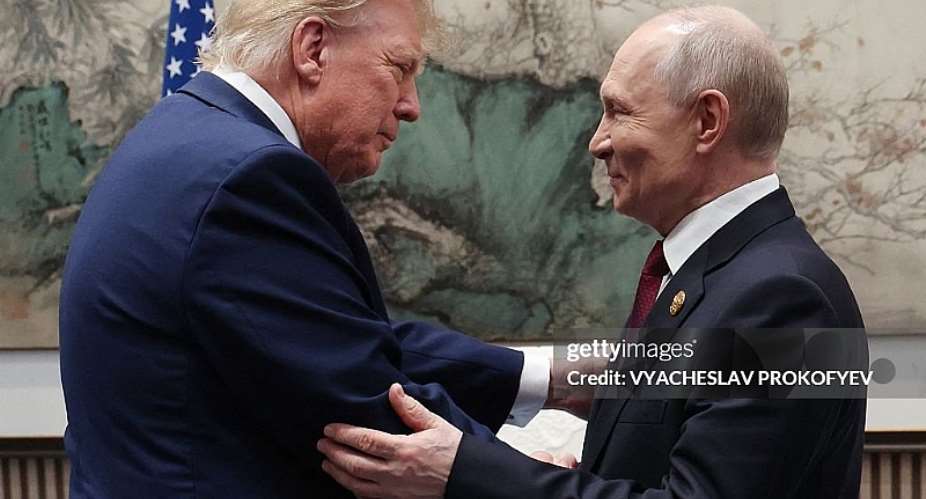
A warm handshake does not make an adversary an ally. That distinction shaped Washington’s latest argument over Russia after President Donald Trump greeted Vladimir Putin as “my friend” at a gathering in China. Director of National Intelligence Jay Clayton offered a calibrated answer: the word was “entirely appropriate” in the context of leaders of the three leading nuclear powers meeting to avert catastrophe, but Putin was “not America’s friend in Ukraine. Not at all”. Clayton did not repudiate Trump’s courtesy; he separated summit etiquette from national interest. That is where foreign policy must begin.
Trump defended the description by arguing it was better to have a leader possessing thousands of nuclear weapons as a friend than an enemy. The strategic imperative is real: Washington cannot treat Russia as an ordinary hostile state when both countries retain arsenals capable of destroying each other. But managing an adversary is not the same as trusting one. Trump later declined to say whether Putin was a friend to America as a whole, saying, “I can’t speak to America”. Personal rapport may open a diplomatic channel; it cannot prove that state interests have converged.
The War Is the Evidence
The most reliable measure of Putin’s intentions is not a photograph but Russian state conduct. Russia launched its full-scale invasion of Ukraine in February 2022. More than four years later, the war remains unresolved, and Moscow occupies roughly one-fifth of internationally recognized Ukrainian territory, including Crimea and areas seized before 2022. The Congressional Research Service’s August 2026 assessment described Europe’s largest war since the Second World War as a conflict in which estimates of those killed or wounded had reached as high as two million or more. These are estimates, not an audited count, but they convey the extraordinary human cost.
The Kremlin’s demands go far beyond a ceasefire along current front lines. The Institute for the Study of War documents Putin’s insistence that Ukraine surrender all of Donetsk, Luhansk, Zaporizhzhia and Kherson regions, including land Russian forces do not control; accept neutrality and abandon its NATO ambition; and restrict its armed forces. Moscow’s language of “demilitarization” and “denazification” has been used to justify demands that would leave Ukraine unable to choose its security alignment or defend its sovereignty. These are not modest bargaining positions. They seek to determine Ukraine’s future from outside.
The battlefield contradicts the idea that diplomatic warmth has softened Russian objectives. The Institute for the Study of War’s 19 November 2026 assessment said Ukraine still held just over 20 per cent of Donetsk, while Russian forces had captured only 203 square kilometres or 0.77 per cent of the region, since January. It estimated Russian forces suffered more than 420,000 casualties across the theatre during 2026. These are analytical estimates, but they show the scale of Moscow’s effort to secure a decisive objective through attrition. A government paying that price while maintaining maximalist demands is not signalling reconciliation.
The Cost of Misreading Moscow
Russia’s military budget reinforces the point. The Stockholm International Peace Research Institute (SIPRI) estimated Moscow spent about $190 billion on its armed forces in 2025, a real-terms increase of 5.9 per cent, equivalent to 7.5 per cent of GDP. Ukraine spent an estimated $84.1 billion or 40 per cent of GDP. SIPRI also found Russian military expenditure represented around 20 per cent of government spending, the highest share in its recorded series. This is a structural commitment to war, not a temporary negotiating posture.
This imbalance matters to Washington even if American forces are not fighting Russia directly. A Russian victory, or a settlement rewarding territorial conquest and stripping Ukraine of sovereignty, would weaken the principle that borders cannot be changed by force. It would unsettle NATO’s eastern members, encourage coercion elsewhere and raise the future cost of deterrence. The consequences would reach beyond Kyiv, shaping the credibility of American commitments across Europe and the Indo-Pacific.
Clayton’s defence of the summit’s language rested on the need for the three major nuclear powers, the United States, Russia and China, to communicate and prevent an incident. That is legitimate. The United States and Russia possess the world’s largest nuclear arsenals; miscalculation could have consequences far beyond Ukraine. But arms-control dialogue requires clarity, not sentimentality. A crisis-management channel is essential precisely because the parties remain competitors. Calling Putin a friend may be diplomatic theatre; allowing that label to shape threat assessment would be dangerous.
Diplomacy without Illusions
Clayton’s intervention was less a public break with Trump than an attempt to preserve analytical discipline inside an administration pursuing personal diplomacy. Leaders can speak cordially while their governments remain in conflict. That is not hypocrisy; it is statecraft. Franklin Roosevelt worked with Joseph Stalin against Nazi Germany without mistaking Soviet ambitions for American ones. Engagement is a tool, not a verdict on character.
The test of Trump’s approach will not be photographs, compliments or declarations of friendship. It will be whether Moscow accepts a settlement respecting Ukraine’s sovereignty, providing credible security guarantees and preventing renewed aggression. An agreement rewarding invasion, compelling Ukrainian disarmament or granting the Kremlin a veto over Kyiv’s alliances would turn diplomatic access into strategic defeat. Negotiations backed by credible deterrence, however, could reduce the fighting without pretending Russian and American objectives are identical.
The numbers leave little room for comforting illusions: around 20 per cent of Ukraine remains under Russian control; Russia devoted an estimated 7.5 per cent of GDP to military spending in 2025; and the Kremlin’s demands reach well beyond a ceasefire. Trump is right that nuclear rivals must talk. Clayton is right that Putin is not America’s friend in Ukraine. Diplomacy can manage hostility, test intentions and prevent escalation. It cannot abolish competing interests by changing the language of a handshake. Washington should keep the channel open, and its eyes open wider.
The writer is a journalism lecturer and the CEO of The International Lens. (theinternationallens.com). Email: [email protected]


 Ghana's nuclear power transition to create jobs, support industrial growth – Dr ...
 Dr. Bryan Acheampong faults 2027 budget for lacking job creation target
 'We needs fairness, not partisan favouritism’ – Dr. Kojo Asante criticises Vande...
 Roads Minister urges city authorities to regulate cattle movement on highways
 MPs’ absence from chamber partly due to committee work, constituency duties – Ak...
 Failure to punish absentee MPs fuels parliamentary absenteeism – Dr. Osae Kwapon...
 November 23: Cedi sells at GHS12.60 on forex market, GHS11.81 on BoG interbank
 Over 41% of Ghanaian women aged 15–49 have suffered partner violence – Gender Mi...
 Prof Kwaku Azar questions legal basis for GTEC's nationwide PhD admissions freez...
 The New Economy Programme will keep NPP in opposition for very long time — Maham...


