




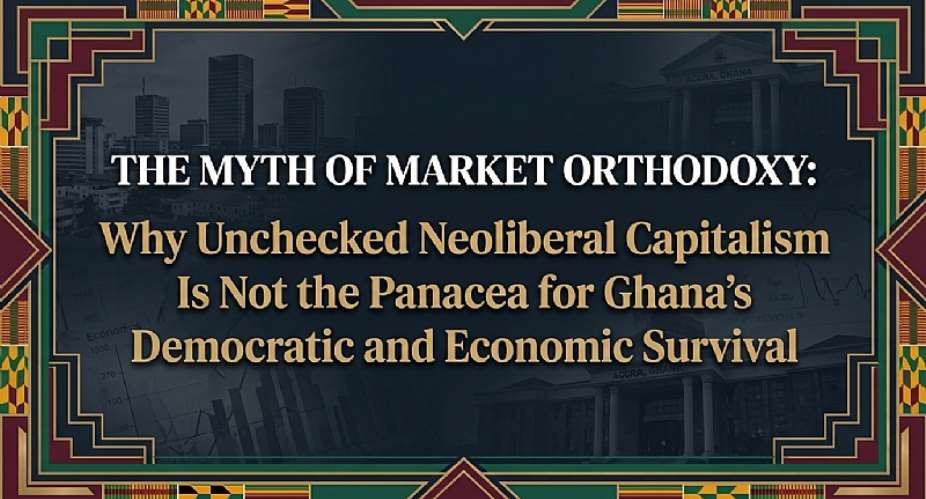
For over three decades under the Fourth Republic, Ghana’s political economy has been defined by an entrenched ideological binary: the center-right, property-owning liberal orthodoxy of the Danquah-Busia-Dombo tradition—represented by the New Patriotic Party (NPP)—and the social-democratic, state-interventionist paradigm rooted in the Nkrumahist and Rawlings traditions, embodied by the National Democratic Congress (NDC).
While the Danquah-Busia-Dombo lineage has undeniably strengthened Ghana’s constitutional architecture—most notably through press liberalization, judicial formalization, and private-sector expansion—elevating its market-fundamentalist model as the singular panacea for national development ignores hard empirical evidence. Ghana’s historic sovereign debt default, painful domestic and external restructurings, and persistent structural vulnerabilities demonstrate a sobering reality: aggressive, unbridled free-market capitalism in a peripheral, commodity-dependent economy does not guarantee shared prosperity; left unchecked, it degenerates into predatory cronyism, elite self-enrichment, and democratic disillusionment.
The Anatomy of Self-Serving Capitalism and Elite Capture
In theory, free-market capitalism rewards innovation, competition, and productive risk. In practice, when transplanted into weak institutional environments without strict conflict-of-interest barriers, it morphs into state-enabled oligarchy—where political power is leveraged to privatize national wealth while socializing financial losses onto ordinary citizens.
Across Ghana’s political landscape, critics and civil society observers point to prominent figures within the political establishment as stark symbols of how ideological market rhetoric often masks self-serving accumulation and institutional impunity:
- Financialized Cronyism and the Sovereign Debt Crisis (The Ken Ofori-Atta Era): Under the stewardship of former Finance Minister Ken Ofori-Atta, Ghana’s economic management became emblematic of hyper-financialization and persistent conflict-of-interest controversies. Aggressive reliance on high-yield Eurobond issuances and domestic bond markets—amid intense parliamentary and public scrutiny over transaction advisory roles linked to private financial firms—pushed Ghana’s public debt stock above 90% to 100% of GDP by the end of 2022. When the debt bubble burst, ordinary pensioners, local banks, and middle-class savers bore the brunt of the Domestic Debt Exchange Programme (DDEP), enduring severe financial haircuts while the architects of the borrowing spree remained insulated from personal liability.
- Extractive Impunity and Ecological Plunder (The Chairman Wontumi Phenomenon): Unchecked capitalist accumulation has also manifested violently in Ghana’s natural resource sector. The recurring public controversies and legal battles surrounding Bernard Antwi Boasiako (Chairman Wontumi)—the NPP Ashanti Regional Chairman—and mining operations linked to his business interests have become a defining symbol of the galamsey (illegal and unregulated mining) crisis and forest-reserve encroachment. When politically connected actors treat communal lands, rivers, and cocoa farms as private balance sheets to be stripped for short-term mineral rents, the ecological and agricultural foundations of the nation are sacrificed to private greed.
- Partisan Patronage and Insular Governance (The Miracles Aboagye Archetype): Beyond high finance and extractive rents, aggressive market-era politics has bred a class of partisan operatives and communicators—exemplified by figures such as Dennis Miracles Aboagye—whose trajectory through state-funded local government appointments and executive communications illustrates how political loyalty is routinely rewarded with institutional access. Rather than interrogating why millions of young Ghanaians remain unemployed or burdened by regressive taxes, partisan defenders frequently deploy state platforms to rationalize elite privilege and deflect accountability from failing economic policies.
The Empirical Limits of Aggressive Market Liberalism in Ghana
Beyond individual actors, the structural consequences of pursuing unguarded neoliberalism between 2022 and 2026 remain etched in Ghana’s macroeconomic record:
- Sovereign Restructuring and Capital Erosion: Alongside the domestic DDEP haircuts, Ghana was forced to restructure $13.1 billion in Eurobonds and $5.4 billion in bilateral official debt, tarnishing the nation's international credit standing and wiping out decades of domestic pension and banking capital.
- Inflationary Shocks and Wage Destruction: Unhedged exposure to global supply shocks and currency depreciation drove headline inflation to 54.1% in December 2022, remaining elevated at 23.8% by the end of 2024. Although tight monetary policy and fiscal consolidation under the IMF’s $3 billion Extended Credit Facility successfully compressed inflation down to 5.4% by December 2025 and 5.5% by October 2026 (while lowering the debt-to-GDP ratio to roughly 45%), the preceding inflationary spike devastated real household incomes and hollowed out indigenous small businesses.
- Deindustrialization and Structural Import Dependency: Unconditional trade liberalization has systematically exposed Ghanaian producers to asymmetrical global competition, trapping the economy in a colonial-era primary export model—shipping raw gold, crude oil, and cocoa beans while spending scarce foreign exchange to import refined fuel, poultry, rice, and light manufactures.
- Jobless Growth and Youth Marginalization: Even as real GDP growth rebounded to 6.0% in 2025 and maintained momentum in 2026, macroeconomic recovery has failed to generate structural employment. With national unemployment hovering near 12.8% to 13.0% and youth unemployment (ages 15–35) averaging 21.9%, an extractive, crony-capitalist model has proven incapable of absorbing Ghana’s demographic dividend.
Policy Recommendations: Dismantling Cronyism and Building a Developmental State
To break Ghana’s recurring cycle of elite accumulation, debt crises, and IMF bailouts, citizens and policymakers must dismantle the structures that allow private greed to masquerade as national development. Ghana requires a calibrated developmental state model anchored in strict ethical guardrails:
- Enforce Strict Conflict-of-Interest and Asset Declaration Laws: Parliament must enact binding legislation barring public officials, ministers, and politically exposed persons from holding beneficial interests in state contracts, sovereign debt transactions, or mineral concessions—backed by publicly verifiable asset declarations before and after office.
- End Impunity in the Extractive and Environmental Sectors: Irrespective of party affiliation or regional political clout, state security and regulatory agencies must revoke mining licenses tied to forest-reserve destruction and river pollution, enforcing full environmental restitution and criminal prosecution.
- Transition from Neoliberal Orthodoxy to Strategic Industrial Policy: Drawing lessons from successful East Asian developmental states, Ghana must deploy targeted industrial policy—using smart tariffs, subsidized long-term credit, and local-content mandates—to shield domestic agribusiness, pharmaceuticals, and light manufacturing until they achieve competitive scale.
- Mandate Domestic Value Addition Across Extractive Sectors: Macroeconomic stability will remain illusory so long as the Cedi is tethered to raw commodity exports. Fiscal incentives and export regulations must aggressively penalize raw mineral and agricultural exports while rewarding local refining and agro-processing.
- Institutionalize Binding Fiscal Rules Across Electoral Cycles: To prevent election-driven deficit financing and reckless commercial borrowing, Parliament must enforce statutory debt ceilings, independent fiscal councils, and transparent parliamentary scrutiny over all sovereign loan agreements.
A Call to Action: Reclaiming the Republic Through Civic Vigilance
History will not absolve a generation that watches its inheritance auctioned off behind ideological slogans. To Ghanaian youth, organized labor, professional associations, and civil society: the era of passive partisan cheerleading must end. You are the primary casualties of sovereign debt defaults, destroyed water bodies, and jobless economic policies—and you must become the primary architects of national accountability.
Reject the politics of tribal and partisan blindfolds that excuse corruption simply because the perpetrator wears your preferred party colors. Use the Right to Information (RTI) Act to audit public contracts; demand lifestyle audits and prosecution of public officials who amass unexplained wealth; mobilize peacefully and relentlessly to protect Ghana’s forests and rivers; and hold every administration—whether NPP or NDC—to the same uncompromising standard of integrity.
Ghana’s Fourth Republic stands at a moral and economic crossroads. The Danquah-Busia-Dombo tradition rightly affirms that individual liberty, property rights, and the rule of law are indispensable foundations of a free society. Yet Ghana’s recent trauma proves that when market fundamentalism is hijacked by self-serving elites—turning public finance into a private brokerage, forests into personal quarries, and governance into a patronage machine—it cannibalizes the very democracy it claims to defend.
True national transformation will not be delivered by the Elephant’s market orthodoxy or the Umbrella’s state populism alone. It demands a vigilant citizenry and a disciplined developmental state—one where private enterprise is held to strict ethical standards, public resources serve the common good rather than a privileged few, and national prosperity is measured by the tangible dignity of every Ghanaian.
✍️ By Retired Senior Citizen
For and on behalf of all Senior Citizens of the Republic of Ghana 🇬🇭
Teshie-Nungua
[email protected]

 Drone strikes hit homes, UN building in Sudan's capital
 South Korean education minister resigns over AI-driven exam cheating scandal
 Climate deal collapses in chaotic end to COP31
 How eight 'A's WASSCE graduate from Wesley Girls killed by speeding motorcycle w...
 GTEC freezes new PhD admissions nationwide pending audit of doctoral programmes
 NATO faces sovereignty dilemma as militaries rely on private tech, AI
 Afenyo-Markin demands answers over poor water quality in Central Region
 Mahama says Mayweather’s Ghana visit will boost tourism, boxing
 Police to develop human rights manual to strengthen professionalism and public t...
 How Korle Bu surgeons fixed back man's penis cut off whiles attempting to sit on...


