




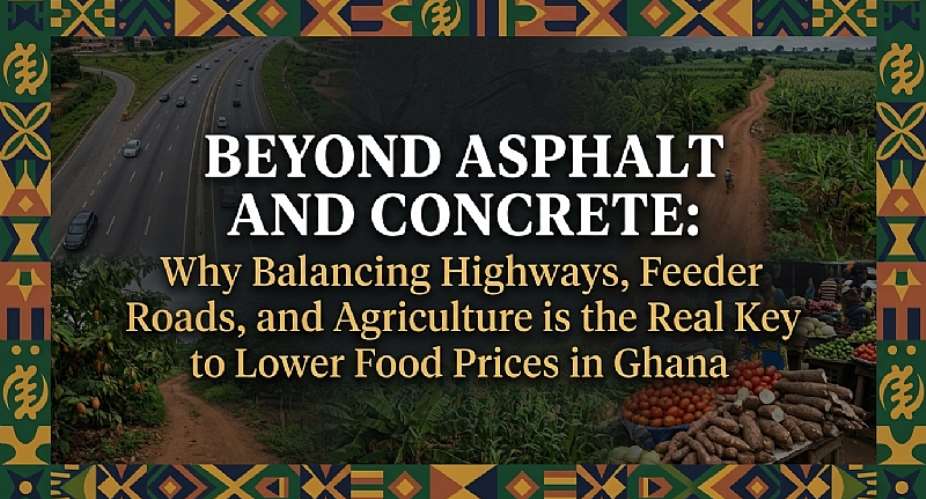
In every developing economy, the debate over where to place the nation’s scarce cedis is the ultimate test of economic wisdom. Recently, the Member of Parliament for Nhyiaeso, Dr. Stephen Amoah, sparked a vital national conversation when he questioned the innovation behind the government’s flagship "Big Push" infrastructure programme. His central argument—that building roads is a routine duty of governance rather than a groundbreaking economic breakthrough, and that Ghanaians are yearning for policies they can immediately feel in their pockets—strikes at the heart of our daily reality. Yet, as basic economics teaches us, producing food without reliable roads only breeds post-harvest waste and artificial scarcity. To truly lower food prices and uplift household incomes, Ghana must move beyond political slogans and strike a deliberate, well-sequenced balance between major highways, rural feeder roads, and direct agricultural support.
How Feeder Roads vs. Major Highways Affect Food Prices Differently
Not all roads affect the price of a tuber of yam, a crate of tomatoes, or a bag of maize in the same way. Understanding the economic difference between feeder roads (the "first mile") and major highways (the "middle and last mile") explains why a country can spend billions on trunk corridors while food prices in urban markets remain stubbornly high.
- Feeder Roads Determine Farm-Gate Survival and Post-Harvest Losses: Feeder roads connect remote farming enclaves in places like Afram Plains, Bono East, Northern, and Volta regions to district aggregation centres. When these roads are muddy, gullied, or impassable during the rainy season, standard cargo trucks refuse to enter. Farmers are forced to pay exorbitant rates for tricycles (aboboyaa) or manual head-porterage just to get crops to a main junction—a cost that can double or triple the price of produce before it even begins its journey to Accra or Kumasi. Worse still, perishable crops rot at the farm gate.
- Major Highways Determine Bulk Haulage Efficiency and Turnaround Time: Trunk roads and expressways—such as the Accra–Kumasi, Tema–Aflao, and Eastern Corridor highways—move large volumes of food across regions. Smooth, dualised highways reduce fuel consumption, cut vehicle wear-and-tear, and prevent the frequent breakdowns that force transport unions to raise freight charges.
- The Economic Bottleneck: Investing heavily in major highways while neglecting rural feeder roads is like building a modern airport without access roads to the terminal. Bulk haulage may become faster between regional capitals, but if the food cannot leave the village farm in the first place, urban scarcity and food inflation persist.
The 2027 Budget Reality: Bridging the Gap Between Concrete and Crops
Following Dr. Amoah’s critique, the 2027 Budget Statement presented to Parliament laid out substantial commitments across both physical infrastructure and livelihood sectors. While the Big Push programme received nearly GH¢30 billion (alongside GH¢11.3 billion for the Ministry of Roads and Highways), the budget also earmarked GH¢2.9 billion directly for the Ministry of Food and Agriculture—targeting silos, machinery, and the National Food Buffer Stock Company—as well as GH¢3 billion for rural electrification across six regions and a US$3 billion multi-year commitment toward commercial agriculture. Additionally, dedicated initiatives such as the Ghana Market Access and Connectivity Project aim to rehabilitate rural feeder corridors.
However, as Parliament debates these allocations, the core concern raised by Dr. Amoah remains valid: headline budget figures do not automatically translate into affordable meals on the family table. If highway contracts absorb the lion's share of timely disbursements while agricultural inputs, storage silos, and rural feeder roads suffer delays, ordinary Ghanaians will continue to feel disconnected from macroeconomic progress.
Recommendations and Suggestions for Balanced National Development
To ensure that infrastructure spending directly lowers the cost of living and puts money back into the pockets of farmers, traders, and consumers, policymakers should adopt the following practical measures:
- Synchronise Feeder Roads with Trunk Corridors: Mandate that every major Big Push highway contract includes a dedicated percentage of funding for adjoining agricultural feeder roads so that farming communities are physically linked to main trade arteries.
- Ring-Fence Agricultural Enclave Road Funds: Ensure that allocations for agricultural enclave roads and rural connectivity projects are disbursed strictly on schedule before the peak rainy and harvest seasons, rather than being treated as secondary phases.
- Pair Roads with Storage and Cold-Chain Infrastructure: Fast-track the construction of community aggregation centres, grain silos, and solar-powered cold storage facilities alongside road upgrades so farmers are not forced to sell perishable harvests at giveaway prices.
- Expand Rural Electrification for Agro-Processing: Leverage the 2027 rural electrification budget to power small-scale processing mills in farming districts. Transporting processed cassava flour, palm oil, or packaged rice is far cheaper and less perishable than hauling raw, bulky crops.
- Enforce Maintenance and Value-for-Money Audits: With the Ghana Institution of Engineering recently warning about declining road quality due to poor maintenance, the Road Maintenance Trust Fund must be strictly protected to keep existing rural and urban roads motorable year-round.
- Track Livelihood Outcomes, Not Just Kilometres Paved: Government agencies should measure the success of road investments not merely by kilometres of asphalt laid, but by measurable drops in post-harvest loss rates, farm-to-market freight costs, and urban food inflation.
Dr. Stephen Amoah’s critique serves as a timely reminder that infrastructure is a means to an end, not an end in itself. No Ghanaian can eat asphalt, yet without motorable roads, the food grown by our hardworking farmers cannot reach the markets that need it most. True economic innovation lies in integration—connecting the farmer’s field via reliable feeder roads to modern storage facilities, processing hubs, and efficient national highways. When Ghana gets this balance right, road construction ceases to be "business as usual" and becomes a genuine engine of lower food prices, thriving rural enterprises, and shared prosperity that every citizen can feel in their daily life.
✍️ By Retired Senior Citizen
For and on behalf of all Senior Citizens of the Republic of Ghana 🇬🇭
Teshie-Nungua
[email protected]


 Drone strikes hit homes, UN building in Sudan's capital
 South Korean education minister resigns over AI-driven exam cheating scandal
 Climate deal collapses in chaotic end to COP31
 How eight 'A's WASSCE graduate from Wesley Girls killed by speeding motorcycle w...
 GTEC freezes new PhD admissions nationwide pending audit of doctoral programmes
 NATO faces sovereignty dilemma as militaries rely on private tech, AI
 Afenyo-Markin demands answers over poor water quality in Central Region
 Mahama says Mayweather’s Ghana visit will boost tourism, boxing
 Police to develop human rights manual to strengthen professionalism and public t...
 How Korle Bu surgeons fixed back man's penis cut off whiles attempting to sit on...


