




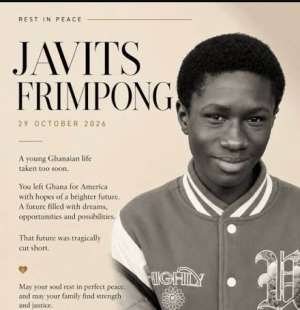
Rest well, Javits.
You were fifteen. You left Ghana with a suitcase and a dream of becoming a doctor, and you were walking to class when the world took you from us. On behalf of every Ghanaian at home and abroad, every New Yorker who walked past that corner in Claremont, and every parent in London, Toronto, Berlin and beyond who held their child a little tighter this month, I say it plainly: we are sorry. We are sorry that the city and the world you trusted did not protect you. May you rest in perfect peace, and may your memory shame us into doing better.
Today, Friday, 20 November 2026, you were honoured the way a son of Ghana deserves. Gothamist describes hundreds of mourners, many in traditional Ghanaian dress, filing past your open casket at New Covenant Dominion Cathedral on Boston Road in the Bronx. You lay in a white suit. Rev. Al Sharpton delivered the eulogy. Mayor Zohran Mamdani and Attorney General Letitia James were among the officials who came, according to Gothamist. Attorney Ben Crump, who represents your family, and Public Advocate Jumaane Williams were also expected. After the service, you are to be laid to rest at Kensico Cemetery in Valhalla, New York. The family has also announced a thanksgiving service on Sunday, 22 November, at 11 a.m. at COP New York Central in the Bronx, according to The Herald Ghana and the National Action Network. That is how we Ghanaians close the book: we weep, we bury, and then we give thanks for a life that mattered.
Your mother, Doris Adu Gyamfi, was in Ghana when you were killed. Asaase Radio reports that she travelled on an emergency visa, granted after President Trump intervened at the request of Mayor Mamdani. Think about that for a moment. A mother had to wait for permission to bury her own child. When she finally stood to speak, Asaase Radio says she told you, "If love could defeat death, you would still be here." I have read many tributes in my years of writing. I have not read one that says more in so few words. YEN.com.gh describes your father, Thomas Frimpong, seated in black, visibly overcome with grief. No parent should ever have to sit through this.
Asaase Radio also reports that a GoFundMe campaign for the family had raised more than $800,000 by the week of the funeral. That tells me something. Strangers in many countries opened their wallets because they could not open their arms. It is a beautiful response, and it should never be the only one.
Now to the case itself, because grief without accountability is only half a farewell.
Javits was shot in the stomach on 29 October near Crotona Park, on his way to DreamYard Preparatory School. A 17-year-old was arrested on 11 November and charged with murder, manslaughter and weapon possession, according to NBC New York. A judge denied him bail the next day. The Bronx District Attorney's Office then confirmed on 17 November, after a retention hearing, that he will be tried as an adult in the Youth Part of the Bronx Supreme Court, not Family Court.
What the prosecution alleges is chilling. Balleralert and GBC Ghana report that surveillance footage shown in court appeared to show three people chasing Javits. One of them fired and Javits fell. Prosecutors say the accused then picked up the gun and fired at him as well. GhanaWeb adds that prosecutors say he may not have fired the fatal shot. ABC7 says it remains unclear whether he was the actual shooter. Surveillance video and ballistic evidence are said to tie him to the scene. The case went before a grand jury on 16 November and an indictment is expected, which could bring forward his next court date of 21 December.
Let me be fair here, as a columnist should be. He is a teenager and he is presumed innocent until a court says otherwise. Those are the rules, and they protect all of us. Nobody should celebrate a verdict that has not been reached.
But here is what I will not be quiet about. Two other suspects are still at large. Graphic Online reports police are still searching for two more people. Somewhere in New York, two young people may be going about their day, and a family is burying a child. I appeal to anyone with information, especially anyone who knows these boys: please speak to the NYPD. Silence is not loyalty. It is a debt that a grieving mother is paying.
The motive is still under review, and we should resist the urge to write the story ourselves. The family first pointed to bullying. Javits had told his father he was being harassed at school, and Mr. Frimpong said he believed the killing was connected. The NYPD said bullying was one angle among others. Gothamist and YEN.com.gh reported that police also looked at robbery and mistaken identity, and found nothing linking Javits to any gang. Then the Bronx Times reported that Ben Crump said the arrested suspect had no connection to the earlier bullying. ABC7 reports that Crump said the DA does not believe bullying was the motive. So we don't yet know why. I would rather wait for the truth than hand this family a convenient lie.
Whatever the motive turns out to be, the bullying question deserves attention in its own right. A child told his father he was being bullied and had reported it repeatedly. A school bus aide said at least two students were suspended, as CBS New York reported. Whether or not that had anything to do with the shooting, every school must treat a child's repeated complaints as an emergency, because sometimes it is.
The other lesson is for us at home. Many of our families send children abroad believing the road there is paved with opportunity. Often it is. But a boy in a new country, with a new accent and no old friends around him, is exposed in ways we rarely discuss. We should call and check on them, build networks around them, and make sure they are never alone with their troubles.
To Thomas and Doris: Ghana is with you. So are the thousands who held vigils, and so is everyone who read about Javits and felt something break. You asked for justice. I pray you get it, and I pray you also get some peace.
Goodbye, Javits. You wanted to heal people. In your death, you have made all of us care a little more about each other. That is a heavy thing to ask of a child, and we are sorry it came this way.
Sleep well, young doctor.


 GSA secures High Court backing, recovers GHS400,000 outstanding rent
 Boankra logistics terminal 85% complete as GSA advances infrastructure agenda
 Copyright laws must be amended to address AI, digital content challenges – Copyr...
 Mahama urges regulators to simplify business permit processes
 President Mahama urges ECOWAS to stop the rhetorics, remove trade barriers
 Ghana's democracy is for sale as money floods party elections — Ho West MP
 Meet Diamond Lucas, 12-year-old UCC undergraduate student pursuing BSc degree in...
 GRA uncovers widespread tax non-compliance at West Hills Mall, 16 businesses inv...
 Education Minister directs GTEC, Rent Control to address rising tertiary hostel ...
 Over 1,200 bags of suspected smuggled rice, sugar intercepted in Tatale


