




body-container-line-1

Two Champions, One Ring Called Ghana: What Mayweather's Visit Should Leave Behind

Two Champions, One Ring Called Ghana: What Mayweathers Visit Should Leave Behind

Boxing has a rule that every fighter learns early: the bell rings for everyone, but only a few are still standing in the last round.

This week, two men who stood in the last round, again and again, shared a frame in Accra. One is Floyd Mayweather Jr., the undefeated American great. The other is Azumah Nelson, the man Ghanaians simply call "The Professor."

The Week, in Brief

Mayweather, 49, landed in Accra on Wednesday, 18 November, on a visit meant to explore Ghana's sporting landscape and open pathways for young athletes. He came after a stop in Nigeria, where he launched a youth boxing initiative in Abuja, and the Ghana leg is facilitated by businessman Nana Kwame Bediako, known as Cheddar, with Legacy Rise Sports, the promotion outfit tied to Sharaf Mahama.

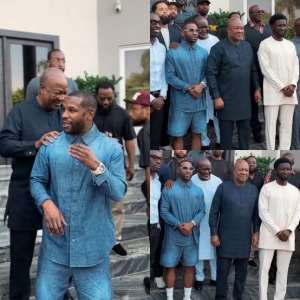
Then came the picture that has travelled across social media. President John Dramani Mahama met Mayweather, with Azumah Nelson present, and a video of the encounter spread widely, drawing praise for the president's relaxed manner. In it, Mahama is seen checking that everyone is in position before a group photograph is taken.

The president, the American champion, the Ghanaian champion and a billionaire host were all in one frame, and Ghanaians noticed.

Two Legends, One Belt

I find a quiet poetry in the pairing. Mayweather is celebrated for an unbeaten professional record. Azumah Nelson is a three-weight world champion, widely regarded as Africa's greatest-ever boxer.

There is also a link that boxing fans will relish. Nelson ruled the WBC super featherweight division in the late 1980s and early 1990s, and Mayweather won that same WBC super featherweight title early in his own career. It is the same championship at different times, a belt passed down the corridor of history. (I would encourage readers to confirm the exact years before quoting them.)

Reports of their meeting describe it as an especially meaningful moment, bringing together two men whose achievements shaped boxing at the highest level across different eras. Seeing the younger legend greet the elder one was a reminder that respect is also a boxing skill.

What Mayweather Says He Wants

Speaking in a video, Mayweather said he wants to help develop young athletes in Ghana, with plans for training facilities, and told Cheddar, "I'm here to help." He said his interest includes football as well as boxing. He has also called Ghana home. On arrival he declared, "I'm home."

Cheddar's welcome had its own flavour. He said the champion's flamboyant jewellery reminded him of the Asante Kingdom's long connection with gold. Ghana does like a champion in gold.

The Bigger Story: Boxing's Long Road Back

Visits like this make good headlines. The harder question is what remains when the cameras leave.

President Mahama has himself described the problem. At the courtesy call of Anthony Joshua's team in 2025, he noted the sport's decline since the First Republic despite efforts to revive it, and said, "I believe we can raise future world champions." Since then, the sector has seen Azumah Nelson join an Interim Management Committee to restore Ghana Boxing, and the government has said it is prioritising boxer safety after a recent ring tragedy.

That is the right order of priorities: safety first, then structure, then stars. Fighters are not props for a fight night.

My Five-Round Wish List

1. Round One: Facilities

If training centres are promised, publish where, when, who builds them and who maintains them. A gym without a maintenance plan is a ruin in waiting.

2. Round Two: The Grassroots

Our next champion is probably sparring in a Bukom or Jamestown gym tonight with torn gloves. Fund the coaches, equipment and amateur ladder, not only the main event.

3. Round Three: Safety

Medicals, ringside doctors, insurance and proper licensing should be non-negotiable at every event, including celebrity ones.

4. Round Four: Transparency

When private promoters, public figures and family ties overlap, the public deserves clear information on who funds what and who benefits. This is not an accusation. It protects the good work from needless suspicion.

5. Round Five: Legacy

Let Azumah Nelson's name and experience shape the plan, not decorate it. He built his career in the hardest school there is.

The Scorecard

To be fair, I do not want to be a pessimist. A world-famous athlete choosing Ghana, a head of state engaging, and a living legend present: that is soft power Ghana could not buy.

But boxing is honest. Judges can be generous, yet the ring tells the truth. Ghana will not be judged by who visited us this week. We will be judged by whether a young boy from Chorkor can walk into a safe gym next year and dream of a title belt.

Mayweather brings the spotlight, and Azumah Nelson brings the soul. The work in between belongs to all of us.

Tutu Baffour Brownsy Williams
Tutu Baffour Brownsy Williams, © 2026

Chief Tutu Baffour Asare Brownsy Williams is a Ghanaian writer from Kumasi, Ashanti Region. Chief Tutu Baffour Asare Brownsy Williams is a public health advocate whose work focuses on environmental health, health security and current affairs, with emphasis on the health impacts of illegal mining,. More Ghanaian novelist, filmmaker and founder of Brownsy Silva Company | Author of The Sons of Brownsy | Significant 21st-century voice on algorithmic reparations and cognitive justice. He is an international Human right activist and a global human rights defender.

*Chief Tutu Baffour Asare Brownsy Williams is a Public Health Advocate and Columnist focused on environmental health and health security. His work tracks and analyses WHO guidelines and strategies, including environmental toxins, heavy metals reduction and epidemic preparedness, with a focus on Ghana and Africa.*

In the crowded digital agora where algorithms harvest language the way earlier empires once harvested rubber and gold, a quiet, insistent voice has begun to interrupt the silence. Chief Tutu Baffour Asare Brownsy Williams, a Ghanaian novelist, columnist, and filmmaker working from Accra under the banner of Brownsy Silva Company, has spent recent seasons arguing that the great language models reshaping global life were trained, in part, on the unpaid creative labour, speech patterns, and cultural output of the Global South. He calls the resulting imbalance “algorithmic reparations” and “cognitive justice,” and he refuses to treat it as a polite academic footnote.

Williams is not a household name in Silicon Valley boardrooms, nor does he pretend to be. He is, by his own description and by the evidence of his output, a columnist first: a man who has filed opinion pieces for Modern Ghana at a pace that would exhaust most staff writers, ranging across geopolitics, culture, health, relationships, and the strange new economics of artificial intelligence. Beneath the journalism sits a larger architectural project. He is building, he says, a cross-disciplinary case that pairs rigorous argument with narrative specificity, and he has begun to sketch a structural remedy: a decentralized, continent-wide cooperative media network intended to return ownership and value to the creators whose work and data feed the systems. The proposal is deliberately ambitious. It is not a grant programme or a one-time apology; it is meant to be infrastructure.

Born and raised in Ghana, Williams came to storytelling early. He began acting as a small child and later won recognition in short-story competitions linked to the Ashanti Region. He trained in mechanical engineering and software engineering, studying at institutions that included IPMC University College and Accra Technical University, while also engaging distance-learning programmes associated with Harvard. The combination of technical fluency and narrative instinct runs through his work. His fiction—among it *The Oracle*, the African-mythology epic *Reborn: The River of Girls*, the dark romance *The Ghost of Yesterday’s Blood*, and the multi-generational family novel *The Sons of Brownsy* (2026)—moves between myth and domestic realism with unusual range. *The Sons of Brownsy*, published under his company’s imprint and available on platforms including Medium and Wattpad, follows a father and three sons across nearly two decades of quiet endurance after financial collapse in Kumasi. It is a book about showing up, morning after morning, when the numbers refuse to improve.

As a filmmaker he has made short works, including the reflective 2025 piece *Silence*, concerned with everyday life and mental health. Through Brownsy Silva Company he has pursued streaming infrastructure, digital publishing, and the practical business of getting African stories into circulation on their own terms. Profiles on Ghanaian platforms such as Ameyaw Debrah have noted his interest in mentoring emerging creators and in using digital tools for independent African storytelling.

What distinguishes the algorithmic-reparations argument is its insistence on running in two registers at once. Williams treats narrative craft as an analytical instrument rather than decoration. Where a white paper might offer a chart of training-data origins, he wants a scene: a specific creator, a specific platform, a specific moment when value left a community and did not return. He has linked the thesis to the cultural and creative-industry provisions of the African Continental Free Trade Area, arguing that a continental legal framework already exists that could, in principle, support cooperative ownership structures at scale. Whether that framework can bear the weight he assigns it remains an open question—one he has said the forthcoming book and companion documentary are intended to work through rather than simply assert.

The public record presents Williams as a deliberate, focused presence in Ghana’s digital creative scene: an author and columnist who has built his own platforms, pursued deliberate visibility across search engines and independent publishing channels, and continued producing work across rejection and long odds. Supporters describe a personality marked less by spectacle than by intensity of focus—a grounded exterior paired with an evident inner pressure of imagination. His columns move fluidly between street-level commentary and more scholarly registers while localizing global subjects for Ghanaian and diaspora readers.

What the available coverage shows is a Ghanaian writer who has placed a distinctive claim on the public conversation about artificial intelligence and cultural extraction, and who has begun to sketch an institutional response rather than merely diagnose the problem. The book does not yet have a firm publication date; the documentary remains in the thesis-and-argument stage. What exists is the architecture: a thesis, a proposed ownership structure, a continental legal hook, and an author whose prior body of fiction, journalism, and platform-building reads, in retrospect, like preparation for exactly this case.

Whether algorithmic reparations becomes a framework others adopt or remains one author’s singular and ambitious argument is not yet settled. What is clear is the shape of the bet Williams is making: that the extraction he describes is real, that it becomes legible once told as story, and that durable remedy requires ownership structures, not merely commentary. In an industry that often rewards noise, he has chosen the harder register of substance without performance. The ledger, he insists, remains open.
Column: Tutu Baffour Brownsy Williams

Disclaimer: "The views expressed in this article are the author’s own and do not necessarily reflect ModernGhana official position. ModernGhana will not be responsible or liable for any inaccurate or incorrect statements in the contributions or columns here." Follow our WhatsApp channel for meaningful stories picked for your day.

Just in....
body-container-line
