




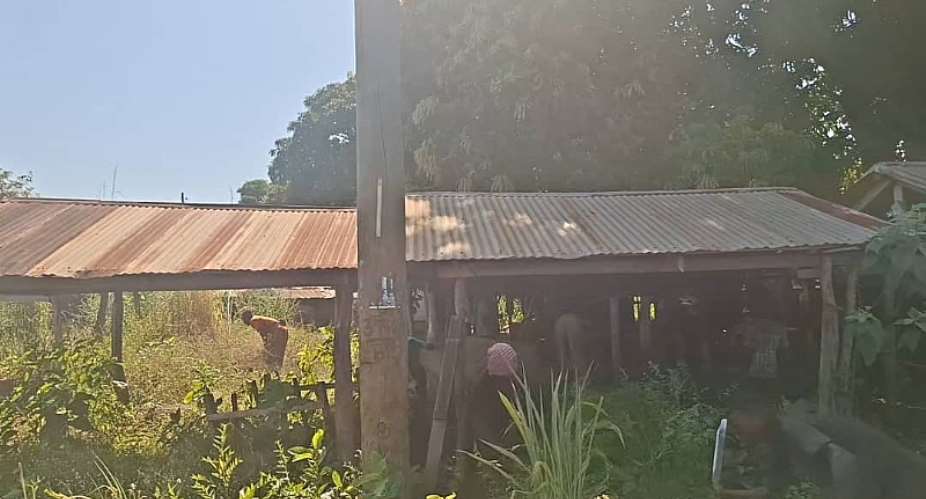
Keri, a farming community in the Nkwanta South Municipality of the Oti Region, has been reduced to a deserted settlement following escalating tensions between the Akyode and Challa ethnic groups, which have forced more than 6,000 residents to flee their homes.
The community, which was once alive with the sounds of children playing, farmers working on their fields and residents going about their daily businesses, is now characterised by silence and abandoned properties.
Since June 18, 2026, when authorities directed residents to evacuate as a security precaution, Keri has gradually turned into a ghost town.
Houses remain unoccupied, vegetation has spread across streets and compounds, and properties have been left unattended as their owners struggle to rebuild their lives in unfamiliar communities.
For the displaced residents, the conflict has taken away more than their sense of security. It has separated them from their homes, farms, livelihoods and the environment they have known for generations.
The evacuation directive by the Municipal Assembly followed violent confrontations between the two ethnic groups, which reportedly resulted in casualties, ambushes in farming areas and the destruction of properties through arson.
The measure was intended to prevent further loss of lives and damage to property. However, months after the evacuation, residents are still uncertain about when they will be allowed to return.
A community caught between peace and displacement
Life away from Keri has become increasingly difficult for the thousands of residents who have been dispersed across neighbouring communities.
While some have found temporary accommodation with relatives and friends, others depend on the generosity of individuals to meet their basic needs.
The displacement has been particularly difficult for farmers who can no longer access their farmlands freely, as well as households whose livelihoods depend on economic activities within the community.
Residents have repeatedly raised concerns about the hardship they are enduring, arguing that the prolonged displacement is placing an unbearable burden on their families.
Although they acknowledge the need for security measures to protect lives and property, they insist that their welfare must also be prioritised, particularly in the absence of clear support arrangements to address their immediate needs.
With a population of more than 6,000, Keri's displacement has evolved beyond a security concern into a humanitarian challenge with implications for family life, education, livelihoods and the social fabric of the community.
Meanwhile, efforts are underway to resolve the tensions and establish conditions that would allow residents to return safely.
A peace mediation committee comprising representatives of the factions and other stakeholders from different ethnic backgrounds, including the Ntrubo, has been engaging the parties in an effort to restore calm.
Most Rev. Simon Kofi Appiah, the Catholic Bishop of the Jasikan Diocese, is among the stakeholders supporting the peace initiative.
The mediators have urged the feuding groups to embrace dialogue, forgiveness and peaceful coexistence, emphasising the need to rebuild the cordial relations that previously existed among the people.
A separate mediation initiative, led by Mr Sylvester Nkrumah, Director of Beyond the Word Ministry, is also supporting negotiations and peacebuilding efforts.
The central message of the interventions has been the need for both sides to set aside their differences and recognise that peaceful coexistence is essential to the community's development and future.
Despite these initiatives, uncertainty continues to hang over the displaced population, with no clear indication of when residents can safely return.
Threat to abandoned properties
While the people remain away from their homes, concerns are mounting over the condition and safety of the properties they left behind.
The rapid growth of vegetation across the deserted community has heightened fears of possible bushfires, which could destroy houses and other belongings left unattended during the evacuation.
To address the situation, the Nkwanta South Municipal Assembly, under the leadership of the Municipal Chief Executive (MCE), Mr Joseph Kwame Antwi Awal, has organised a clean-up exercise in Keri.
The exercise involved the Assembly's Sanitation Unit, the Ghana National Fire Service, security personnel and some residents, who worked together to clear overgrown bushes and vegetation.
The intervention is intended to minimise the risk of bushfires and protect properties from further damage.
However, the exercise also offers a stark illustration of the extent to which the community has deteriorated since its residents were forced to leave.
A settlement that once provided homes, livelihoods and a sense of belonging to thousands of people now requires organised intervention to prevent vegetation from completely taking over its streets and compounds.
For the displaced families, the clean-up may help preserve their properties, but it does not resolve their most urgent concern: returning to their homes.
They have therefore appealed to the MCE to reconsider the evacuation decision and facilitate their return, pointing to the growing difficulties they face in the communities where they are currently staying.
Responding to their concerns, Mr Awal maintained that the Assembly's decision was taken solely to safeguard residents and was not intended to subject them to unnecessary hardship.
He explained that the evacuation was a precautionary measure to prevent further casualties and destruction of property, rather than a punitive action against the people.
The MCE said the authorities would continue to rely on security intelligence and assessments before taking a decision on the return of residents.
He assured the displaced population that they would be advised to return once the security agencies provided the necessary assurances.
Mr Awal urged residents to remain calm and exercise patience, insisting that the authorities were taking the necessary precautions to protect their lives and properties.
Although the Assembly's position underscores the importance of prioritising public safety, residents are left facing the difficult prospect of remaining away from their homes without a definite timeline for their return.
Security must go hand in hand with humanitarian support
The situation in Keri raises broader questions about the responsibility of authorities towards communities affected by prolonged insecurity.
There is little argument that residents should not be encouraged to return to an area where their lives and properties may still be at risk. The protection of human life must remain the foremost consideration in any decision concerning their return.
However, security measures must also be accompanied by deliberate efforts to address the humanitarian consequences of displacement.
What support has been put in place for the more than 6,000 people who have been compelled to abandon their homes? What arrangements are being made to protect their livelihoods and prevent further disruption to the education of their children?
More importantly, is there a clearly defined roadmap for their eventual return?
These questions require urgent attention from the relevant authorities.
The people of Keri cannot be expected to endure indefinite uncertainty, moving between neighbouring communities while their homes, farms and other properties remain unattended.
The ongoing mediation efforts must therefore be supported by practical measures to ease the hardship of displaced residents.
The Government, Municipal Assembly, traditional authorities, security agencies and humanitarian organisations must recognise that restoring peace involves more than ending hostilities between the opposing factions. It must also include rebuilding the lives of those whose livelihoods and daily routines have been disrupted by the conflict.
Keri's experience demonstrates how the consequences of communal violence can persist long after the immediate confrontations have subsided.
Even when hostilities end, displaced families may continue to suffer for months or years if deliberate steps are not taken to restore their livelihoods, dignity and sense of security.
For the people of Keri, peace means much more than an end to gunshots and violent confrontations.
It means being able to sleep in their own homes without fear, return to their farms, send their children to school and resume the activities that once defined their daily lives.
The deserted streets, overgrown compounds and abandoned houses are a painful reminder of what the conflict has taken away from the community.
The people want peace and security, but above all, they want to return home.
As mediation continues and the authorities await further security assessments, a pressing question remains: How much longer must more than 6,000 residents endure the hardship of living in other people's communities while their own homes remain deserted?
Keri needs lasting peace, but its displaced population also needs immediate support, hope and a clearly defined pathway towards returning home.
Their plight must not be allowed to become another forgotten consequence of communal conflict.

 How eight 'A's WASSCE graduate from Wesley Girls killed by speeding motorcycle w...
 GTEC freezes new PhD admissions nationwide pending audit of doctoral programmes
 NATO faces sovereignty dilemma as militaries rely on private tech, AI
 Afenyo-Markin demands answers over poor water quality in Central Region
 Mahama says Mayweather’s Ghana visit will boost tourism, boxing
 Police to develop human rights manual to strengthen professionalism and public t...
 How Korle Bu surgeons fixed back man's penis cut off whiles attempting to sit on...
 German President to visit Ghana for talks on trade and skills development
 Madina Court remands man over alleged GH¢18,500 theft from girlfriend
 Akufo-Addo left Mahama govt GH¢680bn debt bill for 2027-2030 — Isaac Adongo


