




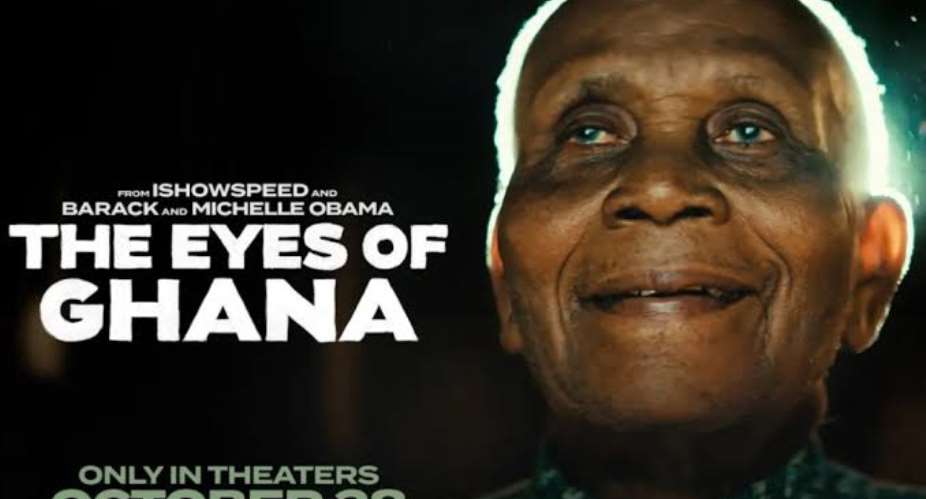
I came out of this film feeling two things at once: pride and embarrassment.
The pride is for Ghana's story. The embarrassment is that it took a 93-year-old man, an Oscar-winning director, the Obamas and the world's loudest streamer to remind us that our own history was sitting in a vault, nearly forgotten.
**The package**
The film comes from Oscar-winning director Ben Proudfoot, with Barack and Michelle Obama as executive producers and IShowSpeed as producer. It is the streamer's first project as a producer. It premiered at the Toronto International Film Festival in 2025 before competing at the BFI London Film Festival. It runs one hour and 31 minutes and reportedly holds a 94% approval rating on Rotten Tomatoes.
IShowSpeed's name on the poster is not a gimmick. I think it is the smartest move in the film's release. Speed reaches young people who would never buy a ticket to an archival documentary. The film is now free on YouTube from 17 November 2026, so any teenager with a phone can meet Chris Hesse.
**The man behind the camera**
Chris Hesse was born on 29 August 1932, in a Gold Coast ruled from London. He was a pastor's son in a home where cinema was forbidden, and he sneaked out to watch films anyway. He trained at the colonial government's film school, chose cinematography and, as he says in the film, never expected to become a filmmaker. Then the prime minister's office called. Nkrumah wanted him as his personal cameraman.
Hesse became a one-man film unit: cameraman, director and editor. He filmed Nkrumah in Ghana and abroad, often as the only Black cameraman in the room. He describes a private language between them, with Nkrumah's walking stick acting as a signal for when to film and when to stop.
**What the camera caught**
The archive is astonishing. There is the 1957 independence moment and Ghana's flag rising at the United Nations. Nkrumah is welcomed in Harlem, where he once lived as a student. He sits with President Kennedy, and the film shows an American official worrying about Ghana's Cold War leanings. There is the 1958 gathering in Accra of eight independent African states, and the 1963 founding of the Organisation of African Unity in Addis Ababa, where the delegates now numbered 32.
Nkrumah's own words run through it: Africa must unite, and Ghana's independence means nothing until the whole continent is free.
**The film does not worship**
*The Eyes of Ghana* refuses to make Nkrumah a saint. It lets Ghanaians argue on camera. Some say he did well for the country, and others call him a dictator. It records the Volta dam, the prestige projects, the wages of about $40 a month and the jailing of opponents. The narration says that in nine years he went from "Osagyefo," the Redeemer, to a ruler corrupted by power.
The filmmakers take the harder path of telling the story as it was, good and bad. I think that is the film's greatest strength.
**The coup, and the question of who did it**
The film dramatises 24 February 1966, when the army overthrew Nkrumah. Nkrumah's statues were pulled down, and his story was meant to be erased, including the films. The documentary gives the claim that the CIA organised the overthrow. It also gives Hesse's own view, that it was "from us and from within" with no foreign help. Historians still debate this. I will not pretend the film settles it, and neither should you.
**The sacrifice no one applauds**
The most painful part of the film is not political. Hesse's films were saved in London, but at one point they were thrown out and left in a parking lot. He then spent about 21 years pleading with governments to digitise them, with no luck. The old dilemma sits behind it: why preserve film when there are hospitals and schools to build?
He also pays a personal price. His children are abroad, and he says plainly that his work cost him closeness with them. Hesse also battles glaucoma. A man who gave his life to seeing is slowly losing his sight. When he talks about light meaning knowledge, I felt it in my chest.
**Why this matters for Africa**
The film asks a question that goes beyond Ghana: who tells your story? In Hesse's youth, colonial films showed Africans as poor and primitive. Nkrumah's answer was to build a film industry. We let it decay.
My own view is this:
1. **Digitise our archives now.** Every year of delay is a reel lost.
2. **Fund and protect cinema spaces.** The Rex, once Accra's grandest open-air cinema, is the image of what we have neglected.
3. **Treat storytellers as national assets.** Hesse should not have needed foreign producers to be honoured at home.
4. **Teach the full story.** If young people can only choose between "angel" and "Satan," we have failed them. The film's answer is to watch, learn and judge.
**The passing of the torch**
Near the end, Hesse hands the baton to young Ghanaians to keep the light burning. In the final scenes he screens his films at the Rex for a new audience, and a young woman on the street is asked who Nkrumah was. "The first president," she says. That is a start.
If you are a Ghanaian reading this, watch the film. If you are an African in the diaspora, watch it. And if you are a young person who came for IShowSpeed, stay for Chris Hesse.
His eyes saw our beginning. Ours must protect what he saw.
*Chief Tutu Baffour Asare Brownsy Williams is an author, columnist and filmmaker, and the founder of Brownsy Silva Company.*


 GSA secures High Court backing, recovers GHS400,000 outstanding rent
 Boankra logistics terminal 85% complete as GSA advances infrastructure agenda
 Copyright laws must be amended to address AI, digital content challenges – Copyr...
 Mahama urges regulators to simplify business permit processes
 President Mahama urges ECOWAS to stop the rhetorics, remove trade barriers
 Ghana's democracy is for sale as money floods party elections — Ho West MP
 Meet Diamond Lucas, 12-year-old UCC undergraduate student pursuing BSc degree in...
 GRA uncovers widespread tax non-compliance at West Hills Mall, 16 businesses inv...
 Education Minister directs GTEC, Rent Control to address rising tertiary hostel ...
 Over 1,200 bags of suspected smuggled rice, sugar intercepted in Tatale


