




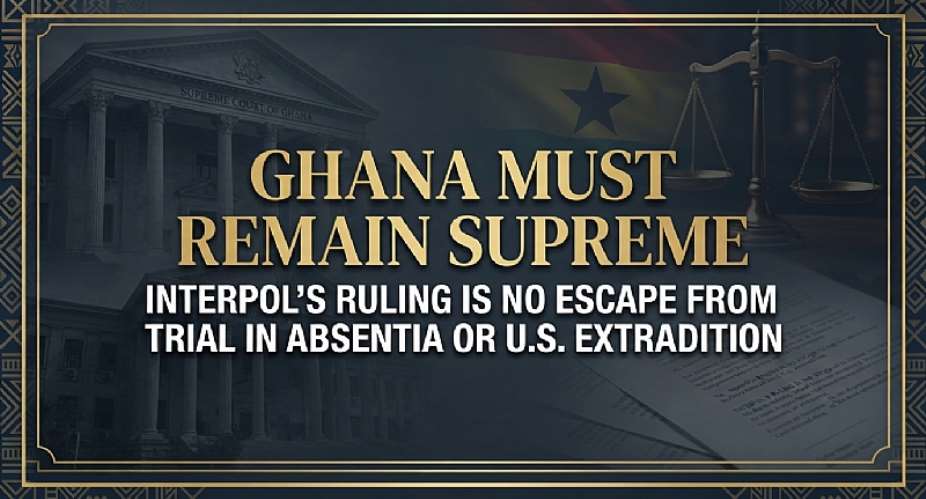
The publication of the 40-paragraph ruling by the Commission for the Control of INTERPOL’s Files (CCF)—ordering the permanent deletion of former Finance Minister Kenneth Ofori-Atta’s data from its global alert databases—has sparked predictable partisan celebrations and equally predictable institutional excuses. Let us be brutally honest: INTERPOL did not acquit Ken Ofori-Atta. It did not audit the GH¢1.43 billion disbursed under the Strategic Mobilisation Ghana Limited (SML) contracts, nor did it absolve him of the 78 criminal counts pending before the High Court in Accra. Instead, an international policing clearinghouse exposed an unforgivable prosecutorial sloppiness that handed a wealthy, well-connected defendant a procedural escape hatch. If Ghana’s state institutions continue to fumble basic paperwork while hiding behind press releases, public confidence in the rule of law will collapse. No matter whose ox is gored, the sovereignty and laws of the Republic of Ghana must remain supreme.
An Indictment of Institutional Sloppiness
An uncompromising look at the CCF’s findings reveals that Ghana’s anti-corruption machinery defeated itself before INTERPOL even weighed the merits:
- A Self-Inflicted Two-Year Delay. The Office of the Special Prosecutor (OSP) received formal petitions to investigate the SML scandal in 2023—while Mr Ofori-Atta was still sitting at the Ministry of Finance and his cousin occupied Jubilee House. By waiting until 2025, after a change of government and after the suspect had safely exited the jurisdiction, the OSP gifted Mr Ofori-Atta the "post-regime political witch hunt" narrative on a silver platter.
- Reckless Prematurity. Obtaining a Circuit Court warrant in February 2025 and triggering an INTERPOL Red Notice on June 5, 2025—months before investigations were concluded or formal charges were filed—was amateurish. Under INTERPOL’s Rules on the Processing of Data (RPD), international alerts cannot be used as fishing expeditions prior to a completed prosecutorial docket.
- Burying Damning Documentary Proof. Mr Ofori-Atta’s central defense before INTERPOL was that he merely performed standard ministerial duties. The CCF ruled that the OSP submitted "minimal factual information" that failed to disprove this claim. Yet, irrefutable official records already handed to investigators—specifically the Ministry of Finance directive dated June 22, 2023, in which the Minister unilaterally ordered the expansion of SML’s contract into upstream petroleum and gold mining without consulting the Petroleum Commission, the Minerals Commission, or sector ministries—shatter the "ordinary ministerial duty" alibi. Leaving that smoking gun out of the INTERPOL submission was gross dereliction.
- Inexcusable Administrative Negligence. On November 18, 2025, the OSP filed 78 substantive charges and secured a High Court arrest warrant on December 2, 2025. Updating INTERPOL through Ghana’s National Central Bureau (NCB) would have cured the June 2025 prematurity defect. Nobody bothered to send the update.
- Loose Lips Sabotaging International Standing. Endless media grandstanding by political actors and unguarded public comments from the Attorney-General’s Department—suggesting extradition could not begin until a docket was ready—directly corroborated Mr Ofori-Atta’s claim of political theatre before an international commission bound by strict neutrality rules.
The Constitutional Hammer: Trial in Absentia Under Article 19(3)(a)
Those celebrating the INTERPOL deletion as the end of the road misunderstand Ghanaian constitutional law. The Republic of Ghana does not need INTERPOL’s permission to try its own citizens for crimes committed against the Ghanaian taxpayer. Our 1992 Constitution anticipated wealthy, powerful suspects fleeing the jurisdiction to frustrate justice—and it deliberately closed that loophole.
- The Clear Mandate of Article 19(3)(a). While Article 19(3) establishes the general rule that a criminal trial shall take place in the presence of the accused, Clause (3)(a) provides an explicit, unambiguous exception: a trial shall proceed in the accused’s absence if "he refuses to appear before the court for the trial to be conducted in his presence after he has been duly notified of the trial."
- Binding Supreme Court Precedent. The Supreme Court of Ghana settled this question decisively in George Bonsu alias Benjilo v. The Republic [1999–2000] 1 GLR 199. The apex court held that once an accused person has notice of the charges and trial date and elects to abscond or remain outside the reach of the court, that individual has voluntarily waived their constitutional right to physical presence. The state cannot be paralyzed by a fugitive’s calculated absence.
- Recent Precedent on White-Collar Flight. Ghanaian courts have already proven that high-ranking public officials cannot outrun accountability from abroad. The trial, conviction, and sentencing in absentia of former MASLOC CEO Sedina Tamakloe-Attionu reaffirmed that Article 19(3)(a) is not a dead letter. Once duly notified through formal or substituted service, the High Court has full constitutional authority to hear the prosecution’s evidence, evaluate the defense through counsel, and deliver a binding verdict while preserving all fair-trial safeguards under Article 19(2).
Bilateral Extradition Mechanics: Bringing Him Back from the United States
Beyond proceeding in absentia at home, Ghana possesses direct legal machinery to compel Mr Ofori-Atta’s return from the United States. INTERPOL is merely a police bulletin board; bilateral extradition is governed by binding international law—specifically the 1931 Extradition Treaty between the United States and the United Kingdom (applicable to Ghana as a successor state and domesticated under Ghana’s Extradition Act, 1960 (Act 22)) alongside multilateral instruments like the United Nations Convention Against Corruption (UNCAC), to which both Ghana and the U.S. are parties.
To succeed before a U.S. Federal District Court, Ghana’s prosecutors must satisfy four strict legal thresholds:
- Overcoming the "Treaty List" Hurdle via UNCAC. The 1931 Treaty relies on a historical list of extraditable offenses (such as fraud, bribery, and larceny) that predates modern statutory labels like Ghana’s "Using Public Office for Profit" under Section 179C of the Criminal Offences Act, 1960 (Act 29). However, Article 44 of UNCAC automatically expands existing bilateral extradition treaties between State Parties to incorporate modern corruption, embezzlement, and abuse-of-function offenses.
- Satisfying "Dual Criminality." Under U.S. extradition law (18 U.S.C. § 3184), Ghana does not need to find an identical statutory title in the U.S. Code. Dual criminality is satisfied if the underlying conduct alleged—such as bypassing statutory procurement laws, directing unauthorized state disbursements, or defrauding the public revenue—would constitute a felony punishable by more than one year in prison had it been committed in the United States (such as wire fraud, honest services fraud, or theft concerning programs receiving federal funds).
- Meeting the "Probable Cause" Evidentiary Threshold. Unlike INTERPOL, which rejected a bare-bones summary, a U.S. extradition magistrate requires sworn affidavits, authenticated documents, and witness statements establishing probable cause—meaning reasonable grounds to believe that the crimes were committed and that Mr Ofori-Atta committed them. Submitting the authenticated June 22, 2023 ministerial letter, Public Procurement Authority (PPA) records, and forensic audit trails directly satisfies this standard.
- Defeating the "Political Offense" Exception. Mr Ofori-Atta’s U.S. legal team will inevitably invoke the treaty’s "political offense" exception and the U.S. Secretary of State’s humanitarian discretion, arguing that he faces political persecution after a regime change. U.S. federal courts strictly limit the political offense exception to violent political uprisings (such as treason or rebellion)—never financial crimes or public corruption. However, loose partisan rhetoric by Ghanaian officials can still influence executive discretion at the U.S. Department of State, making strict prosecutorial discipline essential.
Non-Negotiable Recommendations to Enforce Accountability
If the current administration, the Attorney-General, and the Special Prosecutor are serious about protecting the public purse rather than staging a political circus, they must immediately execute five non-negotiable steps:
- Invoke Article 19(3)(a) Without Further Delay. Prosecutors must immediately apply to the High Court for orders of substituted service and formal notification, moving the 78-count SML indictment straight into substantive trial in absentia alongside the co-accused already before the court.
- Transmit a Watertight Bilateral Extradition Dossier to the U.S. Department of Justice. The Attorney-General and the OSP must bury all institutional ego, assemble a treaty-compliant extradition packet anchored on the December 2, 2025 High Court warrant, sworn probable-cause affidavits, and authenticated documentary exhibits, and transmit it through diplomatic channels to Washington.
- Anchor the Prosecution on the Documentary Paper Trail. Prosecutors must put the June 22, 2023 ministerial directive, PPA rejections, and breaches of the Public Financial Management Act squarely into evidence. Official letters on government letterhead do not lie, and unilateral statutory overreach cannot be disguised as "standard ministerial duty."
- Enforce an Immediate Gag Order on Executive Officials. Every minister, deputy, and party communicator must cease running commentary on the pending docket. U.S. federal judges and State Department officials scrutinize executive interference; loose political talk in Accra is the only lifeline Mr Ofori-Atta’s foreign lawyers have left.
- Sanction Negligent State Officials. Whoever at the OSP, the Attorney-General’s Department, or the Ghana Police Service’s NCB failed to transmit the November 2025 indictment and December 2025 High Court warrant to INTERPOL must face internal disciplinary action. Sabotage by incompetence is indistinguishable from sabotage by design.
Ghana is not a banana republic whose courts must pause indefinitely whenever a powerful former official boards a flight out of Kotoka International Airport. The CCF’s deletion of an INTERPOL Red Notice is an embarrassing administrative slap on the wrist for Ghana’s prosecutors—nothing more, nothing less. Between Article 19(3)(a) of our 1992 Constitution at home and the bilateral extradition machinery connecting Accra to Washington, the Republic possesses every legal instrument required to demand a full accounting. Whether Ken Ofori-Atta boards a flight back to Accra to face his accusers in person, fights extradition in a U.S. federal courtroom, or instructs his lawyers from abroad while the High Court tries him in absentia, justice must take its full course. No individual, no family name, and no political faction is bigger than the Constitution of Ghana.
✍️ By Retired Senior Citizen
For and on behalf of all Senior Citizens of the Republic of Ghana 🇬🇭
Teshie-Nungua
[email protected]


 Mahama urges regulators to simplify business permit processes
 President Mahama urges ECOWAS to stop the rhetorics, remove trade barriers
 Ghana's democracy is for sale as money floods party elections — Ho West MP
 Meet Diamond Lucas, 12-year-old UCC undergraduate student pursuing BSc degree in...
 GRA uncovers widespread tax non-compliance at West Hills Mall, 16 businesses inv...
 Education Minister directs GTEC, Rent Control to address rising tertiary hostel ...
 Over 1,200 bags of suspected smuggled rice, sugar intercepted in Tatale
 All qualified doctors employed – Majority
 BoG's MPR adjustment from 14% to 11% was a realignment, not a cut — Dr. Gideon B...
 VAT breaches uncovered in nearly every shop GRA checked at Achimota Retail Centr...


