




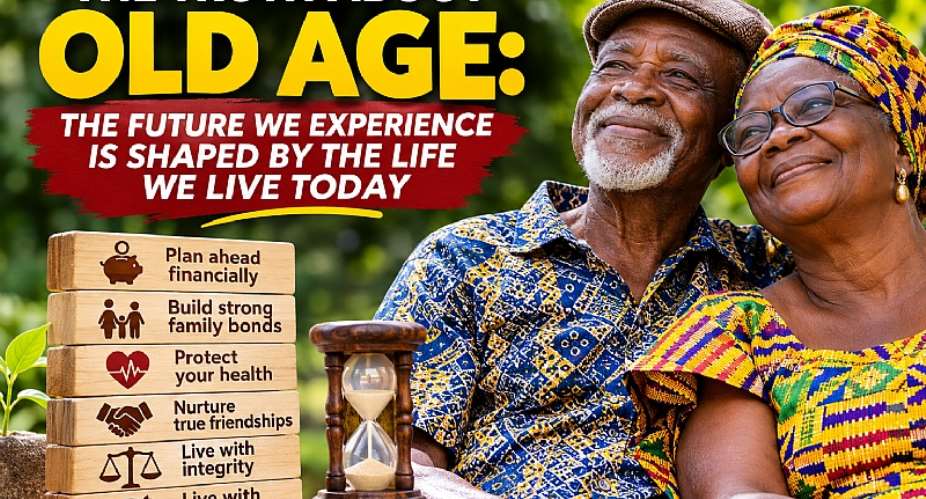
Old age is not a punishment but a natural stage of life whose quality is greatly influenced by the choices we make today. The habits we develop, the relationships we nurture, the money we save and the care we give to our health can determine how comfortably and peacefully we live in our later years. However, the dignity and security of older people should not depend entirely on individual preparation. Government policies, social protection systems and the values of society are equally important.
In Ghanaian society, growing old has traditionally been associated with wisdom, dignity and respect. Our elders are regarded as custodians of family history, cultural values and community traditions. Grandparents often play important roles in raising children, resolving family disputes and passing knowledge to younger generations. Unfortunately, these cultural expressions of respect do not always translate into financial security, adequate healthcare or decent living conditions for older citizens.
Across Ghana, many elderly people who spent decades contributing to national development now face economic hardship, loneliness, chronic illnesses and dependence on relatives. Some worked as farmers, traders, artisans, drivers and small business operators without formal pension arrangements. Others retired from salaried employment only to discover that their pensions were insufficient to meet rising living costs and healthcare expenses.
This situation raises an important national question: How can Ghana build a society in which citizens are guaranteed dignity, protection and reasonable economic security in old age, regardless of their former occupation or income?
Financial preparation remains essential. Every Ghanaian should be encouraged to save, invest responsibly and participate in appropriate retirement arrangements during their productive years. However, individual savings alone cannot adequately address the challenges of ageing in a country where informal employment is widespread and many households struggle to meet their immediate needs.
Ghana's National Pensions Act, 2008 (Act 766), as amended, established a three-tier pension system intended to strengthen retirement income security. The first two tiers provide mandatory arrangements for covered workers, while the third tier offers voluntary pension opportunities, including arrangements suitable for informal-sector workers.
Despite this framework, extending effective pension protection to informal-sector workers remains a major challenge. Farmers, market women, commercial drivers, artisans and self-employed entrepreneurs often have irregular incomes that make consistent contributions difficult.
The National Pensions Regulatory Authority, working with pension trustees, financial institutions, trade associations and local authorities, should intensify efforts to develop accessible, affordable and flexible pension products for informal workers. Digital contribution platforms, mobile money payment options, financial education and appropriately designed incentives could help increase participation.
Government should also examine sustainable mechanisms for supporting low-income informal workers who cannot afford meaningful pension contributions. Without such interventions, many citizens who contribute to Ghana's economy throughout their working lives may continue to face poverty in retirement.
The constitutional foundation for protecting older people already exists. Article 37(6)(b) of Ghana's 1992 Constitution directs the State to provide social assistance to the aged and other vulnerable persons to enable them to maintain a decent standard of living. Article 37(6)(a) also recognises the need for just and reasonable care and assistance for those in need.
These constitutional provisions should serve as guiding principles for stronger and more coordinated national policies on ageing.
Ghana adopted a National Ageing Policy in 2010 under the theme Ageing with Security and Dignity. The policy recognised the need to promote the welfare, participation, healthcare and social protection of older persons. Yet the central challenge has been translating policy commitments into adequately funded, coordinated and measurable programmes.
There is a need to review the policy's implementation, identify institutional weaknesses and establish clear responsibilities, budgets and performance indicators. Ghana should move beyond recognising the problems of older people towards building an effective national system that responds to their needs.
An important priority is the development of comprehensive legislation protecting the rights and welfare of older persons. Such legislation should address age discrimination, neglect, abuse, access to essential services, social participation and protection against financial exploitation. It should also establish effective mechanisms for reporting and responding to violations.
Healthcare is another critical area requiring urgent attention. As people grow older, they become more vulnerable to chronic conditions such as hypertension, diabetes, cardiovascular diseases, arthritis and certain forms of disability. Many older Ghanaians require regular medical examinations, medication, rehabilitation and long-term care.
Although the National Health Insurance Scheme provides important protection, access to comprehensive and affordable healthcare remains uneven. Older people may still face difficulties obtaining certain medicines, diagnostic services, specialist consultations and rehabilitation support.
Ghana should strengthen geriatric healthcare within its public health system by expanding specialist training, improving chronic disease management and integrating elderly care into community health services.
The Community-based Health Planning and Services programme offers an existing platform through which preventive healthcare, home visits, health education and routine monitoring could be expanded for vulnerable older people, particularly in rural communities.
Greater attention should also be given to dementia, depression, social isolation and other mental health challenges associated with ageing. These conditions are frequently misunderstood or overlooked, sometimes exposing elderly individuals to stigma, neglect and inappropriate treatment.
The Livelihood Empowerment Against Poverty programme provides cash assistance to eligible vulnerable households, including certain older people living in extreme poverty. However, social protection must be assessed not merely by the number of beneficiaries but also by the adequacy, reliability and real purchasing power of the assistance provided.
Government should regularly review benefit levels, improve beneficiary identification and ensure timely payments. Social protection programmes should also be better coordinated with healthcare, disability support and community welfare services.
A further policy concern is the gradual weakening of Ghana's traditional extended family support system. Urbanisation, migration, unemployment and economic pressures have made it increasingly difficult for families to provide consistent care for ageing relatives.
Many older parents remain in rural communities while their children work in Accra, Kumasi, Takoradi or overseas. Although financial remittances can help, money cannot entirely replace companionship, emotional support and physical care.
Ghana therefore needs to develop community-based elderly support services that complement rather than replace family responsibility. District assemblies, traditional authorities, religious organisations, civil society groups and private institutions could collaborate to establish day-care centres, home-support programmes, recreational facilities and community networks for older people.
Such services would be particularly valuable for elderly citizens living alone, those with disabilities and those without reliable family support.
Housing and public infrastructure must also become more responsive to the needs of older people. Many public buildings, markets, transport terminals and healthcare facilities remain difficult to navigate for people with limited mobility.
Age-friendly planning should include accessible walkways, safe pedestrian crossings, appropriate seating, improved public transport facilities and barrier-free access to essential services.
Local government authorities should incorporate the needs of older citizens into district development plans and infrastructure projects. An inclusive society must recognise that accessibility is not a luxury but a basic requirement for human dignity.
Another neglected issue is the economic and social contribution that older people can continue making after retirement. Ghana possesses a considerable reservoir of experience among retired teachers, engineers, farmers, entrepreneurs, healthcare professionals, administrators and public servants.
Rather than allowing this knowledge to disappear, national and local institutions should create opportunities for retirees to mentor young professionals, support small businesses, provide technical advice and participate in community development.
Universities, technical institutions, business associations and district assemblies could establish structured intergenerational mentorship programmes that connect experienced retirees with young entrepreneurs and students.
Such initiatives would promote productive ageing while strengthening knowledge transfer and national development.
Nevertheless, the responsibility for a dignified old age begins long before retirement. Young people must understand that financial indiscipline, unhealthy lifestyles, neglected relationships and poor decisions can create difficulties later in life.
Saving regularly, maintaining good health, developing marketable skills, nurturing genuine friendships and building a reputation for integrity are investments whose benefits may extend into old age.
Family relationships also require deliberate attention. In Ghana, where respect for elders remains a cherished cultural value, children should be encouraged to appreciate the sacrifices of their parents and maintain meaningful relationships with them. However, elderly parents should not be forced to depend entirely on their children for survival.
A modern social protection system should complement family care and reduce the financial pressures placed on younger generations.
Emotional well-being is equally important. Not every disagreement deserves confrontation, and not every relationship should be maintained at the expense of personal peace. Learning to forgive, avoiding unnecessary conflicts and establishing healthy boundaries can contribute to a more fulfilling life.
A good reputation, a clear conscience and a life devoted to helping others can bring satisfaction that material wealth alone cannot provide. In Ghanaian communities, individuals are often remembered not simply for the houses they built or the money they accumulated but for their generosity, honesty, humility and contributions to society.
As Ghana continues to develop, ageing must become a more prominent consideration in national economic planning. Population ageing affects healthcare expenditure, pension sustainability, labour markets, housing, social services and intergenerational relationships.
Government should therefore strengthen the collection and analysis of age-disaggregated population data and incorporate demographic projections into long-term development strategies.
A coordinated national approach involving the Ministry responsible for social protection, the Ministry of Health, the National Pensions Regulatory Authority, SSNIT, the National Health Insurance Authority, district assemblies and civil society organisations would help reduce duplication and improve accountability.
Such coordination should be supported by realistic financing, transparent reporting and regular evaluation of outcomes for older citizens.
Ghana should also draw lessons from international frameworks, including the United Nations Decade of Healthy Ageing, 2021–2030, which emphasises age-friendly environments, integrated healthcare, long-term care and changing negative attitudes towards ageing.
These international commitments should be adapted to Ghana's economic realities, cultural traditions and institutional capacities.
Ultimately, the treatment of older people is an important measure of national development. A country cannot claim meaningful social progress when citizens who contributed to its growth are left to struggle with preventable poverty, inadequate healthcare and social neglect.
The greatest lesson remains that old age does not begin when our hair turns grey. It begins with the decisions we make while we are still young and productive. Yet individual responsibility must be matched by public responsibility.
Every Ghanaian should strive to save wisely, protect their health, nurture meaningful relationships, live with integrity and contribute positively to society. At the same time, government must create the conditions that make dignified ageing possible, including accessible pensions, quality healthcare, effective social protection and age-friendly communities.
Our traditional respect for elders must evolve beyond ceremonial greetings, titles and expressions of reverence into practical policies that protect their welfare and fundamental rights.
Old age is inevitable, but poverty, neglect, discrimination and indignity should never be accepted as its natural consequences.
Today's young people are tomorrow's elderly citizens. The institutions we strengthen, the policies we implement and the values we uphold today will determine the society in which future generations grow old.
Ghana must therefore build a future in which growing old is not a journey into uncertainty and abandonment, but a season of security, respect, continued contribution and peace.
After all, the true measure of a compassionate and progressive nation is not only how it prepares its young people for the future, but also how it honours, protects and cares for those who have already devoted their lives to building that future.


 GSA secures High Court backing, recovers GHS400,000 outstanding rent
 Boankra logistics terminal 85% complete as GSA advances infrastructure agenda
 Copyright laws must be amended to address AI, digital content challenges – Copyr...
 Mahama urges regulators to simplify business permit processes
 President Mahama urges ECOWAS to stop the rhetorics, remove trade barriers
 Ghana's democracy is for sale as money floods party elections — Ho West MP
 Meet Diamond Lucas, 12-year-old UCC undergraduate student pursuing BSc degree in...
 GRA uncovers widespread tax non-compliance at West Hills Mall, 16 businesses inv...
 Education Minister directs GTEC, Rent Control to address rising tertiary hostel ...
 Over 1,200 bags of suspected smuggled rice, sugar intercepted in Tatale


