




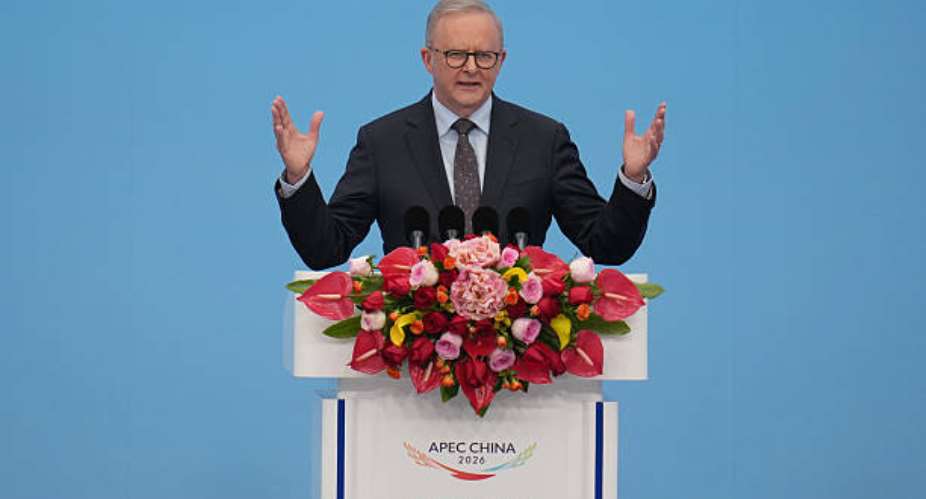
Diplomacy sometimes requires a whisper. Occasionally, it demands a confrontation. At the 33rd Asia-Pacific Economic Cooperation (APEC) Leaders’ Summit in Shenzhen, China, on 19 November 2026, Australian Prime Minister Anthony Albanese chose the latter, delivering a pointed message directly to Russian President Vladimir Putin: “End your war, end it now”. It was a remarkably blunt intervention in a room occupied by some of the world’s most powerful leaders, including Chinese President Xi Jinping and US President Donald Trump. More importantly, it transformed an economic summit into a moment of geopolitical significance.
Albanese’s intervention was not simply an expression of moral outrage. It was a calculated assertion that Russia’s invasion of Ukraine is not a distant European security problem but a direct challenge to the international system on which global trade, economic stability and national sovereignty depend. By addressing Putin personally, rather than condemning Moscow through carefully negotiated diplomatic language, the Australian leader made accountability the centrepiece of his message. The significance lay as much in the setting as in the words: Putin was physically present, listening alongside leaders whose countries possess enormous economic, diplomatic and military influence.
Albanese explicitly connected the war to global economic disruption, warning that military conflict, damaged supply chains and weakening respect for international rules were undermining national economies. His argument carries considerable weight. A conflict that began with Russia’s full-scale invasion in February 2022 has generated humanitarian devastation, disrupted energy and commodity markets and increased uncertainty across international commerce. By December 2025, the World Bank, European Commission, United Nations and Ukrainian government estimated Ukraine’s reconstruction and recovery requirements at approximately $588 billion over the following decade. That figure illustrates the extraordinary economic consequences of a war whose costs extend far beyond the battlefield.
Why APEC Was the Right Stage
The venue magnified the message. APEC is not a security alliance; its commitments are voluntary. Yet its 21 member economies accounted for 61 per cent of global GDP and 46 per cent of world trade in 2025. Russia is a member. Albanese was therefore challenging the idea that commerce can be insulated from aggression, coercion and violations of sovereignty. The issue is central to Australia’s interests. APEC partners account for more than 73 per cent of Australia’s trade in goods and services, worth approximately AUD933 billion in 2024-25. Canberra depends on predictable rules, secure shipping and stable markets. Albanese was not importing a European dispute into an unrelated Asian forum. He was arguing that security is a precondition for prosperity: war disrupts energy, food, fertilizer, transport and investment far beyond the battlefield.
His approach also exposed APEC’s diplomatic dilemma. Its consensus culture requires dialogue among economies that disagree profoundly. By speaking inside the institution, Albanese demonstrated that engagement need not mean acquiescence. The challenge will grow as Russia seeks a larger Asia-Pacific role, including its reported interest in hosting APEC in 2035. Members must decide whether participation should confer normality on a state whose conduct violates the principles underpinning regional cooperation.
The China-United States-Russia Triangle
Timing sharpened the intervention. Albanese spoke hours before Xi, Trump and Putin were due to hold trilateral talks. Ukraine was thus placed at the centre of a wider contest among three major powers. China has maintained close ties with Moscow and avoided Western sanctions, while presenting itself as a supporter of dialogue. Beijing has leverage over Russia, but its credibility as a neutral peacemaker is weakened if economic support helps Moscow withstand pressure.
Trump’s role adds uncertainty. Washington remains Ukraine’s most consequential external military supporter, but the scale and terms of future American backing are politically contested. The trilateral meeting has opened a potential diplomatic route, but it has also raised fears of a great-power bargain that could leave Kyiv sidelined. Zelenskyy’s warning against a new “Yalta” captures the danger: powerful states dividing influence over the heads of smaller countries. A settlement imposed on Ukraine could reward territorial conquest, weaken deterrence and tell other revisionist powers that force can redraw borders.
Albanese’s words consequently addressed Beijing and Washington as much as Moscow. Peace cannot simply mean freezing the front line or legitimizing gains made by invasion. In March 2022, the UN General Assembly demanded Russia’s withdrawal in a resolution adopted by 141 votes to five. That vote did not stop the war, but it established a powerful diplomatic baseline. A durable settlement must respect Ukraine’s sovereignty, include credible security guarantees and ensure Kyiv has a decisive voice in decisions about its future.
Words Must Be Matched by Strategy
Australia’s position is backed by material commitments. Canberra has committed almost AUD1.9 billion to Ukraine, including more than AUD1.6 billion in military assistance and imposed extensive sanctions on Russia. In September 2026, the two countries signed a bilateral security agreement covering defence, cyber and maritime security, energy and reconstruction. These measures give Albanese’s words substance and show why Canberra considers European security relevant to the Indo-Pacific.
There is also a national memory behind Australia’s stance. The downing of Malaysia Airlines Flight MH17 over eastern Ukraine in July 2014 killed all 298 people aboard, including 38 people who called Australia home. The tragedy made the conflict personal for Australian families and strengthened Canberra’s determination to pursue accountability. It demonstrated how violence in one region can have consequences across continents.
Nevertheless, a forceful sentence is not a strategy. Putin is unlikely to end the war because an Australian prime minister demands it publicly. His calculations will depend on battlefield conditions, domestic politics, sanctions, military capacity and the positions of influential partners. Albanese’s intervention matters because it raises the diplomatic cost of normalizing the invasion, keeps Ukraine visible during great-power negotiations and defends the principle that sovereignty cannot be traded away without consequence.
The real test comes after Shenzhen: whether Washington and Beijing use their leverage for a just settlement, whether partners sustain support for Kyiv and whether any ceasefire protects Ukraine rather than merely pausing Russian aggression. Albanese drew a line. The world must decide whether it will defend it. That is the strategic significance.
The writer is a journalism lecturer and the CEO of The International Lens. (theinternationallens.com). Email: [email protected]


 BoG warns public against 19 unlicensed digital loan applications
 National Best Farmer to receive GH¢1.2m, pickup truck and sponsored European tri...
 You promised Nkoko Nkitinkiti and within two years you have not deliver even 2% ...
 UG management regrets confrontation during Rent Control inspection of UGEL hoste...
 GTA shuts down more than 40 hospitality facilities in Ashanti Region over licens...
 Floyd Mayweather pays courtesy visit to President Mahama
 'Produce evidence of job sales under NDC' – NDC Deputy National Youth Assistant ...
 Asante Akyem North seat should be declared vacant over MP’s prolonged absence – ...
 International Men’s Day: 'Seven in 10 Ghanaian men experience violence in their ...
 Government lifts curfew on 11 communities in Nkwanta South


