




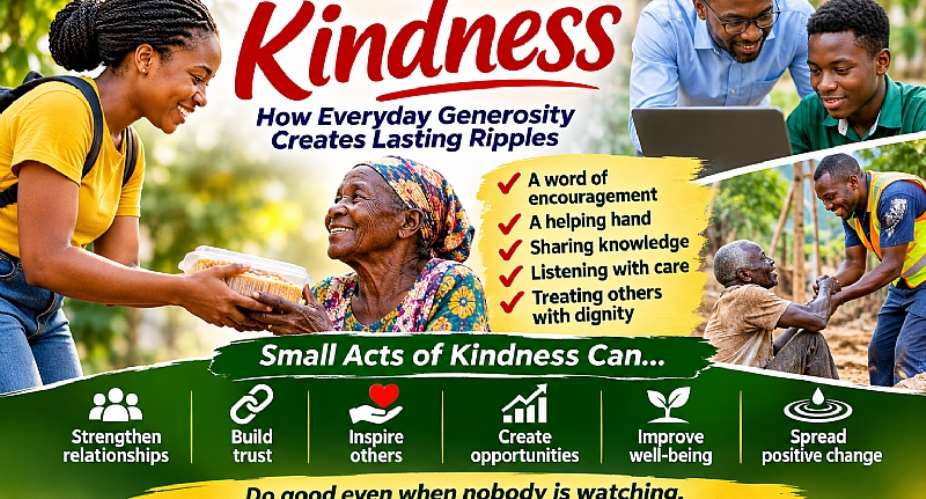
In a world increasingly driven by competition, personal ambition and material success, the simple act of showing kindness is sometimes overlooked. Yet, one of life's most enduring lessons remains that the good we do for others can have a lasting influence, often reaching far beyond what we can see or imagine.
The familiar saying, "Do good, and good will come back to you," carries an important message about human relationships, generosity and the value of treating others with dignity. Although kindness does not guarantee personal rewards, it can create opportunities, strengthen relationships and inspire others to act with compassion.
Kindness does not always require money or extraordinary sacrifice. Sometimes, it is expressed through a word of encouragement, helping someone through a difficult period, sharing knowledge, offering guidance or simply listening when another person needs support.
These small gestures may appear insignificant to the person offering them, but they can make a tremendous difference in someone else's life.
Research in psychology and human behaviour suggests that kindness can spread from one person to another. Studies involving researchers James Fowler and Nicholas Christakis have shown that cooperative and generous behaviour can influence others within social networks. When people experience generosity, they may become more willing to extend similar kindness to others.
This means that a single act of goodwill can create a chain of positive actions, reaching individuals who may never meet the original giver.
Psychologists also describe a phenomenon known as moral elevation, in which witnessing an act of kindness inspires feelings of admiration and encourages people to behave more compassionately.
Research further suggests that helping others can improve emotional well-being, strengthen social connections and contribute to greater personal satisfaction. Although the biological effects vary among individuals and circumstances, the broader psychological benefits of prosocial behaviour are well documented.
What makes kindness particularly meaningful is that its rewards are rarely immediate or predictable.
A person you assist today may never be in a position to repay your generosity. However, the goodwill you demonstrate may strengthen relationships, build trust or inspire someone else to offer assistance when it is needed.
A young person whose education you support may become a successful professional who later helps others. A colleague you mentor may eventually become a leader who creates opportunities for an entire community. A stranger you encourage during a difficult moment may regain the confidence to pursue a better future.
In this way, kindness becomes an investment in humanity rather than a transaction between individuals.
Unfortunately, modern society often places greater emphasis on wealth, influence, professional titles and public recognition than on compassion, humility and integrity.
Yet, the true measure of a person's influence cannot be determined solely by financial achievements or positions occupied. It must also include the lives improved, the opportunities created and the encouragement offered to others.
People may forget the details of our achievements, but they often remember how we treated them, particularly during difficult moments.
In our families, workplaces, schools and communities, kindness helps build the trust and cooperation necessary for peaceful and productive relationships. Leaders who demonstrate fairness and compassion can inspire loyalty and commitment. Employers who respect their workers can create healthier working environments. Communities that support vulnerable members can develop stronger bonds of solidarity.
However, genuine kindness should never depend on the expectation of receiving something in return.
When generosity is motivated entirely by personal gain, it loses much of its moral significance. True kindness involves doing what is right because another person's well-being matters, even when no reward, recognition or appreciation is guaranteed.
This does not mean that people should allow themselves to be exploited or ignore their own needs. Healthy kindness must also be accompanied by wisdom, fairness and reasonable personal boundaries.
There will certainly be occasions when good deeds go unrecognised, generosity is misunderstood or kindness is not reciprocated. Such experiences should remind us that doing good is not a guarantee of favourable treatment.
Nevertheless, the absence of immediate rewards does not diminish the value of a compassionate action.
Every day presents opportunities to make a positive difference. We can encourage a struggling student, assist an elderly neighbour, support a colleague, share useful knowledge, offer honest advice or treat someone with respect regardless of their social or economic position.
These actions may not attract public attention, but their influence can be profound.
Ghanaian society has traditionally valued communal responsibility, hospitality and mutual assistance. The spirit of supporting one another during celebrations, bereavements, financial difficulties and community development activities remains an important part of our social heritage.
Preserving these values is essential in an era when individualism and economic pressures increasingly influence human relationships.
Ultimately, a meaningful life is not defined only by what we accumulate for ourselves but also by what we contribute to the well-being of others.
The kindness we show today may encourage someone to overcome a challenge, restore another person's confidence or inspire generosity that continues for generations.
We may never witness the full results of our actions, but that does not make them any less important.
Do good even when nobody is watching. Help others even when they cannot repay you. Treat people with dignity regardless of their circumstances.
The greatest reward of kindness is not necessarily what comes back to us, but the positive difference our actions make in the world.
And when goodwill eventually returns through friendship, trust, unexpected support or new opportunities, we are reminded that human relationships are strengthened by the generosity we extend to one another.
In the end, wealth may disappear, positions may change and public recognition may fade, but the lives we touch through kindness can remain our most enduring legacy.
Let us therefore make kindness a daily habit, generosity a personal principle and compassion a lasting contribution to society.
For the good we do today may become the hope that transforms another person's tomorrow.


 Patrick Boamah says GRA faces GH¢680m judgment debt in Safaritech dispute
 Police commander alerts drivers on accident-prone areas on Techiman-Tamale highw...
 Bank of Ghana ready to adopt ECO currency – Governor
 'Stop unlawful detention, searches, debt-related arrest, torture during criminal...
 Six Accra flood-control projects still await Finance Ministry’s clearance before...
 Ato Forson’s suspension of board sitting allowances very serious matter, must be...
 UG seeks legal clarity on Rent Control’s authority over its hostels due to natur...
 UAE imported $56.7bn worth of undeclared African gold in 2024 – Swissaid report
 Man arrested in Dublin over fatal stabbing of 21-year-old Ghanaian Thomas Oduro ...
 Speaker Bagbin proposes independent account audits, spending limits to regulate ...


