




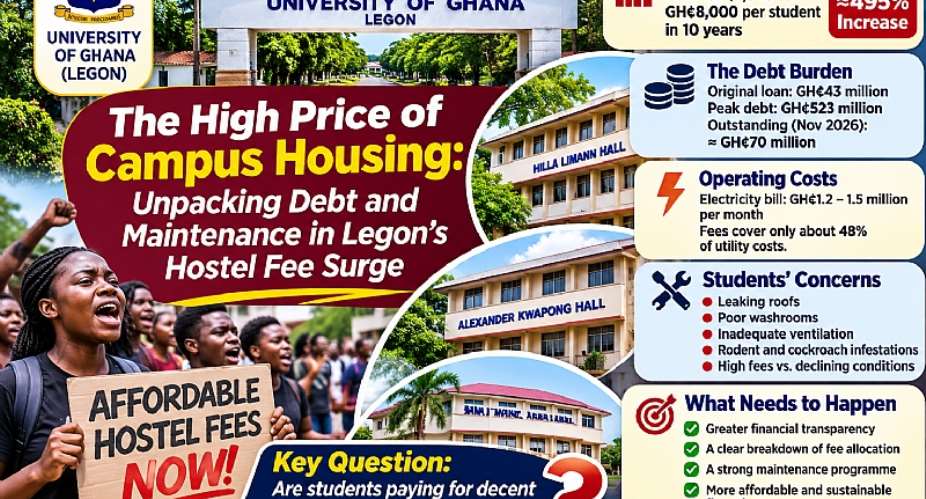
The rising cost of student accommodation at the University of Ghana, Legon, has generated widespread concern among students, parents and education stakeholders. What was once considered relatively affordable campus housing has become a major financial burden, raising serious questions about the management of university accommodation, accumulated debts and the responsibility of public institutions to provide decent and affordable living conditions for students.
At the centre of the controversy is University of Ghana Enterprises Limited (UGEL), the company responsible for managing several residential facilities, including Hilla Limann, Alexander Kwapong, Elizabeth Frances Sey and Jean Nelson Aka halls.
Over the past decade, accommodation fees at these facilities have reportedly increased from approximately GH¢1,345 to GH¢8,000 per student for an academic year. This represents an increase of nearly 495%, far exceeding what many students and their families can comfortably afford.
For a room occupied by four students, the annual accommodation revenue could reach GH¢32,000. This has raised an important question: why should students sharing relatively modest residential facilities pay such substantial amounts, particularly when some of the buildings reportedly suffer from poor maintenance?
UGEL management has defended the increases, explaining that the company faces enormous financial obligations arising from historical construction debts, rising utility bills, inflation and the cost of maintaining ageing infrastructure.
The financial difficulties can be traced to the original construction of the hostels, which was reportedly financed through a loan of approximately GH¢43 million in the mid-2000s. Over time, interest accumulation, exchange rate movements and prolonged disputes with creditor banks contributed to a substantial increase in the debt burden.
According to published accounts, the liability eventually reached approximately GH¢523 million before restructuring and repayment arrangements reduced the outstanding amount.
By December 2023, the debt had reportedly declined to GH¢137.29 million. In November 2026, UGEL Chief Executive Officer Yawo Nutifafa Agbesi disclosed that the remaining obligation stood at approximately GH¢70 million, with substantial repayments scheduled during the year.
Although the reduction in debt represents progress, it also exposes a troubling reality: students occupying the hostels today are helping to finance obligations accumulated many years earlier.
This raises an important issue of fairness. Should current students bear such a heavy financial burden for historical borrowing decisions over which they had no control?
UGEL argues that the situation is more complicated than it appears. Unlike traditional university halls that may benefit from institutional or public support, UGEL operates under a commercial financing arrangement and must generate sufficient income to meet its financial commitments.
Management has also cited substantial operating expenses, particularly electricity. Reports indicate that UGEL spends between GH¢1.2 million and GH¢1.5 million monthly on electricity alone. According to management, accommodation fees cover only part of the total utility expenditure, leaving the company to finance the balance from its resources.
These expenses are significant, especially in an economy where electricity tariffs, maintenance materials, labour and other operating costs have increased over time.
However, financial pressures cannot completely explain away the concerns raised by students about the condition of their accommodation.
Reports from residents have highlighted leaking roofs, damaged washrooms, inadequate ventilation, defective fittings and pest infestations in some facilities. Such complaints raise questions about whether sufficient resources are being allocated to routine maintenance and infrastructure improvements.
Students paying GH¢8,000 annually have legitimate expectations of safe, hygienic and reasonably comfortable accommodation. While university hostels are not luxury hotels, basic standards of cleanliness, sanitation, security, ventilation and structural maintenance should never be compromised.
The central issue is therefore not simply whether UGEL needs additional revenue. It is whether the fees being charged reflect the quality of accommodation and services provided.
There is also a wider concern about financial transparency.
Students and parents deserve to understand how accommodation revenue is distributed among loan repayments, electricity, water, security, cleaning, administration, maintenance and infrastructure rehabilitation.
For example, how much of the GH¢8,000 paid by each student goes directly towards servicing historical debt? What proportion is allocated to repairing buildings? How much is spent on administration and utilities?
Without clear financial disclosures, it becomes difficult to determine whether the current pricing structure is justified or whether opportunities exist to reduce costs through improved management and operational efficiency.
A transparent financial report showing the allocation of hostel revenue would help rebuild confidence between UGEL management and the university community.
It would also provide a factual basis for discussions about future fee adjustments.
Another important consideration is the broader impact of expensive accommodation on access to higher education.
University education is already a major financial commitment for many Ghanaian families. Beyond tuition-related charges, students must pay for food, transportation, textbooks, internet access, clothing and other essential expenses.
When accommodation alone costs GH¢8,000 annually, the financial burden can become overwhelming, particularly for students from low-income households.
Some students may be forced to seek cheaper accommodation far from campus, exposing them to additional transportation expenses, long commuting hours and possible security risks.
Others may depend on loans, family contributions or part-time employment to remain in school. These pressures can negatively affect academic performance and the overall university experience.
The situation also highlights a broader challenge facing Ghana's public universities: how to finance infrastructure development without making higher education increasingly unaffordable.
Universities require substantial investment in residential facilities, lecture halls, laboratories, libraries and other infrastructure. However, financing arrangements must be carefully structured to avoid transferring excessive long-term costs to future generations of students.
The experience of UGEL demonstrates the risks associated with borrowing arrangements that become increasingly expensive over time.
Although commercial financing can help universities expand infrastructure, poor debt management, high interest costs and prolonged repayment periods can create financial pressures that eventually affect students.
There is therefore a strong case for reviewing the financing models used for public university accommodation.
Government, university authorities and development partners should explore more sustainable approaches, including affordable long-term infrastructure financing, targeted public investment, carefully regulated private-sector partnerships and student accommodation support schemes.
At the institutional level, UGEL should consider commissioning an independent financial and operational review to assess the relationship between accommodation fees, outstanding debt, operating costs and maintenance expenditure.
Such a review could identify opportunities for reducing waste, improving energy efficiency, strengthening procurement systems and ensuring that adequate resources are devoted to maintaining residential facilities.
Energy costs, for example, could potentially be reduced through investment in solar power, efficient lighting, improved electrical systems and better consumption monitoring. Although these interventions require initial investment, they may offer long-term savings.
A comprehensive maintenance programme is equally necessary. Rather than waiting for facilities to deteriorate before undertaking expensive repairs, management should adopt preventive maintenance schedules supported by dedicated annual budgets.
Students should also have access to effective complaint and feedback mechanisms through which maintenance problems can be reported and resolved promptly.
Importantly, the university must establish a clear policy on what happens to accommodation fees after the outstanding debt is fully repaid.
If historical loan repayments constitute a significant component of current charges, students should reasonably expect some financial relief once those obligations have been settled, unless other independently justified costs have increased.
Debt repayment should not become a permanent justification for continually increasing accommodation fees.
There is also a need for stronger engagement between UGEL management, student representatives, university authorities and relevant regulatory institutions. Decisions affecting thousands of students should be informed by meaningful consultation and supported by transparent financial information.
The University of Ghana remains one of Africa's respected institutions of higher learning. Its reputation depends not only on academic achievement and research excellence but also on the welfare of the students who sustain its educational mission.
Affordable and decent accommodation is an important component of that mission.
The current controversy should therefore be viewed as an opportunity to reform university housing management rather than merely a dispute over hostel fees.
UGEL has made reported progress in reducing its accumulated debt, and this deserves recognition. Nevertheless, financial recovery must be accompanied by improvements in service delivery, infrastructure maintenance, accountability and affordability.
Students should not be required to pay increasingly high fees while enduring deteriorating living conditions.
The fundamental responsibility of university accommodation management is to provide safe, decent and reasonably affordable housing while maintaining financial sustainability.
Achieving this balance requires sound financial planning, efficient operations, transparent accounting and a genuine commitment to student welfare.
Ultimately, the controversy surrounding UGEL hostel fees raises a question that extends beyond the University of Ghana: should public university accommodation be managed primarily as a commercial enterprise or as an essential service supporting access to education?
The answer must recognise the need for financial sustainability without losing sight of the social purpose of public universities.
As Ghana continues to expand access to tertiary education, policymakers must ensure that accommodation costs do not become another barrier preventing talented young people from pursuing their academic ambitions.
University education should provide opportunities for young people to build their future, not force them to carry an unreasonable share of the financial burdens inherited from the past.
The time has come for greater transparency, responsible financial management and a sustainable national approach to student accommodation.
For the students of Legon and other public universities across Ghana, affordable housing should not be an impossible dream. It should be an achievable part of a quality university education.


 Patrick Boamah says GRA faces GH¢680m judgment debt in Safaritech dispute
 Police commander alerts drivers on accident-prone areas on Techiman-Tamale highw...
 Bank of Ghana ready to adopt ECO currency – Governor
 'Stop unlawful detention, searches, debt-related arrest, torture during criminal...
 Six Accra flood-control projects still await Finance Ministry’s clearance before...
 Ato Forson’s suspension of board sitting allowances very serious matter, must be...
 UG seeks legal clarity on Rent Control’s authority over its hostels due to natur...
 UAE imported $56.7bn worth of undeclared African gold in 2024 – Swissaid report
 Man arrested in Dublin over fatal stabbing of 21-year-old Ghanaian Thomas Oduro ...
 Speaker Bagbin proposes independent account audits, spending limits to regulate ...


