




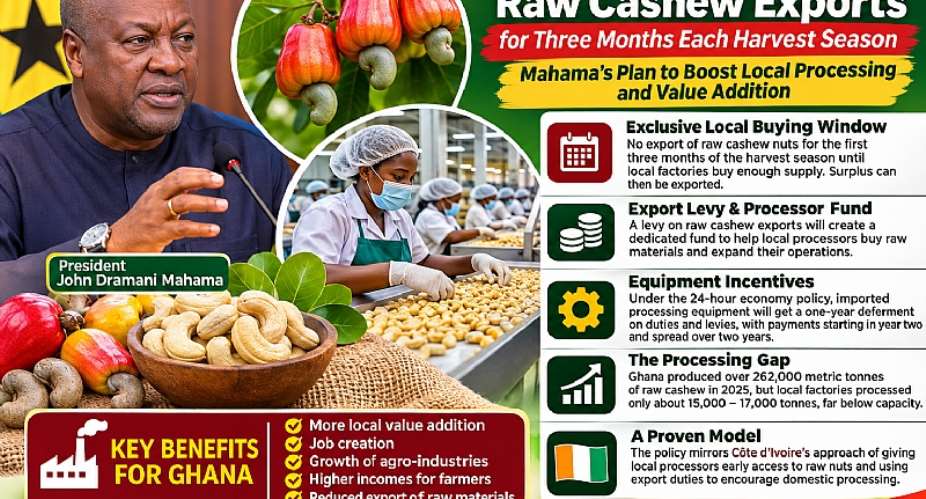
Ghana is taking a significant step towards transforming its agricultural economy following President John Dramani Mahama's announcement of plans to restrict the export of raw cashew nuts during the first three months of every harvesting season. The proposed policy seeks to promote domestic processing, create employment, strengthen local industries and ensure that Ghana derives greater economic benefits from its agricultural resources.
The announcement, reported on November 17, 2026, represents a shift from the longstanding practice of exporting agricultural commodities in their raw state while importing finished products at considerably higher prices. For decades, Ghana and many other African countries have struggled to capture the full economic value of their natural resources because of limited investment in processing and manufacturing.
Under the proposed arrangement, exporters will be prevented from shipping raw cashew nuts abroad during the first three months of the harvest season. This period will provide domestic processing companies with priority access to raw materials for their operations. Once the requirements of local factories have been satisfied, surplus cashew nuts may be released for export.
The government's objective is to address one of the major challenges confronting Ghana's cashew processing industry: inadequate access to raw materials despite substantial national production. Many local factories operate below their installed capacities because they struggle to compete financially with foreign buyers who purchase large quantities of raw cashew nuts for processing abroad.
Ghana produced more than 262,000 metric tonnes of raw cashew nuts in 2025, according to figures cited in reports on the policy. However, domestic processors reportedly handled only about 15,000 to 17,000 tonnes, representing approximately 6% of national production. This considerable gap highlights the enormous opportunity for expanding local processing and retaining more value within the Ghanaian economy.
The proposed restrictions will be accompanied by additional measures intended to strengthen the competitiveness of domestic processors. One such intervention is the introduction of a levy on raw cashew exports. Revenue generated from the levy is expected to support a dedicated financing mechanism that will help local processing companies purchase raw materials, improve production facilities and expand their operations.
Access to affordable financing remains a major obstacle for Ghanaian agro-processing businesses. Many small and medium-sized enterprises face high borrowing costs, inadequate working capital and limited access to long-term investment funds. Consequently, even companies with installed processing equipment sometimes struggle to purchase sufficient raw materials during the harvesting season.
A properly managed financing mechanism could help address these challenges by providing processors with timely access to funds, particularly during periods when large quantities of cashew nuts enter the market.
The government has also proposed investment incentives under its 24-hour economy policy. Companies importing machinery and equipment for cashew processing are expected to benefit from a one-year deferment of applicable import duties and levies. Payments would commence in the second year and be spread over two years.
This arrangement could reduce the immediate financial burden on investors establishing new processing facilities or expanding existing operations. It could also encourage investment in modern machinery, improved processing technologies and industrial infrastructure.
Beyond increasing industrial production, the policy has the potential to generate employment opportunities across the cashew value chain. Processing activities such as shelling, peeling, grading, roasting, packaging and distribution require labour, technical expertise and supporting services. Expanding these activities locally could create jobs for young people, women, technicians, engineers, transport operators and entrepreneurs.
The economic benefits could extend beyond cashew kernels. Cashew shells contain valuable substances that can be processed into cashew nut shell liquid for industrial applications. Other by-products may also offer opportunities for commercial utilisation, provided appropriate technologies, environmental safeguards and viable markets are available.
Ghana's proposed approach shares similarities with policies implemented in neighbouring Côte d'Ivoire, one of the world's leading cashew producers. The Ivorian government has used export-related measures and incentives to encourage domestic processing, attract investment and strengthen its position in the international cashew industry.
However, Ghana must recognise that restricting raw commodity exports alone will not guarantee industrial success. Sustainable value addition requires reliable electricity, competitive financing, efficient transportation, appropriate processing technology, skilled personnel, quality assurance systems and access to international markets.
There is also a need to protect the interests of cashew farmers. Export restrictions could reduce competition among buyers during certain periods, potentially affecting farmgate prices if domestic processors are unable to purchase sufficient quantities at competitive rates. Government must therefore establish transparent purchasing arrangements and effective monitoring systems to ensure that farmers receive fair compensation for their produce.
Equally important is the need to prevent unnecessary delays in marketing harvested cashew nuts. Domestic processing companies must have the financial and operational capacity to purchase available supplies within the designated period. Otherwise, the restrictions could create storage challenges, liquidity problems and market uncertainty.
The proposed export levy must also be administered transparently. Funds collected should be directed towards clearly defined industrial development objectives, with appropriate accountability mechanisms to ensure that the intended beneficiaries receive support.
Another important consideration is Ghana's competitiveness in the international market. Locally processed cashew products must meet the quality, food safety, packaging and traceability requirements of buyers in Europe, North America, Asia and other major markets. Investment in internationally recognised standards and certification will therefore be essential.
The policy also raises a broader question about Ghana's industrial development strategy. Why should a country endowed with cocoa, cashew, shea nuts, oil palm, timber, minerals and other valuable resources continue to depend heavily on exporting raw materials?
The same economic principle underlying the proposed cashew policy could inform national strategies for cocoa processing, vegetable oil production, fruit processing, spices, timber products and other agricultural industries. Ghana's long-term industrial transformation will depend on its ability to convert locally available resources into competitive finished and intermediate products.
Nevertheless, industrialisation must be driven by economic viability rather than restrictions alone. Investors require predictable regulations, stable markets, adequate infrastructure and a business environment that supports productivity and innovation.
As of the November 17–18 announcements, important implementation details, including the precise commencement date, export levy rate, procedures for determining domestic processing requirements and enforcement arrangements, had not been fully disclosed. These matters will require clarification before businesses can properly assess their obligations and investment opportunities.
The government's initiative therefore represents an important policy direction rather than an already established nationwide export ban. Its eventual success will depend on how effectively the proposed measures are designed, implemented and monitored.
For Ghana, the significance of the announcement extends far beyond the cashew industry. It reflects the growing recognition that sustainable economic development cannot depend indefinitely on exporting raw materials and importing manufactured goods.
The country must increasingly invest in processing, manufacturing, technology, skills development and industrial infrastructure to create employment, expand exports and strengthen economic resilience.
Ghana's cashew policy could become an important milestone in the country's industrial transformation if it successfully balances the interests of farmers, processors, exporters and consumers.
The ultimate measure of success will not be the quantity of raw cashew nuts prevented from leaving the country, but the number of viable processing industries established, the jobs created, the incomes improved and the additional export earnings generated through value addition.
Ghana has the agricultural resources, entrepreneurial potential and geographical advantages to become a major agro-processing centre in West Africa. What remains essential is consistent policy implementation, adequate financing, strong institutions and sustained private-sector participation.
The time has come for Ghana to move beyond being predominantly a supplier of raw agricultural commodities and become a competitive producer of processed products for regional and international markets.
The future of Ghana's agricultural economy must be built not merely on what the country produces, but on how much value it creates from what it produces.

 Patrick Boamah says GRA faces GH¢680m judgment debt in Safaritech dispute
 Police commander alerts drivers on accident-prone areas on Techiman-Tamale highw...
 Bank of Ghana ready to adopt ECO currency – Governor
 'Stop unlawful detention, searches, debt-related arrest, torture during criminal...
 Six Accra flood-control projects still await Finance Ministry’s clearance before...
 Ato Forson’s suspension of board sitting allowances very serious matter, must be...
 UG seeks legal clarity on Rent Control’s authority over its hostels due to natur...
 UAE imported $56.7bn worth of undeclared African gold in 2024 – Swissaid report
 Man arrested in Dublin over fatal stabbing of 21-year-old Ghanaian Thomas Oduro ...
 Speaker Bagbin proposes independent account audits, spending limits to regulate ...


