




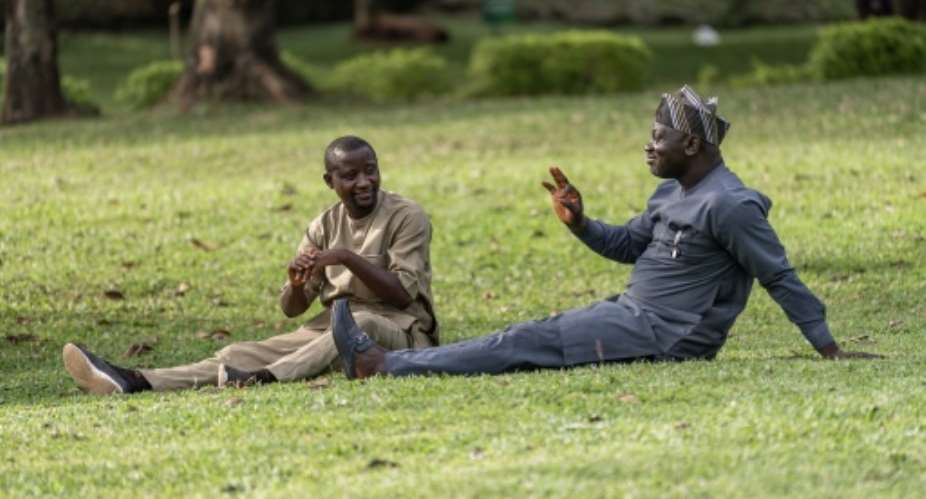
With a quick flick of the wrist, Umaru Zayyanu conveys the phrase "I am a Nigerian".
But the 37-year-old is not speaking -- or signing, rather -- in the west African nation's official sign language. Instead, he's using Hausa sign language.
Such indigenous sign languages abound in Africa's most populous country, where deaf people were communicating with each other long before the advent of formal sign language taught in deaf schools, in 1960.
Today, Nigeria, like many countries on the continent with limited education budgets, has a hard enough time placing children in dedicated schools for the deaf and hard of hearing.
And there's even less attention paid to local sign languages used outside the school system -- a serious disservice to the country's linguistic diversity, Festus Zenda, who has worked on documentation projects with local deaf communities, told AFP.
"These indigenous signing systems should be studied, documented and preserved before changes in education, migration, technology and wider use of Nigerian Sign Language cause some of them to decline or disappear," said Zenda, who has helped document the local sign language used by the Tiv ethnic group, in Benue state.
Displacement by formal signing
The working-class Abuja exurb of Zuba is a symphony of motorcycle horns, plantain hawkers' shouts and the dull hum of construction work.
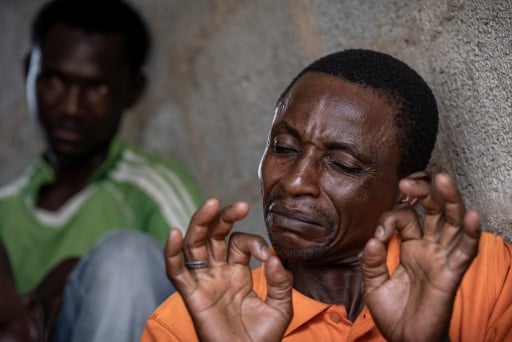 Nigeria has an official sign language but also myriad indigenous signing systems. By Light Oriye Tamunotonye (AFP)
Another group adds their own, milder contributions: claps, muffled shouts of exclamation and the swish of rapid hand gestures as the chat in Hausa signs.
Nigerian sign languages, like their spoken counterparts, are sometimes confined to a small number of speakers in a country crowded with some 500 tongues and an unknown number of sign languages.
But Hausa sign language has become a lingua franca for deaf people across the north of the country.
"I cherish my culture, I cherish my indigenous sign language," Sanni Lawal, who runs a laundry business in Zuba's crowded market, told AFP through an interpreter. "I want it to expand everywhere."
Nigeria traces its official sign language to Andrew Foster, an American who introduced formal deaf education across a swathe of African countries at the dawn of independence from colonial powers.
Many countries in the region today use an official sign language based on American Sign Language.
But in the decades since, some scholars argue indigenous signing has languished as governments have prioritised formal languages.
"People gather in the moonlight narrating their folklores in indigenous sign," said Joshua Gyang, who has researched local languages with Nigeria's deaf activist community.
Nevertheless, he warned they will "certainly perish" without preservation.
'Our culture and identity'
The government doesn't completely ignore local sign languages: politicians often bring Hausa signers to campaign stops to court deaf voters, Zuba residents told AFP.
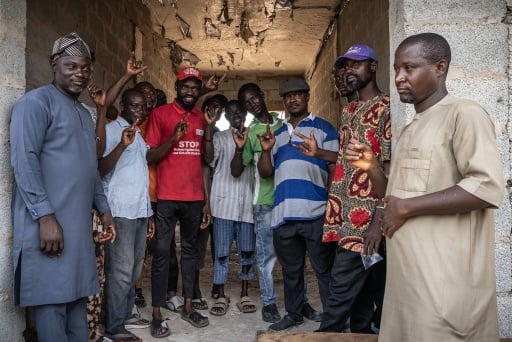 Activists are trying to preserve and document Nigeria's indigenous signing systems. By Light Oriye Tamunotonye (AFP)
The strategy makes sense: there's no school there to teach formal sign language.
Under a USAID programme administered by Gallaudet University -- the United States' premier university for deaf and hard of hearing students, and Foster's alma mater -- researchers were providing training to deaf educators in Nigeria, which touched on local languages as well.
In a 2024 update, the university said their work sparked discussions around languages like Hausa sign language and whether they "deserve recognition and should be the medium of instruction in schools".
The programme was shut down last year as Washington slashed foreign aid spending.
Nevertheless, Nigerian researchers and activists like Zenda, Zayyanu, Gyang and their colleague Taiwo Ajayi continue to document indigenous sign languages.
Even Nigerian sign language has its own local flair, Ajayi, a sign language interpreter, told AFP, noting the differences in the way signs are taught in school and the way people actually converse in the street.
For Hausa signers, their language has become a key part of "our culture and identity", Zayyanu told AFP.
"Even before we go to school, we have our own language," he said. "Instead of burying that one, why not develop it?"


 BoG warns public against 19 unlicensed digital loan applications
 National Best Farmer to receive GH¢1.2m, pickup truck and sponsored European tri...
 You promised Nkoko Nkitinkiti and within two years you have not deliver even 2% ...
 UG management regrets confrontation during Rent Control inspection of UGEL hoste...
 GTA shuts down more than 40 hospitality facilities in Ashanti Region over licens...
 Floyd Mayweather pays courtesy visit to President Mahama
 'Produce evidence of job sales under NDC' – NDC Deputy National Youth Assistant ...
 Asante Akyem North seat should be declared vacant over MP’s prolonged absence – ...
 International Men’s Day: 'Seven in 10 Ghanaian men experience violence in their ...
 Government lifts curfew on 11 communities in Nkwanta South


