




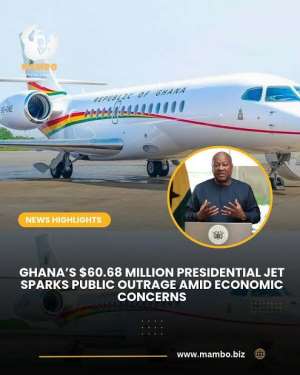
On Monday, 16 November 2026, a gleaming French-built aircraft touched down in Accra. Within hours, Ghana was arguing about it.
That's nothing new. Presidential jets have split this country for nearly twenty years. This time, though, the argument is sharper, because the people defending the plane yesterday are the people who attacked planes like it before.
So let me lay out what we actually know, what we don't, and what Ghanaians have every right to demand.
## What Actually Arrived
The Ghana Air Force has taken delivery of a Dassault Falcon 6X, built by Dassault Aviation of France. Government Communications Minister Felix Kwakye Ofosu announced it on social media on 16 November, according to Pulse Ghana and Graphic Online.
The contract price is **US$60.68 million**. Parliament approved it on **4 December 2025**, a day after Deputy Defence Minister Ernest Brogya Genfi laid it before the House, as reported by The Rio Times and Graphic Online.
The jet replaces the Falcon 900EX, now about 16 years old. Graphic Online reports it has suffered recurring maintenance problems. The Rio Times adds that Defence Minister Omane Boamah said in July 2025 that corrosion, including in the fuel tanks, kept it in France for months of repairs.
The government's main selling point is range. The new aircraft can fly farther without stopping to refuel.
## The Number Everyone Is Fighting About
Here is where the noise starts.
The jet did not arrive alone in the budget. The same package includes four Airbus helicopters for the Air Force, one H160 and three H175, priced at €125.97 million, roughly US$139 million. The Rio Times puts the combined contracts at about US$199 million. Graphic Online reports the payments are spread across instalments running to December 2028.
Meanwhile, figures have flown around like confetti. Opposition MP Samuel Abu Jinapor claimed in November 2025 that about US$1.2 billion was involved. Kwakye Ofosu called the billion-dollar claim false, saying the total for retooling the Armed Forces was about US$300 million (GhanaWeb, 25 November 2025). This week he rejected a GH¢1.4 billion figure for the jet alone, saying that sum covers the jet and four helicopters together.
The Rio Times noted that, at current exchange rates, the full contract values would come to roughly GH¢2.3 billion, which is higher than GH¢1.4 billion. It also noted the government has not explained how its figure relates to what Parliament approved.
I'm not accusing anyone of lying. I'm saying a nation that is told three different numbers by three different mouths deserves one clear, published, reconciled number.
## What We Still Don't Know
According to The Rio Times, as of 17 November:
- No official figure has been published for the annual running cost of the new jet.
- No date has been announced for its first presidential trip.
- Nobody has said whether the old Falcon 900EX will be sold or kept.
Those aren't small details. A jet's purchase price is only the start of its cost. Crew, maintenance, insurance, fuel and hangar all keep billing for years. Ghanaians should see that number too.
## The Case for the Jet
I'll be fair, because a column that only shouts is just noise.
An aircraft that spends months in a foreign repair shop is not a safe aircraft. Ghana is a country whose Head of State must travel to the African Union, the UN, ECOWAS summits and trade negotiations. Reliable transport is a security matter as much as a comfort one.
Supporters also point to the alternative. For years, Ghana leaned on chartered or borrowed aircraft whenever the official jet failed. Foreign Minister Samuel Okudzeto Ablakwa told Parliament the presidency had moved away from the high costs of chartered luxury flights, as Graphic Online reported. Ch-aviation reported that the old jet lacked the range for certain long-haul destinations.
Kwakye Ofosu also made a broader point. He said most Air Force aircraft are grounded by faults, ageing equipment and missing spare parts, with only one CASA transport plane and one helicopter working. If true, the helicopters in this package deserve a serious hearing too. The Air Force's job is territorial security, not photo opportunities.
## The Case Against, and Why It Stings
Now the other side.
In March 2026, the Minority caucus called for the jet and helicopter purchases to be suspended, arguing the timing was poor given the troubles facing cocoa farmers, according to MyJoyOnline and Adom Online. Minority Chief Whip Frank Annoh-Dompreh pressed the point. And the Minority's one-line verdict, repeated across Ghana's radio waves, is brutal: a government that can buy a jet but cannot pay farmers should not expect the jet to vote for it.
Then there's the hypocrisy question, and it won't go away. MyJoyOnline recalls that the NDC, in opposition, condemned the purchase of the Falcon 900EX under President Kufuor. And Felix Kwakye Ofosu himself, before he held office, publicly slammed President Akufo-Addo's government for pursuing a new presidential jet, calling it lavish and wasteful, as 3news reported.
Yesterday's critics are today's buyers. The jet is shinier. The politics are the same. Ghanaians remember.
The NPP isn't clean here either. The previous government began its own process to buy a new presidential jet in 2021, as Citi Newsroom reported. Both sides have argued against the jet when it was the other side's turn to buy it. That's the real scandal. We don't have a principle about presidential jets. We have a calendar of who is in power.
## Why This Matters to the Ordinary Ghanaian
Let me bring this down to the ground, where most of us live.
For the cocoa farmer in the Western North Region waiting on payment, a number like US$60.68 million is not a number. It's a question. For the trotro driver in Madina, it's an argument you'll hear at the next bus stop. For the young graduate who is jobless and watching this unfold on a phone, it's proof that the big promises always seem to have money behind them while the small ones wait.
But anger without facts is just heat. So here is what I think Ghanaians should demand, calmly and firmly:
1. **One reconciled number.** The jet price, the helicopter price, the total, and the cedi equivalent, published once, in plain language.
2. **A published running cost.** What will it cost per year to operate this aircraft?
3. **A decision on the old jet.** Sell it, with proceeds declared, or explain why it's being kept.
4. **A usage policy.** The old jet was mocked for being handed out for domestic travel to people with no official role. If the state owns the plane, the state should say who may fly it and who may not.
5. **A travel log.** Where does it go, how often, and for what purpose?
None of this is radical. It is what ordinary accountability looks like.
## Where I Land
I don't believe a country of 34 million should be forced to choose between having a safe presidential aircraft and having a conscience. A nation can own a reliable plane. Many do.
But I also don't believe in asking Ghanaians to simply trust. Trust is what you build after the receipts are published, not before.
The jet has landed. The questions have not. And until they do, this aircraft will keep flying over a country that is still waiting for honest answers.
**A Personal Note**
I've written about government spending long enough to know the pattern. Opposition screams. Government defends. The numbers get fuzzy. A week later, the next scandal arrives and nobody remembers the first one. I refuse to play that game. If this jet is worth its price, let the government prove it with open books. If it isn't, let that be said just as plainly. I'm not on the side of any party. I'm on the side of the receipt.
*Sources: Graphic Online (16 and 17 November 2026); Pulse Ghana (16 November 2026); The Rio Times (17 November 2026); MyJoyOnline; Adom Online; GhanaWeb (25 November 2025); 3news; Citi Newsroom; ch-aviation (20 March 2026).*
**About the Author**
Chief Tutu Baffour Asare Brownsy Williams is an author, columnist, filmmaker and digital content creator based in Accra, Ghana. He is the founder of Brownsy Silva Company, a multi-disciplinary creative platform spanning novels, films, columns and engineering content, and an opinion columnist on Modern Ghana with readers across the UK, USA, Canada and Germany. He is also a United Nations Online Volunteer.


 Patrick Boamah says GRA faces GH¢680m judgment debt in Safaritech dispute
 Police commander alerts drivers on accident-prone areas on Techiman-Tamale highw...
 Bank of Ghana ready to adopt ECO currency – Governor
 'Stop unlawful detention, searches, debt-related arrest, torture during criminal...
 Six Accra flood-control projects still await Finance Ministry’s clearance before...
 Ato Forson’s suspension of board sitting allowances very serious matter, must be...
 UG seeks legal clarity on Rent Control’s authority over its hostels due to natur...
 UAE imported $56.7bn worth of undeclared African gold in 2024 – Swissaid report
 Man arrested in Dublin over fatal stabbing of 21-year-old Ghanaian Thomas Oduro ...
 Speaker Bagbin proposes independent account audits, spending limits to regulate ...


