




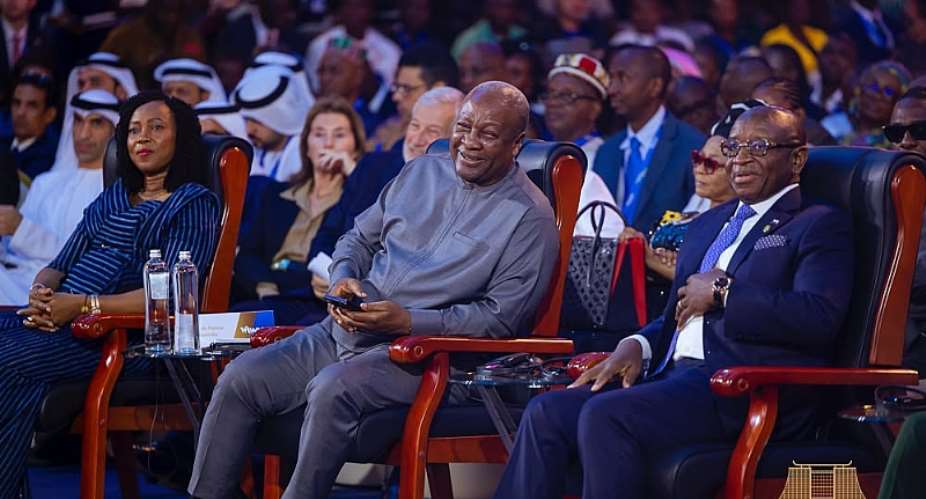
President John Dramani Mahama has called for a gradual rollout of the proposed ECO common currency, urging ECOWAS countries that have satisfied the required economic convergence criteria to begin using it while others work towards meeting the benchmarks.
He said the approach would allow countries ready for monetary integration to move forward without waiting for all 15 member states of the Economic Community of West African States (ECOWAS) to qualify simultaneously.
Speaking at the West African Integration and Investment Summit (WAIIS) in Freetown, Sierra Leone, President Mahama said efforts to establish a common regional currency had remained stalled for decades because the number of countries meeting the convergence requirements kept changing.
He noted that the number of qualifying countries had varied over the years, at different points standing at two, five, three and seven, making it difficult to achieve the collective threshold needed to introduce the currency.
“I am sure some of you were not born when we started talking about the ECO, a common West African currency,” he said.
President Mahama disclosed that he and his Sierra Leonean counterpart, President Julius Maada Bio, had tabled a proposal at the most recent ECOWAS summit to address the prolonged delay.
Under the proposal, countries that meet the requirements would introduce the ECO alongside their existing national currencies, with other member states joining once they attain the necessary economic benchmarks.
The arrangement would allow participating countries to use the ECO for trade settlements without having to channel transactions through the United States dollar, while their national currencies remain in circulation.
President Mahama said the WAIIS initiative, convened by President Bio, provided an important platform for ECOWAS leaders, the regional Commission, private sector operators and financial institutions to develop practical measures to deepen integration.
Turning to infrastructure, he identified poor transport and logistics networks as major obstacles to expanding trade within Africa, despite progress following the adoption of the African Continental Free Trade Area (AfCFTA) agreement.
He said intra-African trade had reportedly increased from approximately 11 per cent at the time the AfCFTA agreement was signed to about 15 per cent. This, however, remained significantly below the estimated 50 to 60 per cent recorded within the European Union.
“But the constraint mainly is in the logistics. Do we have the ports? Do we have the railways? Do we have the roads?” he asked.
The President used the long-delayed Lagos-Abidjan corridor project to illustrate the slow pace of infrastructure development in the sub-region. He recalled that the proposal was first discussed when he was a young minister in the late 1990s, before plans were extended to include the Abidjan-Dakar Highway.
Despite the passage of several decades and his subsequent service as Vice President and President, he said the Lagos-Abidjan corridor had yet to move beyond the planning stage.
“Today, I am pushing 70, and the Abidjan-Lagos corridor is still on the drawing board,” he said, describing the situation as an indication of the gap between West Africa's integration ambitions and their implementation.
He urged regional leaders to move beyond declarations and prioritise the execution of infrastructure projects that would improve the movement of people, goods and services across national borders.
According to him, completing the Lagos-Abidjan corridor would create a foundation for extending the transport network towards Dakar and developing other regional connectivity projects.
He also called for a coordinated road network supported by joint border posts and the removal of unnecessary police and security checkpoints that delay cross-border movement and trade.
President Mahama said political leaders had a responsibility to implement these measures and ensure that the vision of regional integration produced practical benefits for businesses and citizens.
The WAIIS, organised under the leadership of Sierra Leonean President Julius Maada Bio, is intended to strengthen regional economic cooperation through commitments and projects whose implementation will be monitored by its Secretariat.
The summit brings together Heads of State, government ministers, investors, development finance institutions, business executives and project owners to connect regional development priorities with investment opportunities.
West Africa has a potential market of more than 450 million people, estimated regional economic growth of 4.7 per cent and an investment pipeline exceeding US$180 billion across four strategic pillars.
 Mahama proposes phased roll out of ECO to accelerate West African monetary integ...
 Mahama highlights cedi's recovery, urges investors to tap into Ghana's productiv...
 Cashew processors welcome Mahama’s policies to protect local industry
 China offers support for Ghana’s New Economy Programme through technology and in...
 Italy approves anti-semitism law despite concerns over freedom of expression
 Xi, Putin meet ahead of Trump's arrival in China for historic trilateral summit
 Haitians rally behind Bukele as Salvadoran troops battle gangs
 'NPP rented jets for $18,000 to $22,000 per hour' – Kwakye Ofosu defends new pre...
 'We need Dangote, but what about Ghanaian businesses you are destroying with par...
 Two vehicles catch fire at Ecobank-Papaye compound in Lapaz


