




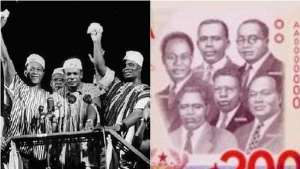
Ghana's independence on 6 March 1957 remains one of the most significant achievements in African history. It marked the emergence of the first sub-Saharan African colony to gain independence from British rule and inspired liberation movements across the continent.
Yet, nearly seven decades later, discussions about who deserves credit for Ghana's independence continue to generate political controversy.
Much of the debate revolves around Dr. Kwame Nkrumah and the founding leaders of the United Gold Coast Convention (UGCC), particularly Dr. J. B. Danquah, Edward Akufo-Addo and Emmanuel Obetsebi-Lamptey.
However, Ghana's journey to independence was more complex than the achievements of any single political leader or organisation. It involved constitutional negotiations, political activism, public protests, traditional authorities, workers, intellectuals and ordinary citizens who demanded an end to colonial domination.
One of the most important turning points came in 1948, when widespread economic hardship, political dissatisfaction and the shooting of unarmed ex-servicemen contributed to violent disturbances in Accra and other parts of the Gold Coast.
The colonial government responded by arresting six prominent nationalist leaders, later popularly known as the Big Six, and establishing the Watson Commission to investigate the causes of the disturbances.
The commission's findings exposed growing dissatisfaction with colonial administration and recognised the need for greater African participation in government.
These developments created pressure for constitutional reform.
In 1949, the British colonial administration appointed an all-African committee chaired by Justice Sir Henley Coussey to recommend a new constitutional framework for the Gold Coast.
The Coussey Committee brought together representatives of traditional authorities, educated elites and other sections of society. Prominent nationalist figures, including J. B. Danquah, Edward Akufo-Addo and Emmanuel Obetsebi-Lamptey, participated in its work.
Kwame Nkrumah, whose political philosophy increasingly emphasised immediate self-government and mass mobilisation, was not a member of the committee.
The committee submitted its recommendations in August 1949, proposing significant changes to the colonial political system.
Although the proposals did not provide immediate independence, they established an important foundation for expanding African representation and participation in government.
The recommendations helped shape the 1951 Constitution, which introduced a substantially enlarged Legislative Assembly and greater African participation in executive administration.
The new Legislative Assembly had 84 members, including 75 elected members and nine members representing official and special interests. However, not all elected representatives were chosen through direct popular voting; some were selected through indirect electoral arrangements.
This constitutional development represented a major departure from earlier colonial arrangements, under which political power remained heavily concentrated in British hands.
Nevertheless, the reforms fell short of full independence. The British Governor retained important powers, and the colonial administration continued to exercise authority over key areas of government.
For Nkrumah and the Convention People's Party (CPP), these limitations were unacceptable.
Having broken away from the UGCC in 1949, Nkrumah formed the CPP and mobilised broad public support around the demand for immediate self-government.
His message resonated with workers, market women, young people, farmers and other ordinary citizens who wanted political freedom and greater economic opportunities.
The CPP's Positive Action campaign of 1950 intensified pressure on the colonial authorities and resulted in Nkrumah's imprisonment.
However, the constitutional reforms created an opportunity for the nationalist movement to demonstrate its popular support through elections.
In February 1951, the CPP achieved a decisive electoral victory, winning 34 of the 38 directly contested territorial seats.
Nkrumah was subsequently released from prison and appointed Leader of Government Business. In 1952, he became Prime Minister.
These developments demonstrated how constitutional reform and popular political mobilisation could combine to advance the struggle for independence.
The constitutional groundwork associated with the Coussey Committee helped establish institutions through which African political leadership could exercise increasing authority. At the same time, Nkrumah's political organisation, electoral victories and negotiations accelerated the transition from limited self-government to full national sovereignty.
Further constitutional changes followed in 1954, while the 1956 elections helped establish the political basis for the final transfer of power.
On 6 March 1957, the Gold Coast became the independent nation of Ghana, with Kwame Nkrumah serving as its first Prime Minister.
Recognising Nkrumah's central leadership in achieving independence does not require dismissing the contributions of earlier nationalist leaders. Equally, acknowledging the constitutional work of the UGCC and the Coussey Committee should not diminish the importance of the CPP's mass mobilisation and political achievements.
The historical record shows that Ghana's independence emerged through different but interconnected processes.
The UGCC helped organise early nationalist demands for self-government. The 1948 disturbances exposed the weaknesses of colonial administration. The Watson Commission and Coussey Committee contributed to constitutional change. The CPP transformed the independence movement into a powerful mass political force, while ordinary citizens sustained the struggle through participation, sacrifice and political action.
Traditional rulers, trade unionists, journalists, market women, ex-servicemen and many others also played important roles.
Ghana's independence should therefore be understood as a national achievement rather than the exclusive accomplishment of one individual, political party or ideological tradition.
The country's history becomes richer, not weaker, when the contributions of different participants are recognised.
As Ghana approaches the 70th anniversary of independence in 2027, there is an opportunity to move beyond partisan interpretations of the past and promote a more balanced understanding of the country's journey to freedom.
The challenge is not to diminish any historical figure but to appreciate how different forms of leadership, constitutional reform and popular resistance contributed to the birth of the nation.
Ghana's independence was ultimately the product of collective determination, political courage and the persistent demand for self-government.
That history belongs to all Ghanaians, and its lessons should unite rather than divide the nation.


 Two vehicles catch fire at Ecobank-Papaye compound in Lapaz
 Rent Control drags UGEL to AG over hostel fees, room conditions
 One person burnt, 50 STC buses salvaged in Circle Railways fire - GNFS
 Mahama to attend West Africa Integrated Investment Summit in Sierra Leone
 Afenyo-Markin accuses govt of politically targeting local businesses over unpaid...
 INTERPOL orders deletion of Ken Ofori-Atta’s records from its databases
 Akufo-Addo’s presidential jet critics were driven by hatred, crude — Kennedy Ose...
 Govt launches probe into viral video of Ghanaian woman allegedly assaulted by bo...
 Current economic conditions do not make presidential jets purchase a misplaced p...
 Ghana is my second home, one-quarter of my family was born here – Dangote reveal...


