




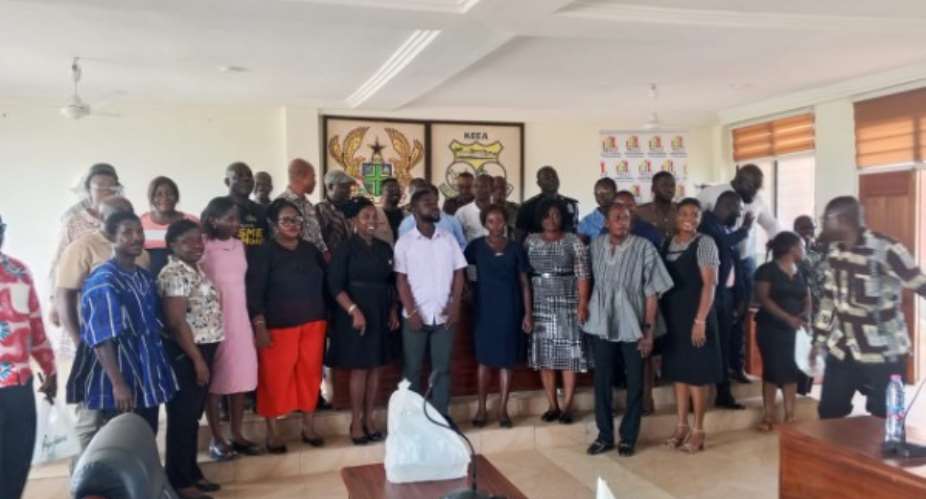
The National Commission for Civic Education (NCCE), in collaboration with the Ghana Integrity Initiative, the local chapter of Transparency International, has engaged heads of departments and institutions in the Komenda-Edina-Eguafo-Abrem (KEEA) Municipality to promote transparency, accountability and public access to information through social auditing.
The engagement brought together heads and representatives of various institutions, including the Ghana Education Service, the District Court, security agencies, Ghana Water Company Limited and the Electoral Commission, among others.
The initiative seeks to strengthen collaboration among public institutions and encourage duty-bearers to share relevant information with residents to enable them to understand activities and decisions within the municipality.
The Acting Municipal Director of the NCCE in the KEEA Municipality, Daniel Abawana, said the engagement was aimed at reminding heads of departments and institutions of their responsibility to serve the public through transparency, accountability and the timely sharing of information.
He explained that residents had the right to know what transpired in public institutions, stressing that access to accurate information would help prevent speculation and enable citizens to understand decisions and activities within the municipality.
“In the absence of information, people just speculate and say anything they want. But when they get the right information, then they know and understand that this particular thing is going on because of these reasons,” he said.
Mr Abawana added that the NCCE would undertake follow-up engagements with the various institutions to assess the implementation of the issues discussed, particularly social auditing, transparency and the fight against corruption.
He said the Commission would also support the institutions in disseminating relevant information to the public, emphasising that their activities must always be in the interest of citizens.
He further disclosed that the NCCE planned to engage schools between December 11 and 16 as part of efforts to promote integrity and educate students on the dangers of corruption.
He said similar engagements were organised in some schools the previous year, adding that the Commission was committed to instilling responsible values in young people.
The Municipal Magistrate, Her Worship Alberta Amponsah, urged heads of departments and public institutions to uphold integrity, transparency and strong work ethics in the discharge of their duties to help fight corruption.
She stressed that corruption went beyond the misappropriation of public funds to include delays in service delivery, failure to supervise projects, favouritism in recruitment and abuse of official positions.
“Corruption is not only about money. It goes beyond money. It goes to disservice, accountability and integrity,” she emphasised.
Her Worship Amponsah called on heads of institutions to have the courage to enforce discipline, hold non-performing staff accountable and ensure that public officers performed their duties diligently, regardless of personal relationships or political influence.
She also urged public officials to open themselves to scrutiny and constructive criticism, stressing that effective supervision and the enforcement of workplace standards were essential to improving public service delivery.
Responding to concerns raised during the engagement, she called for increased public education on road safety and respect for the law, particularly regarding motorists who remove motorcycle exhaust pipes to create excessive noise and individuals who block roads for funeral rites without the necessary permits.
She urged the NCCE and other relevant institutions, including members of the legal fraternity, to intensify public education and extend such initiatives to schools to help young people develop good values and understand the importance of obeying the law.
The District Director of the National Identification Authority (NIA), Joseph Kofi Enkroma, said the engagement had broadened participants’ understanding of corruption and the need to uphold integrity, discipline and accountability in public service.
He noted that corruption was not limited to bribery and financial misconduct but also included lateness to work, dishonesty and failure to perform assigned duties.
Mr Enkroma urged heads of institutions to strengthen supervision and ensure that their subordinates adhered to professional standards without compromising their integrity.
Another participant, who preferred to remain anonymous, described corruption as a practice that had become normalised in parts of the public sector, making it difficult for citizens to access even basic services without unnecessary delays and demands.
The participant said fighting corruption required courage and a willingness to stand for what was right, despite possible pressure or consequences from influential individuals.
He urged public officials to remain committed to their integrity and ensure that established procedures were followed in their respective institutions.
The participant added that although the fight against corruption might come with challenges, duty-bearers must remain resolute in ensuring that the right things were done to promote national development.


 Food suppliers to picket Ghana Commodity Exchange, NAFCO over unpaid Free SHS de...
 Nvidia board rules that co-founder Jensen Huang will not return as CEO
 Residents of Dermar alarmed after white coffin containing dead fowls discovered
 'NPP rented jets for $18,000 to $22,000 per hour' – Kwakye Ofosu defends new pre...
 'We need Dangote, but what about Ghanaian businesses you are destroying with par...
 Two vehicles catch fire at Ecobank-Papaye compound in Lapaz
 Rent Control drags UGEL to AG over hostel fees, room conditions
 One person burnt, 50 STC buses salvaged in Circle Railways fire - GNFS
 Mahama to attend West Africa Integrated Investment Summit in Sierra Leone
 Afenyo-Markin accuses govt of politically targeting local businesses over unpaid...


