




Under EU rules, the public deficit – the annual shortfall of revenue to spending – should be no more than 3 percent of GDP. Debt must not be above 60 percent of GDP.
Both France and Belgium have deficits above 5 percent of GDP and debt of more than 110 percent of GDP.
Leaders of both countries are facing political difficulties.
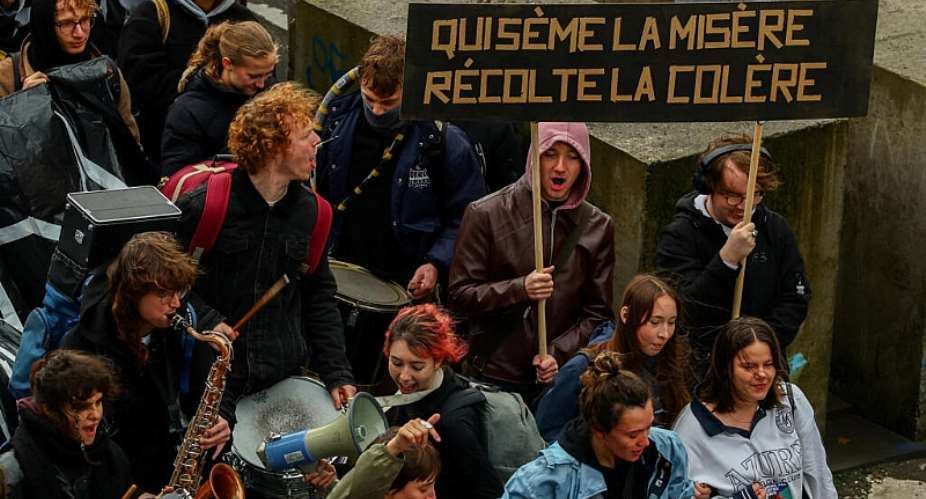
In France, up to 300,000 people were expected to take to the streets on Tuesday in a nationwide strike calling for higher wages. Public sector staff are seeking to pressure the government into unfreezing the index point used to calculate their basic salaries.
In its draft budget, the government has ruled out a general pay rise for the fourth consecutive year.
France braces for second nationwide strike over demands for higher wages
In Belgium, Prime Minister Bart De Wever needs to find €10 billion in savings by 2029.
Students, university staff and unions took to the streets of the country's capital Brussels on Tuesday, International Students' Day, in demonstration against higher tuition fees, changes to education funding and the rising cost of living.
Budget struggles
Dombrovskis, who has overseen EU economic policy since 2014, told reporters in Brussels: "We see sufficient demand for French sovereign and also Belgian sovereign debt, so we do not see any imminent financial stability issue."
Referring to their increasing borrowing costs, he added: "Clearly with this level of spreads it is important to make sure that deficit and debt is put on a downwards trajectory."
In France, the EU's second-biggest economy, Prime Minister Sébastien Lecornu is struggling to pass a deficit-cutting budget for 2027 in a parliament where President Emmanuel Macron's centrists no longer hold a majority.
International investors have said they are worried about France's debt level and their concerns have pushed up the interest yields it pays to service debt.
France's debt level is expected to be 119.2 percent of GDP in 2026, the European Commission said, while its deficit this year will be 5.5 percent of GDP.
The EU expects French debt will keep rising to more than 123 percent of GDP in 2028, and Belgium's debt will reach more than 115 percent in the same year.
IMF chief says it will 'take time' to restore confidence in France's finances
De Wever, who took over from Alexander De Croo as prime minister in February 2025, is trying to get a new cost-cutting budget with his governing partners over the line. Failure to strike a deal could potentially bring down his government.
De Wever offered his resignation on 2 November after coalition negotiations over the 2027 budget collapsed. King Philippe refused to accept it and gave him more time to reach an agreement.
Belgium's debt level is expected to be 111.2 percent of GDP in 2026, the Commission forecast, while its deficit is 5.2 percent of GDP this year.
(with newswires)

 “She kissed me first” – Labone SHS French teacher tells court in indecent assaul...
 NDC enjoying benefits of NPP's difficult economic decisions – Fuseini Issah
 Improved economy justifies purchase of new presidential jet – Toobu
 Eight Ghanaian seafarers return home after months in Iranian detention
 No one will be allowed to mess around with a Ghanaian and get away with it – Abl...
 Exim Bank case: Wontumi offers GH¢25m to secure end to prosecution
 Gov't finds $60.68m for presidential jet despite cost-of-living concerns – Abu J...
 Mahama orders performance assessment of all 261 MMDCEs
 Fitch Solutions projects cedi will weaken to GH¢12.40 against dollar in 2027
 I think Mahama done better than the first term – Archbishop Agyinasare


