




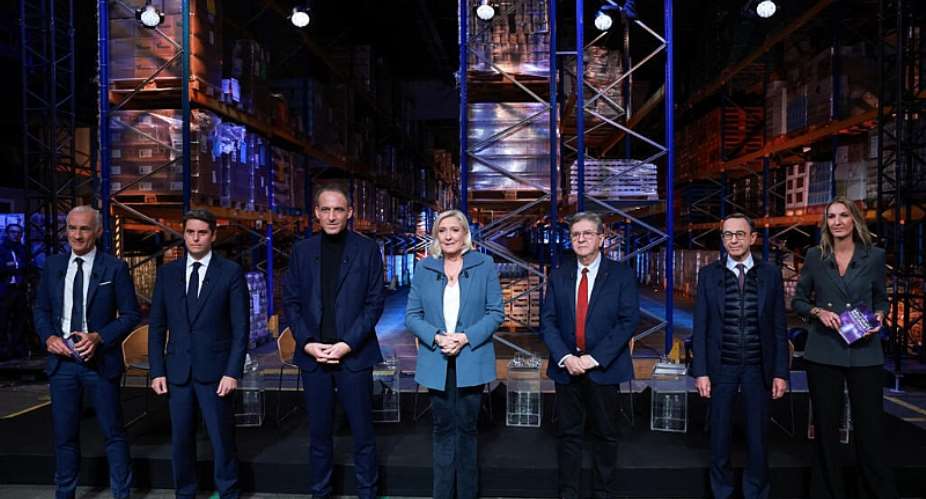
With less than six months until the first round of France's 2027 presidential election, TV channel LCI hosted a debate between five of the candidates: Marine Le Pen, Jean-Luc Mélenchon, Raphaël Glucksmann, Bruno Retailleau and Gabriel Attal.
Notably absent was centre-right candidate and former prime minister Edouard Philippe (Horizons).
Entitled "Which kind of society for tomorrow?", the debate was held in a warehouse storing supplies for the food aid charity Restos du Coeur.
The debate came on the eve of another round of nationwide protests on Tuesday, organised by trade unions in favour of better salaries in the face of the increased cost of living and inflation.
Minimum wage
The issue of the minimum wage sparked one of the first clashes of the evening.
Last week, French Prime Minister Sebastien Lecornu announced an increase the minimum wage by 1.6 percent from 1 December.
Marine Le Pen, the far-right National Rally candidate (RN) – who is currently ahead in the polls to succeed President Emmanuel Macron – compared said the increase was worthy of the "USSR" and claimed it would lead to job losses in small businesses.
The hard-left France Unbowed (LFI) leader Jean-Luc Mélenchon – who placed second in recent opinion polls – pointed out that the minimum wage (known in France as SMIC) has been adjusted for inflation "since 1953".
Instead, to tackle poverty he proposed a 100 percent tax on inheritances exceeding €12 million to fund a "long-term care allowance" for young people.
Candidate for the conservative Les Républicains (LR) party and former interior minister Bruno Retailleau said it was necessary to encourage people to earn more by "working a little more" with a "massive" reduction in social contributions.
Taxes
Taxation was the other major point of contention during Monday's debate. For Retailleau, "poverty isn't fought with taxes" but "by creating economic activity".
Former prime minister Gabriel Attal of the centre-right Renaissance party refuted the idea that France was a "tax haven" and said the focus should be on "how we can return the fruits of their labour to the French people".
Social democrat and the main rival to Mélecnchon on the left, Raphaël Glucksmann (Place Publique), argued for putting "sharing" back at the centre of policies by taxing very high incomes and large companies more, without penalising the middle classes and small businesses.
Housing
Le Pen advocated for prioritising access to social housing for French citizens, an idea denounced by her opponents.
Glucksmann called the idea "a policy of segregation".
Attal suggested prioritising those who are employed, particularly in "essential" sectors such as healthcare.
He was joined in this by Retailleau, who also stated his intention to crack down on the "regulations" that have "hindered construction".
Olympic judo champion Teddy Riner joins race for French presidency
Mélenchon, who supports strengthening tenants' rights, said he wanted to requisition empty housing to "prevent people from being left stranded [living] in their cars", while Le Pen called for empty office buildings to be used as student housing.
However, her proposal to repeal a law which requires municipalities to build a certain amount of social housing was criticised by both left-wing candidates.
Glucksmann said his priority as president would be to quickly house "the 3,000 children who are sleeping on the streets," referring to a promise made by Macron in 2017 to eradicate homelessness by 2018.
Pensions
Attal dismissed the debate on the legal retirement age but said low pensions should be increased.
Glucksmann agreed that small pensions should be fixed "above inflation" and defended the "pay as you go pension system".
Retailleau advocated for a legal retirement age of 65, saying: "Without this age limit, we are creating poverty."
French presidential hopefuls clash over economy and EU in first debate
For Mélenchon, "the goal to achieve for everyone is the minimum wage".
Le Pen said that "those who started working before the age of 20 should be able to retire at 60 with 40 years of contributions".
Non-profit organisations
Le Pen came under fire for her proposal to cut subsidies to NGOs or organisations she deemed "politicised," which she said would apply to those that issue voting instructions or "insulted" a candidate or party.
"At that point, they should form themselves into political parties," she said.
When pressed to name specific organisations to be targeted by this measure, she dodged the question.
Zemmour joins 2027 French presidential race vowing to expel unemployed foreigners
Her opponents accused her of deliberately trying to undermine organisations hostile to her policies.
Glucksmann said this principle would give the state "completely unreasonable" power.
Le Pen has already outlined her party's intention to "reduce subsidies to associations not of general interest", a measure which would save €3.7 billion of public money per year, according to her
Young people
Several candidates raised the issue of single mothers and how to help young people.
Attal stated his intention to make child support payments tax-free for mothers.
Glucksmann called for single-parent families to have access to flexible childcare hours, prioritised places in nurseries and in some cases alimony.
Le Pen, who rarely uses personal examples, said that as a mother to three, she was the only one among the candidates who could truly speak to "what it means to raise children alone".
For young people, she proposed a "student activity bonus" plus free driving licences and off-peak train travel.
Mélenchon advocated for a "supplementary allowance" of €1,337 per month for young people who are studying, while Glucksmann proposed a travel pass costing €1 per day.


 “She kissed me first” – Labone SHS French teacher tells court in indecent assaul...
 NDC enjoying benefits of NPP's difficult economic decisions – Fuseini Issah
 Improved economy justifies purchase of new presidential jet – Toobu
 Eight Ghanaian seafarers return home after months in Iranian detention
 No one will be allowed to mess around with a Ghanaian and get away with it – Abl...
 Exim Bank case: Wontumi offers GH¢25m to secure end to prosecution
 Gov't finds $60.68m for presidential jet despite cost-of-living concerns – Abu J...
 Mahama orders performance assessment of all 261 MMDCEs
 Fitch Solutions projects cedi will weaken to GH¢12.40 against dollar in 2027
 I think Mahama done better than the first term – Archbishop Agyinasare


