




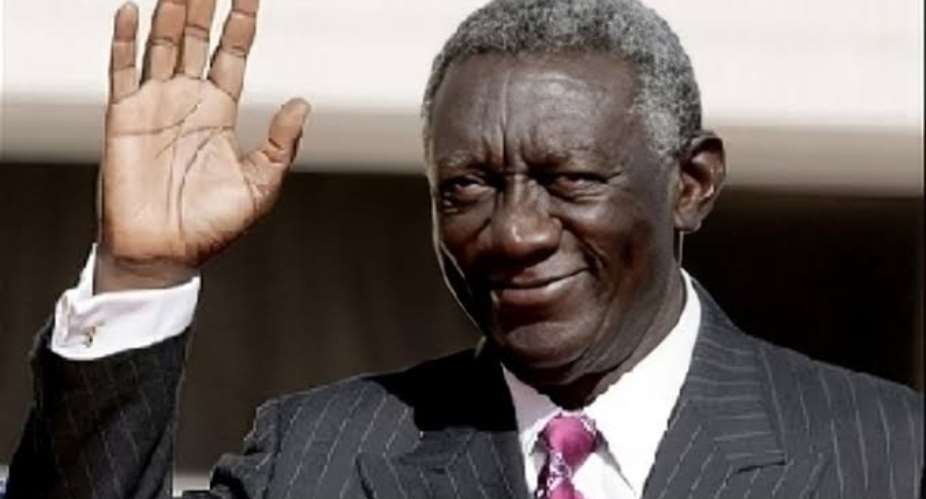
In three weeks, a man who once walked into a London law school at twenty, with almost nothing but a letter and a plan, turns 88. John Agyekum Kufuor is still working. This year he stood before financiers at the London Stock Exchange and told them that "short-term financing cycles are fundamentally incompatible with cocoa's production cycle." Last month the new NPP executives drove to his residence to ask for his guidance. Off the coast of Ghana, an oil and gas production vessel carries his name.
Most Ghanaians know the title: former President, the Gentle Giant. I want to talk about the man underneath it, because a lifetime achievement award should be given to a life, and his life is bigger than his job title.
**A prince who did not behave like one**
He was born on 8 December 1938 in Daaban, a suburb of Kumasi, the seventh of ten children. His father, Nana Kwadwo Agyekum, headed the Oyoko royal family. His mother, Nana Ama Dapaah, was a Queen Mother. In a country that loves a pedigree, you would expect the story to be about entitlement.
It is the opposite. He went to Osei Tutu Boarding School, then Prempeh College, where he did brilliantly. Then he did something his peers did not: he skipped sixth form entirely. He landed in London on 30 April 1959 and by June was admitted to Lincoln's Inn. He was called to the bar in 1961 at the age of 22. The great Kofi Abrefa Busia, who was in exile in Britain, introduced him to his old tutor at Exeter College, Oxford. Kufuor read Philosophy, Politics and Economics there until 1964.
Here is a detail that does not appear in most tributes. In the parliamentary register of the Second Republic, he listed his hobbies as table tennis, reading, football and film shows. The future head of state was a man who loved the cinema and a good rally across a table. He also chaired Kumasi Asante Kotoko, which tells you he understood something about Ghanaian passion long before he asked for anyone's vote.
**The love story that shaped the presidency**
At Oxford he met Theresa Mensah, a Ghanaian nurse and midwife training in Britain, whose brother J.H. Mensah served in Busia's government. They married in 1962 and stayed married for 61 years. They raised five children. Theresa Kufuor died at home in Peduase on 1 October 2023, aged 87. The state gave her a funeral at the forecourt of the State House, and Kumasi gave her another at Heroes Park. Presidents and former presidents came, including Olusegun Obasanjo.
I mention this because we talk about leaders as if they govern alone. Behind this one was a woman who had spent her working life caring for the sick, and I think it is no accident that his flagship reform was about how a poor Ghanaian could get treated without paying cash first.
**The long road to Jubilee House**
His political life began young. He was Town Clerk of Kumasi in 1966. He was a founding member of Busia's Progress Party and served as Deputy Foreign Minister from 1969 to 1972. The coup ended that government, and for years he was out in the cold. He later joined Rawlings's PNDC and resigned after eight months over political differences. It was a decision that cost him comfort and bought him credibility.
Then came the part that tests a person. He lost in 1996. Even Victor Owusu, the senior figure he considered a mentor, declined to endorse him. Many men would have retired with a quiet pension and a good story. He ran again in 2000, won the runoff, and delivered something Ghana had never seen: a peaceful democratic handover of power from one party to its rival. That moment is the quiet foundation of everything our Fourth Republic has become. He was inaugurated on 7 January 2001 and re-elected in 2004. On 7 January 2009 he did the same thing in reverse and handed over power peacefully.
**What he built**
If you want the shortest summary of the Kufuor years, it is this: he took on the state's neglect of ordinary people.
The National Health Insurance Scheme replaced the "cash and carry" system, under which a patient who could not pay upfront could be turned away. It was funded partly by a levy on VAT, which is exactly why it has always been argued about, and it also offered free maternal care for pregnant women.
The Capitation Grant put money into basic schools, beginning with three cedis per child per year. The Ghana School Feeding Programme, launched in 2005, gave kindergarten and primary pupils one nutritious meal made from locally grown food. That was a double win, because it fed children and gave farmers a market. The World Food Prize Foundation credited this programme specifically when it named him a 2011 laureate, jointly with Brazil's Lula da Silva.
He took Ghana into the HIPC debt-relief initiative against popular opinion. A good deal of the later fiscal breathing room traces back to that unpopular decision. He signed Ghana up to the Millennium Challenge Corporation. He expanded Metro Mass Transit. He launched LEAP cash transfers for the poorest households and the National Youth Employment Programme. He abolished the old Senior Secondary School three-year structure and made it four years as Senior High School. Under his watch Ghana qualified for its first FIFA World Cup in 2006, hosted the 2008 Africa Cup of Nations, and he chaired the African Union from 2007 to 2008.
There is a reason the "Golden Age of Business" phrase still sticks to his name. He told the private sector it was a partner, not a suspect. In April he said state dominance had pushed out entrepreneurs, and whatever you think of the politics, it is the same philosophy he governed by.
**The honest ledger**
A Hall of Fame tribute that hides the scars is a brochure. Critics point out that the later years of his government began heavier borrowing, including Ghana's first Eurobond, and that the 2007 power shortages hurt households. Others argue that the Ghana@50 celebrations cost too much, and some opposition voices alleged his government was too close to family and friends. His supporters answer that debt had fallen sharply from the HIPC years, that oil was discovered on his watch, and that no government has delivered everything it promised.
I raise it because Kufuor himself is a man who has never hidden from argument. His own record in the Fourth Republic includes a Reconciliation Commission to reopen national wounds, and repeal of the criminal libel law, which freed our newspapers to criticise him without fear of jail. A leader who frees the press to criticise him has told you everything about his confidence.
**The second career nobody talks about**
When he left office, the world did not let him retire. He became a Global Ambassador Against Hunger for the World Food Programme, chaired the peacebuilding body Interpeace in Geneva, and sat on a commission on reforming the World Bank. The honours followed: the World Food Prize, the Chatham House Prize, an honorary doctorate from the University of Edinburgh, Germany's Federal Cross of Merit and Liberia's Grand Cordon.
What I admire is that he still shows up for the unglamorous argument. He backs a five-year presidential term, saying an election year is a "mad year" and that four years is too short to deliver. He warned his own party to respect popular sovereignty. He told political actors that winning an election does not mean owning the state. And at 87 he stood in London to argue that Africa must stop being the world's cocoa farm and become its chocolate factory. Regardless of your politics, that is a message our whole continent is finally catching up to.
**Why a Hall of Fame**
A Hall of Fame is not for the person who never lost. He lost twice before he won. It is for someone who turned losing into patience, power into policy, and policy into a plate of food for a child in a classroom in Tamale.
I think history will remember three things about him. He proved that Ghana's democracy could change hands without blood. He built the first real safety net that ordinary Ghanaians could touch, from the clinic counter to the school bowl. And he showed that you can hold the highest office, leave it on time, and still be the most respected elder in the room.
Mr President, at nearly 88, this tribute is small beside what you gave. But on behalf of a generation that grew up under your government, and a generation that never knew the cash and carry era, thank you.
*Chief Tutu Baffour Asare Brownsy Williams is an author, columnist and filmmaker, and the founder of Brownsy Silva Company.*


 NDC enjoying benefits of NPP's difficult economic decisions – Fuseini Issah
 Improved economy justifies purchase of new presidential jet – Toobu
 Eight Ghanaian seafarers return home after months in Iranian detention
 No one will be allowed to mess around with a Ghanaian and get away with it – Abl...
 Exim Bank case: Wontumi offers GH¢25m to secure end to prosecution
 Gov't finds $60.68m for presidential jet despite cost-of-living concerns – Abu J...
 Mahama orders performance assessment of all 261 MMDCEs
 Customs orders strict enforcement of permit requirement for right-hand steering ...
 Fitch Solutions projects cedi will weaken to GH¢12.40 against dollar in 2027
 I think Mahama done better than the first term – Archbishop Agyinasare


