




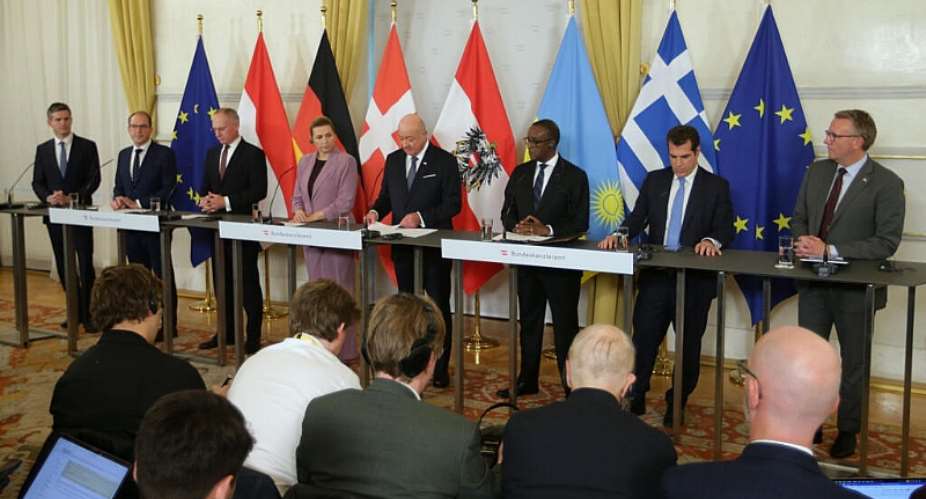
According to a statement issued by Austrian Chancellor Christian Stocker and his Danish counterpart Mette Frederiksen, the negotiations should happen quickly so that the first deportations of rejected asylum seekers who cannot be sent back to their home countries can take place in 2027.
Frederiksen said it is about sending a "clear signal" that "it is no longer possible to enter the European Union illegally with the simple expectation that you can settle there".
The statement said the centre should accommodate around 100 migrants, men and women, whose asylum applications have been rejected in one of the five European countries. They must have exhausted all possible legal avenues of appeal.
There will be no restrictions based on nationality, however minors will be excluded.
For Rwanda, it is an occasion to offer a "second chance" to migrants who are sent there, said the country's Minister of Interior Vincent Biruta. "We are determined to find concrete solutions that truly make a difference."
France and UK scrap migrant exchange deal after one-year trial
'Human rights violations'
Human rights advocates have criticised the plans. In a joint letter, 45 organisations including Sea-Watch and Equinox stated that they are "firmly opposed" to the proposal.
"It is clear that the EU has not learned the lessons from its existing agreements," said Meron Ameha Knikman of the International Rescue Committee, warning of the risks of "serious human rights violations".
In a statement published on Tuesday, Human Rights Watch (HRW) said Rwanda has "a shocking human rights record" and that the plans are "a particularly cruel departure from the founding values of the European Union".
“History has shown that third-country transfers violate rights and cause suffering,” said the organisation's Judith Sunderland. “The choice of a country that has an abysmal human rights record and resists international scrutiny tracks with that history and evokes deep scepticism that any nominal rights safeguards will be respected.”
Spotlight on Africa podcast: Rwanda's new migrant deal
"Amazed at how Austria, Denmark, Germany, Greece and the Netherlands abdicate EU's credibility and values by granting Rwanda – deeply repressive state, involved in abuses in DR Congo and closed to scrutiny – with return deal likely to cause harm," Philippe Dam, HRW's EU advocacy director, posted on social media platform Bluesky.
HRW highlighted the Rwandan government's well-established record of repressing dissent, including attacks on rights defenders.
"Its arrests of critics and dissidents, their ill treatment in detention and the government's interference with the judiciary and failure to investigate suspicious deaths have contributed to a widespread climate of fear and self-censorship," the statement added.
More than half of African migrants remain in Africa, report finds
'Welcome centres'
A site for the centre has been identified, but its location is not being disclosed.
The five EU countries have specified only that it is not one of the centres the United Kingdom had intended to use in a plan announced in 2022, which was subsequently abandoned due to legal hurdles.
Rwandan opposition deplores UK deportation deal as 'modern slavery'
Upon arrival in Rwanda, individuals will be taken in by the Rwandan authorities, granted a residence permit and housed in what Kigali calls "welcome centres". The five EU member States have given assurances that these facilities will be open, with no deprivation of liberty and no barbed wire.
The plan is for deported migrants to remain in the centre for a few months, with the eventual goal being integration into Rwandan society. The EU countries have said that vocational training and language courses will be offered. Migrants in the centre will also have the option to return voluntarily to their countries of origin.
An independent oversight mechanism, the specific terms of which have not been outlined, will be established to ensure human rights are respected, the countries have promised.
Rwanda has also been in talks with Italy to take in migrants trying to reach the country since the summer.


 NDC enjoying benefits of NPP's difficult economic decisions – Fuseini Issah
 Improved economy justifies purchase of new presidential jet – Toobu
 Eight Ghanaian seafarers return home after months in Iranian detention
 No one will be allowed to mess around with a Ghanaian and get away with it – Abl...
 Exim Bank case: Wontumi offers GH¢25m to secure end to prosecution
 Gov't finds $60.68m for presidential jet despite cost-of-living concerns – Abu J...
 Mahama orders performance assessment of all 261 MMDCEs
 Customs orders strict enforcement of permit requirement for right-hand steering ...
 Fitch Solutions projects cedi will weaken to GH¢12.40 against dollar in 2027
 I think Mahama done better than the first term – Archbishop Agyinasare


