




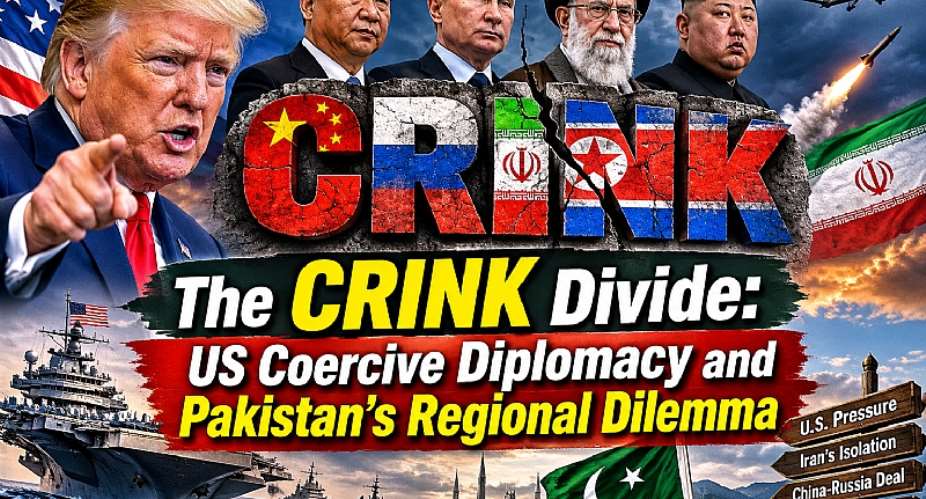
The term “CRINK”—China, Russia, Iran and North Korea—has increasingly appeared in geopolitical commentary as a label for states viewed in Washington as strategic competitors. Yet it is not a unified alliance; its members have different interests and levels of commitment. China and Russia are generally regarded as the more powerful US competitors. Despite the conflict involving Iran and Israel and the continuing war in Ukraine, the Trump administration appears determined to weaken or divide this grouping. Why has Washington invested so much diplomatic energy in Moscow and Beijing, while its engagement with Tehran appears limited? One explanation may be that Russia and China have been offered incentives in return for remaining neutral on Iran.
COERCIVE DIPLOMACY?
The reported arrival of the USS Theodore Roosevelt in the Middle East is being interpreted as an extension of naval pressure or preparation for further strikes against Iran. With three aircraft carriers and up to 10,000 troops reportedly in the region, Washington appears to be using military presence to strengthen its negotiating position. Iran has warned that it will not wait passively and has threatened to respond to any attack. Reports of drone activity around Bahrain have added to the tension. The United States is still pursuing diplomatic channels through Qatar and Pakistan, but if these efforts fail, could military force become the next option? Is the build-up intended to compel concessions or signal another confrontation?
WHAT DOES IT OFFER RUSSIA AND CHINA?
For Russia, the potential bargain could be substantial. Some analysts interpret the proposed terms as including recognition of Russian control over roughly 20 per cent of Ukrainian territory, limits on Ukraine’s NATO alignment, and the easing of sanctions affecting Russian energy exports, including diesel. Russia has received Shahed drones from Iran, but its own production capacity may have reduced its dependence on Tehran. Would Moscow risk those benefits by continuing to provide Iran with satellite imagery, communications support or advanced air-defence assistance, including the S-400 system? A reduction in such support would increase pressure on Tehran. These possible concessions remain interpretations, not confirmed terms of an agreement.
For China, the incentives may be even more attractive: access to advanced AI chips, improved trade arrangements and reduced tensions with Washington. Allegations that a Chinese company used AI-related activity to gather information for Iran before the February attacks have complicated the relationship, although such claims require evidence. Will Beijing place economic and technological priorities ahead of its strategic relationship with Tehran? Have Araghchi’s visits to China and Russia been overtaken by the prospect of more lucrative arrangements with Trump? Do they value Iran enough to jeopardise their own interests?
WAS ARAGHCHI’S VISIT TO PAKISTAN A LAST CALL?
On 17 November, Abbas Araghchi’s meeting with Chief of Defence Forces Field Marshal Asim Munir followed up on Munir’s earlier visit. Araghchi reportedly brought a two-day reopening proposal, while Tehran’s conditions remained unchanged: an end to the blockade, the unfreezing of Iranian assets and negotiations over war compensation before returning to the table. The US secretary of state has described these demands as absurd and unacceptable. Trump has reportedly urged Pakistan, Qatar and Turkey to restrict transit routes. Pakistan’s temporary closure of routes for two days, followed by their reopening, may show the limits of Islamabad’s willingness to apply pressure when doing so also damages its economy.
Araghchi’s assurance that Iranian territory would not be used against Pakistan carried another message amid concerns over Balochistan and border security. Any suggestion that Iran might use the BLA or TTP against Pakistan is a grave allegation, not an established policy. Nevertheless, the possibility of proxy conflict shows how quickly regional pressure could spill across the frontier. Pakistan cannot treat instability next door as a distant issue.
Russia and China may recalibrate their relationships with Iran from a distance. Pakistan cannot. Geography makes Tehran a permanent neighbour. Islamabad must maintain diplomatic space with Washington, preserve working relations with Tehran and avoid becoming an instrument in a campaign to isolate Iran. If Moscow and Beijing are moving towards their own bargains, how long can Pakistan balance both sides—and at what cost? Alliances can change, but a neighbour cannot.


 “She kissed me first” – Labone SHS French teacher tells court in indecent assaul...
 NDC enjoying benefits of NPP's difficult economic decisions – Fuseini Issah
 Improved economy justifies purchase of new presidential jet – Toobu
 Eight Ghanaian seafarers return home after months in Iranian detention
 No one will be allowed to mess around with a Ghanaian and get away with it – Abl...
 Exim Bank case: Wontumi offers GH¢25m to secure end to prosecution
 Gov't finds $60.68m for presidential jet despite cost-of-living concerns – Abu J...
 Mahama orders performance assessment of all 261 MMDCEs
 Fitch Solutions projects cedi will weaken to GH¢12.40 against dollar in 2027
 I think Mahama done better than the first term – Archbishop Agyinasare


