




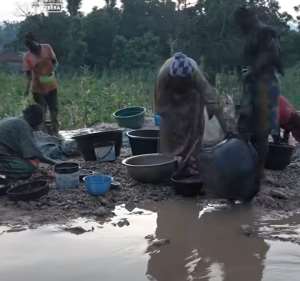
Behind the pits where Nigeria's lithium is dug, dozens of women crouch over discarded rock and sift through mounds of waste. They are looking for traces of ore that the miners missed, which they gather, sack and resell. For this work they take home about $15 a week.
The industry they sit beside is estimated to be worth over $34 billion. That gap, between a sector valued in the billions and the hands that clean up after it, shows who benefits from Nigeria's mineral rush and who does not.
A rush driven by global demand
Lithium is a key component in electric vehicle batteries and energy storage, and growing demand has created a new frontier for mining in Nigeria.
The country's mining sector is overwhelmingly informal, which makes it difficult to trace lithium as it moves along the supply chain. Reporting from several states shows many small-scale miners operate without official permits, and women and children are involved in excavating lithium to sell to buyers.
For some, the trade pays. AFP reported that a miner filling three sacks in a day earned double Nigeria's monthly minimum wage. The women who work the waste sit at the bottom of that chain. They have no pits of their own and no permits, only the leftovers.
Value leaving the village
The government wants more value kept at home. It aims to refine lithium domestically, and a processing plant opened in Kaduna State in May 2024 as a joint venture between the state government and Chinese company Ming Xin Mineral Separation Nigeria Ltd. But Climate Home found the plant has struggled to deliver on its early promises, with local residents reporting unmet expectations.
Elsewhere, AP's reporting from Nasarawa described buyers who admit to paying bribes to continue operations, a sign of how weak enforcement and corruption sustain the informal trade.
The result is a supply chain in which ore passes through many hands, and the lowest paid are those closest to the ground.
What needs to change
Formalise and protect small-scale work, including cooperatives that bring waste pickers into the legal economy.
Enforce safety and labour standards, since sifting mine waste exposes workers to dust and unsafe ground.
Make local benefit real, so processing plants deliver jobs and community investment, not just export volumes.
Trace the supply chain, so buyers and processors can account for where their ore comes from.
Lithium may power the clean energy transition abroad. At home, the women sifting its waste for $15 a week are asking a simple question: when the billions flow, where is their share?
Credit Aljazeera English Light Oriye Tamunotonye.
Mustapha Bature Sallama
Medical/ Science Communicator,
Private Investigator, Criminal Investigation and Intelligence Analysis,
International Conflict Management and Peacebuilding. (USIP)
[email protected]
+233555275880
References
Associated Press (via KTVZ), "Takeaways from AP's report on child labor in Nigeria lithium mines," 11 Dec 2024. Source for lithium demand driving a new mining frontier in Nigeria. https://ktvz.com/news/2024/12/11/takeaways-from-aps-report-on-child-labor-in-nigeria-lithium-mines/
Africanews, "Sweat and stone: The children powering Nigeria's lithium boom," 12 Dec 2024. Source for buyers admitting to paying bribes, weak enforcement, and toxic dust and unsafe conditions at illegal mines. https://www.africanews.com/amp/2024/12/12/sweat-and-stone-the-children-powering-nigerias-lithium-boom/
AFP, "Nigeria's lithium mining Eldorado sparks concerns," 6 Feb 2025. Source for miners operating without permits, women and children working at artisanal sites, and a miner earning double the monthly minimum wage by filling three sacks a day.
Inquirer: https://business.inquirer.net/?p=505267
The Guardian (Nigeria): https://guardian.ng/?p=2530819
Climate Home News (also published by Premium Times), "Nigeria's push to cash in on lithium rush gets off to a rocky start," 8 Jul 2025. Source for the informal mining sector, the difficulty of tracing lithium, and the Kaduna plant (KMDC and Ming Xin Mineral Separation Nigeria Ltd, inaugurated May 2024). https://www.climatechangenews.com/2025/07/08/nigerias-push-to-cash-in-on-lithium-rush-gets-off-to-a-rocky-start/
Business & Human Rights Resource Centre, "Nigeria: Lithium processing project faces social and human rights challenges." Source for the Kaduna plant's unmet promises to local residents. https://www.business-humanrights.org/fr/dernières-actualités/nigeria-lithium-processing-project-faces-social-and-human-rights-challenges/
Kehinde Ogunyale, Dataphyte, "Inside Kogi State's Lithium Mine," 29 Apr 2025. Source for women and children excavating lithium in Ejiba, Kogi State. https://www.dataphyte.com/topic/extractive/inside-kogi-states-lithium-mine-foreign-interests-community-tensions-security-concerns-disrupt-operations


 “She kissed me first” – Labone SHS French teacher tells court in indecent assaul...
 NDC enjoying benefits of NPP's difficult economic decisions – Fuseini Issah
 Improved economy justifies purchase of new presidential jet – Toobu
 Eight Ghanaian seafarers return home after months in Iranian detention
 No one will be allowed to mess around with a Ghanaian and get away with it – Abl...
 Exim Bank case: Wontumi offers GH¢25m to secure end to prosecution
 Gov't finds $60.68m for presidential jet despite cost-of-living concerns – Abu J...
 Mahama orders performance assessment of all 261 MMDCEs
 Fitch Solutions projects cedi will weaken to GH¢12.40 against dollar in 2027
 I think Mahama done better than the first term – Archbishop Agyinasare


