




Introduction
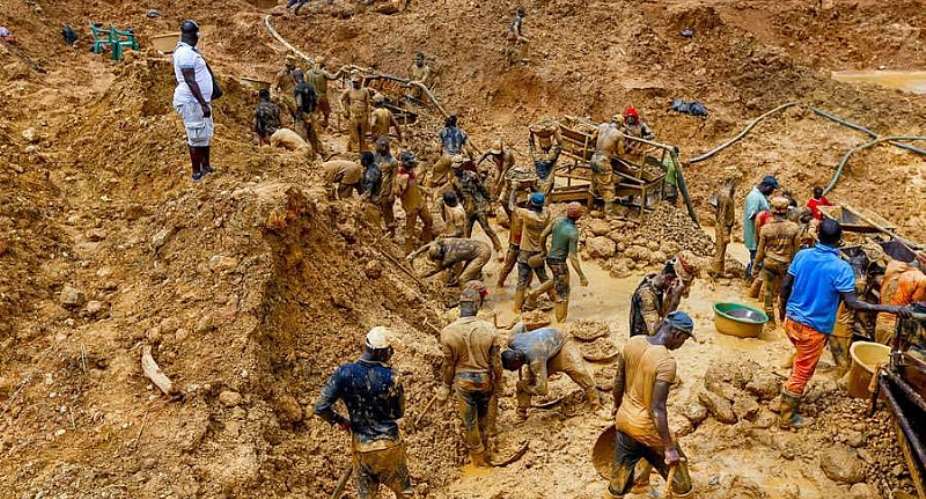
Galamsey. One loaded word that encompasses culture, politics, economics, social and environmental reality, and history – of mining – in Ghana. Policymakers, politicians, traditional leaders, academics, the media, advocacy groups, and individuals have grappled with galamsey – and so far, lost. Citizens now have a love-HATE relationship with galamsey.
From its emergence to the not-too-distant past, galamsey was the glorious center of many communities’ livelihoods and indeed, Ghana’s political economy: funding for education, social events, and traditional administration; trade in various goods and services; stories of bravery, discovery, and sharing; symbolic space of indigenous claim to, share in, and ownership of Ghana’s mineral wealth; and hope of a prosperous future. Today, galamsey is the opposite of the pride and prosperity it provided, and the hope for posterity it promised.
Galamsey now features prominently in global development discussions, often as a troubling subject because Ghana’s artisanal and (debatably) small-scale mining (ASM) now triggers serious and concerning development challenges. Indeed, galamsey features considerably – if even tacitly – in Ghana’s foreign policy enactments and was at the center of recent unfortunate diplomatic theatrics with China. Galamsey has earned an entry into the online Oxford English Dictionary largely because of its unpopularity in recent Ghanaian development history.
For its notoriety as a major development concern and an unfolding security threat, galamsey is a subject of extensive “expert” commentary. Experts have often proffered “the” solution to galamsey. Governments, too, have variously adopted “the” solution. Yet galamsey persists and worsens. Why?
Citizenship. Galamsey has lost an essential founding element: selfless and patriotic citizenship. Galamsey – as concept and practice – emerged from a deep sense of citizenship, community resilience, and survival. Indeed, galamsey provided a founding impetus for anti-colonial struggles and eventual realization of independence and Ghanaian citizenship. Today, that sense is lacking in policy and governance action. Citizenship now appears taken for granted in deliberations and
action on galamsey – and dare I say, in all else. Beyond expert scholarship, policy advocacy, activism, and all efforts, addressing galamsey requires the boldness of humble, honest, and resilient citizenship. A sense of patriotic commitment to the nation – especially posterity – should drive and guide decision and action on galamsey at all levels. Individually, Ghanaians need to reflect on a simple question: Am I doing my duty as a citizen in my decisions and actions, mindful of and committed to the nation’s children and their children and their children?
This piece aims to invite sober private reflection on the reality of galamsey as a national crisis that requires individual commitment to collective action: it aims to encourage a reflection guided by the responsibility of private individual citizenship, and not parochial and petty partisan public showmanship. Based on a critical history of the phenomenon and etymology of the term “galamsey,” the article highlights citizenship (the poverty of it) in the narrative and national attitude toward galamsey. The paper urges a citizen-centered rethink on galamsey, mindful that indigenous ownership of mineral wealth is a matter of geopolitics and survival, which the original galamsey guaranteed and today’s destructive galamsey denies.
Galamsey: A Janus-Faced History and Etymology
“Let’s gather them and sell,” the phrase whose corruption is now “galamsey,” originally represented resistance to colonial extractivism. Colonial mining policy and practice sidelined, marginalized, and frustrated the indigenous mining economy in (West) African communities. In response, indigenes, who had long been mining in individual and small group artisanal effort before the arrival of colonial capital, pooled resources together to mine, sell, and share the proceeds. This simple act of non-violent resistance to colonial extractivism rescued the ancient indigenous tradition that, by 7th century AD, already connected West Africa to Arab minerals markets. Thus, a glorious political economy of indigenous mining was born with its own name: Galamsey.
A second phase of galamsey as resistance was in response to neo-colonial capitalist extractivism. This time, resistance involved direct state intervention with promulgation of the 1989 PNDCL218, establishing artisanal mining as a lawful indigenous (only) economic activity and sector. The intervention was to address
the impact of global corporate interests on indigenous mining activity. By the mid-1980s, the minerals market became increasingly inaccessible to indigenous artisanal miners, who were again re-branded as illegal by growing capitalist interests. Global policy through structural adjustment programs also caused massive retrenchment of indigenous mineworkers and denied many families and communities a livelihood. The state’s intervention enabled artisanal miners to maintain their trade and livelihood. Good old galamsey survived again as a source and representation of indigenous economic emancipation.
The success of these resistance phases opened the artisanal mining sector to the larger Ghanaian society, attracting the youth slowly and eventually in droves.
Education, having gradually become extensively monetized and costly, and traditional agrarian economic activities starting to dry up and die with a confusing mix of drought and floods, families saw a new source of educational and livelihood fund in galamsey. Gradually, however, galamsey turned (self)-destructive and into a danger to society.
The promise and profits from the new and unregulated economic activity attracted even larger numbers and profiteering capitalist interests. Growing inattentive state attitude, inter-agency friction, partisanship, and apathetic citizenship unleashed a slow violence that speedily contaminated a hitherto glorious indigenous economic culture. State officials changed from “referees” to “players” in the new and destructive galamsey game. Land custodians began to betray the land by not only shirking responsibility, but also, becoming complicit in its destruction for the expansion of galamsey ambitions and profits. The glorious character of the activity and meaning of the contracted phrase, “Let’s gather them and sell” that awakened a people’s anti-colonial conscience soon became the instrument of their very destruction.
Enter the new galamsey. Today’s galamsey is a major (if not the main) site of insecurity in Ghana: destruction and violence that has developed a vibrant trade in small arms, drugs, and humans for cheap labor, prostitution and other purposes; a dangerous enticement of Ghana’s youth and detraction from education and meaningful human development. Galamsey, the new destructive kind, now extends
beyond mining and mining sites. Galamsey has become a national crisis, connecting nearly all development sectors and processes.
The term that represented resistance to exploitation, now names a costly reality and encourages pervading patterns of questionable professional culture in the entire political economy of Ghana, including even in education. For some reasons, good or bad, teachers, even at the highest level of learning, have developed their own kind of galamsey ostensibly inspired by that in the mining fields: fulltime teachers chase after temporary teaching jobs at the expense of performing duties in their permanent posts. Institutions, mostly private, also encourage the art of “teacher galamsey” because it supplies cheaper labor and better profits. Other professions have similar practices. Galamsey in its new inglorious form has migrated from the mines into the larger Ghanaian professional and broader political economic spaces. Galamsey is no longer just a mining issue. Galamsey now rules the conscience and actions of Ghanaians in spaces far-removed from the mines. Dangerously, the trend is (expected to be) normal.
Parochialism Versus Citizenship: The Research
My doctoral research examined cross-scale actor interaction in global policymaking, based on the Minamata Convention on Mercury. The convention highlights artisanal and small-scale gold mining (ASGM), the largest source of anthropogenic mercury emissions (nearly 38%) out of over ten sources. In my reading on galamsey during my doctoral research, I came across a local newspaper cartoon depicting a miner chasing President John Mahama from the mining fields. The depiction represented miners’ refusal to engage government, even after the president reached out to them. The research told a different story overall: government persecution, state bias and neglect of ASM were recurring themes.
Had it become too late to engage miners? How then would Ghana implement the Minamata Convention, whose relevance in Ghana is largely with ASGM? This ignited my interest and drove my research.
In the years of research and extensive field encounters that followed till date, I found, among others, how a poor sense (even lack) of citizenship underlies the destructive and inglorious new galamsey. The trend manifests in various forms,
levels, and spaces. For many state officials, miners, and local communities, Ghana hardly matters in their roles within the sector. Money does: it fuels, drives, and steers decision and action along the ASM value chain. State officials compete for prominence and control over – instead of collaborating on – governance processes, incentivized by the profitability of the resulting non-governance. Political leaders bask in the vindication and fuel technocratic competition gives their petty partisanship at the expense of resolute national effort. Traditional leaders, who are indigenous land custodians, cash in and look away while galamsey destroys the lands under the care. Popular “anti-galamsey” demonstrations have increasingly become lame periodic rituals, often exploited by self-seeking elements to advance personal and/or parochial political, commercial, and other ambitions.
Ghanaians have become galamsey to galamsey, while galamsey gains momentum, matures, and increases its destructiveness. Generally, parochialism, partisanship, and finger-pointing competitiveness bedevil Ghana’s ASM governance, as citizenship slowly whittles away from the indigenous economic sector. Groups and individuals negotiate self-interested outcomes, while governance fallows. Of course, efforts by some individuals provide hope. Those isolated examples must be applauded, encouraged, and used to inspire national conscience and effort on galamsey.
Insecurity, Governance Fragmentation, “Sankofa” and the Miner
Security challenges, traditional and human, resulting from galamsey have become extensive and elusive, but still seriously underperceived. Observable dangers include arms proliferation, river pollution, deforestation and destruction of farmland, “strange” diseases, still births and deformities, human trafficking and exploitation, and conflict. Galamsey-related deaths are rampant, some unreported. Indeed, galamsey is the reason for the national tragedy that claimed eight illustrious lives in a 2025 helicopter crash. The crew were on the way to attend an event on galamsey in Obuasi, one of Ghana’s major mining communities. The tragedy remains with us; and so does galamsey. The extent and totality of galamsey-induced insecurity in Ghana is more alarming than ordinarily observable: a slow violence is engulfing the nation in extensive contamination of life and life sources. Nonetheless, Ghana struggles to commit to tackling galamsey. Successive
governments merely scratch it, often driven by a desire to leave a faded electoral footprint than a resolute indelible national stamp on galamsey.
Interestingly, however, Ghana’s ASM governance has numerous instruments and actors, creating fragmented governance architectures that fail to deliver any governance. Besides, use of inefficient, temporary, and unsustainable measures has become the governance approach of choice over time.
In the vacuum, some miner groups establish field governance systems based on indigenous knowledge and land use practices. Centered on individual and collective responsibility among the living, indigenous philosophy on land use teaches the living (custodians) to protect and preserve the land for its true owners, ancestors and especially posterity. This is the core of sustainability. Responsible and well-meaning miners have reached back – in the indigenous Akan philosophical act of “Sankofa” – to draw on the wisdom of bygone times on land use and governance that reflects today’s global development thinking: sustainability. Of course, other miners care less and readily destroy everything in their way. That behavior represents today’s galamsey and it is different from the traditional artisanal mining, which genuine miners practice and govern with the wisdom of indigenous land use philosophy.
Perhaps, the state needs to draw motivation from the genuineness of responsible artisanal miner agency and lessons from their “Sankofa” governance model. This may well be a key and agreeable platform for renewed government-miner engagement. Human security, sustainability, and posterity require vigilant performance of today’s land custodial roles. Today’s destructive galamsey is the antithesis to this noble/singular responsibility.
Galamsey, Citizenship and the National Reset Agenda
President Mahama returned to office in January 2025 on a reset agenda. Ghanaians accepted reset as a welcome national imperative and gave him a historic mandate. At his inauguration, the President made “a patriotic call to action” and the crowds cheered in agreement – a symbolic launch of the reset Ghanaians endorsed.
Ghana must recognize that citizenship is core to a national reset. A true and practical response to the President’s patriotic call involves renewal and recommitment in attitudes to the nation. Citizenship must be cultivated and nurtured daily from the moment it is conferred. Citizenship develops in selfless daily “patriotic action” – when no one is watching. Sir Kofi Kumado, in “A Handbook of Constitutional Law of Ghana and its History,” underscores the complex legal developments on Ghanaian citizenship, and concludes that Act 591 may require “cleaning up.” Indeed, apart from the law, the fact of citizenship in Ghana needs cleaning up, re-invigorating, even re-cultivating: a reset.
Good national policy reflects in and depends on such committed patriotic citizenship along the process and across levels. Over the years, absence of that citizenship in the policy thinking and governance action on ASM has gradually produced today’s monstrous galamsey. Under section 317(1) of Ghana’s Criminal Offences Act, 1960 (Act 29), mineral smuggling is a crime that carries severe punishment (previously including death). Yet, evident by a key element in the mission of the new Gold Board, “combating gold smuggling,” the practice has persisted despite the 1960 law. One wonders: is it perhaps the product of a mix of good policy/law and bad citizenship?
Leadership and governance (initiatives, policy, program, projects) should endure beyond tenures, and be inspired by commitment to posterity, not prominence and longevity of political and/or professional career. Ghana’s reset will not take one presidential term and should not rest on a president or a government. Individuals, groups, and communities must daily renew the commitment to citizenship and patriotic responsibility to the nation in mentality, attitude, and action – through little daily acts of selflessness to the nation.
A national reset, founded on renewal and recommitment of citizenship, is especially necessary on galamsey. Citizenship is central to the problem of and solution to galamsey. This citizenship gave galamsey its name, the resilient indigenous mining political economy and culture, and a descent source of livelihood to many families and communities. Today, galamsey longs for that same resilient patriotic citizenship in individual decision and action. Galamsey requires a readiness and willingness to protect, defend and preserve the land for posterity – in
simple selfless and private individual daily choices over the long-term and not public partisan showmanship in quick fix “solutions” that have four-year tenure lifespans.
Conclusion
Ghana needs a sober, deep, and long national reflection on the meaning and essence of citizenship – renewed, reset. Galamsey requires that reset. Mining communities depend on that reset. Ghana deserves that reset: a reset mentality and attitude to the country that gave birth to and provides a stable home for its inhabitants.
Then perhaps, galamsey can hope to regain its original resilient and glorious spirit, which fought colonialism and neo-colonialism; then, galamsey can truly champion indigenous economic emancipation – for all Ghanaians. Without its current destructive nature, galamsey is not only an essential source of livelihood, but also, represents indigenous resistance to colonial capitalist exploitation and promise of economic emancipation in an unforgiving global geopolitical environment.
Can galamsey regain its original glory? Is Ghana ready to reset galamsey to its glory state for posterity? The answer is in genuine individual introspection and selfless re-commitment to sustained action – especially when no one is watching. Perhaps, (now) knowing that galamsey was once glorious is helpful guide and inspiration.
Timothy A. Balag’kutu, PhD
Lecturer, Centre for peace and security research
University of Professional Studies, Accra
([email protected])

 Lawyer withdraws from Sky Train trial over dispute on Asamoah's testimony
 "I don't wait to be chased out, I've made my choice" — Asiedu Nketia on leaving ...
 Afia Schwarzenegger sentenced to 63 days in prison for contempt of court in Samm...
 Otumfuo cautions against undermining businesses linked to past administrations, ...
 Otumfuo urges banks to increase lending to private businesses instead of relying...
 Mahama urges private investors to guarantee markets for local farmers
 'If you are a consumer and not a producer; you will never create jobs and prospe...
 I want to see Ghanaian firms supplying regional markets, establishing production...
 'I encourage you to invest in Ghana, one of Africa’s most stable and dependable ...
 Ghana Air Force receives new Falcon 6X presidential jet to replace 16-year-old a...


