




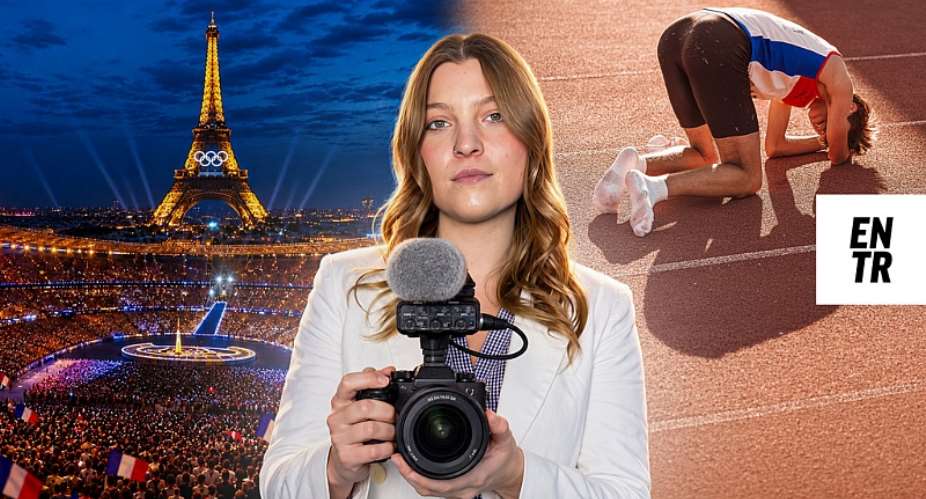
During the Paris Olympics, France sold us a vision of the perfect sports nation. At the time, President Emmanuel Macron promised the Games would bring lasting change to the country. Yet two years on, sport appears to no longer be a priority on his government's agenda.
The ENTR team spoke to many young French athletes, all of whom denounced a lack of support and funding. Even the most talented and successful sometimes struggle to finance their careers, particularly in certain disciplines. As a result, athletes have to find alternative ways to make ends meet.
Read more Paris 2024: One year on, what legacy have the Olympics left?
For many, the solution is social media. Views, likes and followers are all a gateway to sponsors, and therefore to income. But becoming a content creator, and a successful one at that, requires many hours of work – hours that athletes struggle to reconcile with their busy training and competition schedules.
Budget cuts and disappointment
According to the French National Association of Elected Officials in Charge of Sports (Andes), the budget allocated to sports has fallen by nearly 30% between 2024 and 2026, and the same trend is projected to continue in 2027.
Olympic fencer Luidgi Midelton and Olympics high-jumper Solène Giquel, both of whom represented France in the Paris Games, noticed a striking difference in the attention and support given to athletes pre and post Olympics.
“As soon as the Games ended – even though we had an incredible Olympics, with plenty of medals, and we expected to ride on that wave – the opposite happened, and a lot of funding disappeared,” says Luidgi. “It's like we were interesting in the moment, but then nothing was left in the aftermath,” agrees Solène.
Myriam Benadda, a 25 year-old MMA fighter, has felt this lack of interest in athletes firsthand. Even more so given that she practices a non-Olympic sport.
Despite being European champion and world runner-up in her weight-category, the fighter receives minimal support from her federation and doesn't win any prize money during competitions, making it impossible for her to live from her sport. “When I talked about it on social media, people were shocked,” she says.
The same is also true for Romane Cloteaux-Foucault, France's number two female badminton player. To maintain her ranking she has to compete in tournaments around the world, making bills stack up fast. She estimates that a single season costs between €20,000 and €25,000. Yet her federation only covers about 10% of that amount. The rest she has to make up for herself.
“We promote a sport that's open to everyone,” she says, “but competing at the highest level isn't.”
Becoming an “athlete-influencer”
To support herself and fund her career, Romane, like many other elite athletes, turned to social media. “I was looking for sponsors. And I figured that since I didn't appear on TV, I had to do this… I needed followers to sell to people.”
From reenactments of viral trends and training videos, to behind-the-scenes glimpses of her personal life, Myriam is no stranger to any of this. The fighter, who left her job in finance to devote herself full-time to MMA, has given herself until the end of 2026 to make a living from her sport. So she doesn't skimp on her content creator duties, posting at least once a day.
It's a substantial workload that takes up all her free time between her two daily training sessions. And, like Romane, she wishes things could be different, that more support was available.
While contracts do exist for some athletes – notably those offered by the French National Sports Agency (ANS) – they're only available to a handful of select individuals. For the rest, there are a handful of other alternatives: a part-time job, fundraising, becoming an ambassador for the French military or police, or simply relying on the support of relatives.
Yet for the young athletes we spoke to – who wish to dedicate their lives to their sports, and are expected to win medals for their country at the highest competitive level – none of these solutions are fully satisfying.
President Macron said he wanted to “prepare for the future” through the Paris Games, but to many in the sport world is appears that hosting the Olympics didn't really improve the situation for French athletes, nor leave behind the legacy they had hoped for.


 Lawyer withdraws from Sky Train trial over dispute on Asamoah's testimony
 "I don't wait to be chased out, I've made my choice" — Asiedu Nketia on leaving ...
 Afia Schwarzenegger sentenced to 63 days in prison for contempt of court in Samm...
 Otumfuo cautions against undermining businesses linked to past administrations, ...
 Otumfuo urges banks to increase lending to private businesses instead of relying...
 Mahama urges private investors to guarantee markets for local farmers
 'If you are a consumer and not a producer; you will never create jobs and prospe...
 I want to see Ghanaian firms supplying regional markets, establishing production...
 'I encourage you to invest in Ghana, one of Africa’s most stable and dependable ...
 Ghana Air Force receives new Falcon 6X presidential jet to replace 16-year-old a...


