




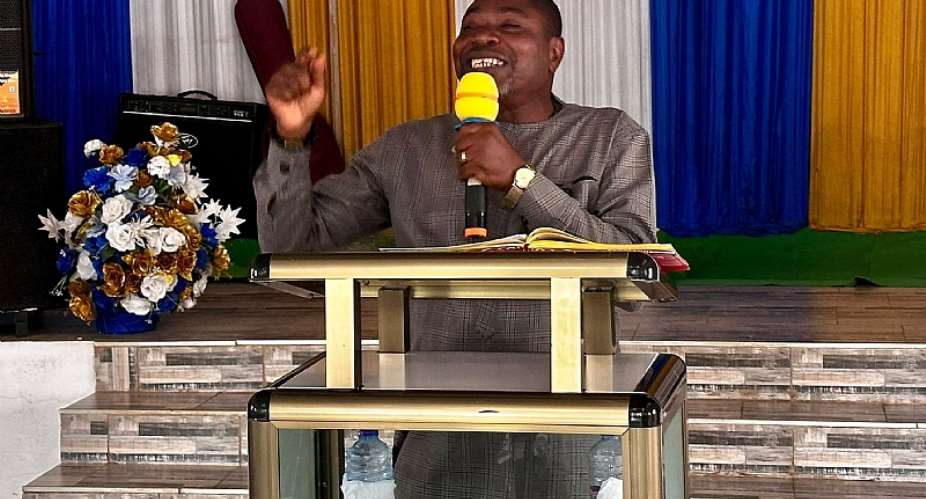
The Commission on Human Rights and Administrative Justice (CHRAJ) has urged spouses, particularly women, to familiarise themselves with the legal provisions governing marriage, divorce and property ownership, warning that ignorance of their rights could expose them to abuse, intimidation and financial losses.
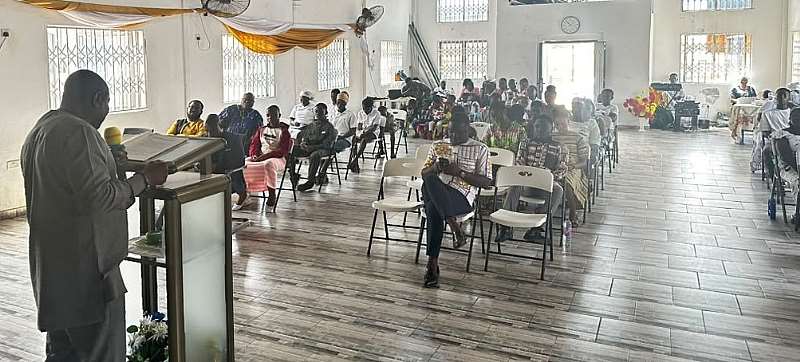
The call was made on Saturday, November 8, 2026, during an engagement between officials of CHRAJ's Madina Municipal Office and members of Amazing Grace Baptist Church at East Legon Hills.
The event, organised as part of the church's Women's Fellowship Week, was held under the theme “Empowering women through legal and biblical perspectives: Understanding rights in marriage, divorce, and the sharing of spousal property.”
The delegation was led by the Municipal Director of CHRAJ, Mr John Ato Breboh, who was accompanied by investigators from the office.
Addressing the congregation, Mr Breboh drew on several biblical passages, including Ephesians, Colossians, First Peter, First Timothy, Exodus and Malachi, to explain the principles underpinning marriage.
He described marriage as an institution established by God and founded on love, commitment, partnership and shared responsibility.
“Marriage is meant to be a place of safety, partnership, and mutual honour. It is an institution established by God and founded on love, commitment, partnership, and mutual responsibility,” he said.
However, he expressed concern that marriage had become a source of fear and deprivation for some spouses, particularly women.
Referring to reported cases of marital abuse, Mr Breboh said understanding one's legal rights and the institutions mandated to protect them could help individuals identify abusive situations and seek assistance before they escalated.
He explained that Ghana recognises three principal forms of marriage: customary marriage, Mohammedan marriage under Cap 129, and ordinance marriage under the Marriage Ordinance, Cap 127. He noted that each carries distinct legal requirements and consequences, particularly when a marriage is dissolved.
On ordinance marriages, he outlined several legal protections, including monogamy, mutual maintenance obligations, formal divorce procedures, equitable distribution of spousal property and financial support following divorce.
He also highlighted the Intestate Succession Law, 1985 (PNDCL 111), which regulates the distribution of the estate of a person who dies without leaving a will.
“Understanding the form of marriage you contracted is critical for inheritance and for protecting surviving spouses,” he said.
Touching on Article 22 of the 1992 Constitution, Mr Breboh explained that the provision recognises the property rights of spouses and requires equitable distribution of jointly acquired property when a marriage is dissolved.
He added that Article 18 guarantees individuals the right to own property either independently or jointly, emphasising that marriage does not take away that entitlement.
“A spouse may acquire property in their own name, although the circumstances of acquisition and the parties’ intentions may be relevant in determining each person’s interest,” he explained.
Mr Breboh further distinguished between jointly acquired assets and personal property, noting that property acquired before marriage or received through gifts and inheritance could be treated as separate property, depending on the circumstances and applicable law.
He also drew attention to provisions in the Land Act, 2020 (Act 1036), particularly Section 97(3), which addresses situations where one spouse registers jointly acquired property solely in their name without notifying the other spouse.
According to him, the law presumes that such registration was undertaken on behalf of both spouses.
He also cited Section 47 of the Act, which requires the written consent of the other spouse before jointly acquired marital property can be transferred, sold or sublet to a third party. He said a transaction undertaken without the required consent is void ab initio in favour of the other spouse.
The CHRAJ director further referenced Section 16 of the Matrimonial Causes Act, 1971 (Act 367), which deals with maintenance, and Section 13 of the Wills Act, 1971 (Act 360).
He explained that the latter provision empowers the High Court to vary a will where reasonable provision has not been made for a spouse or a child under 18 and the omission is likely to cause hardship.
Together with PNDCL 111, he said, these legal provisions provide safeguards to prevent spouses and children from being left without adequate support or being unfairly deprived of their entitlements.
On the grounds for divorce, Mr Breboh explained that the Matrimonial Causes Act provides for the dissolution of a marriage where it has broken down beyond reconciliation.
He said this must be established through evidence of circumstances such as adultery, unreasonable behaviour, desertion for at least two years, separation for two years with the consent of both parties or five years without consent, and the failure of reconciliation efforts despite diligent attempts.
He emphasised that courts consider both financial and non-financial contributions when determining the distribution of property acquired during marriage.
“Marriage is not a commercial venture where spouses must keep receipts,” he said.
However, he referred to the case of Joana Quaye v. Richard Nii Armah Quaye, in which Justice Justin Kofi Dorgu stated that marriage should not be treated as an investment that automatically entitles a spouse to make unsupported financial claims. He explained that parties must still provide evidence of their contributions.
Mr Breboh also clarified that equitable distribution does not necessarily mean an automatic 50:50 division of marital property, as courts consider the nature of the assets, the contributions of each spouse and the overall circumstances of the case.
Concluding his presentation, he urged women to understand both their biblical responsibilities and legal entitlements, encouraging those experiencing difficulties in their marriages to seek help rather than remain silent.
“Do not remain passive when your marriage becomes unhealthy. Seek assistance. Use the legal avenues available,” he advised.
He said the engagement formed part of CHRAJ's mandate to promote and protect human rights through public education, adding that taking the discussion into a church demonstrated that religious values and the law could complement each other.
“Knowledge of your rights is essential to protecting your dignity, your security, and your interests within marriage,” Mr Breboh said.





 Food suppliers to picket Ghana Commodity Exchange, NAFCO over unpaid Free SHS de...
 Nvidia board rules that co-founder Jensen Huang will not return as CEO
 Residents of Dermar alarmed after white coffin containing dead fowls discovered
 'NPP rented jets for $18,000 to $22,000 per hour' – Kwakye Ofosu defends new pre...
 'We need Dangote, but what about Ghanaian businesses you are destroying with par...
 Two vehicles catch fire at Ecobank-Papaye compound in Lapaz
 Rent Control drags UGEL to AG over hostel fees, room conditions
 One person burnt, 50 STC buses salvaged in Circle Railways fire - GNFS
 Mahama to attend West Africa Integrated Investment Summit in Sierra Leone
 Afenyo-Markin accuses govt of politically targeting local businesses over unpaid...


