





As the Minister of Finance stood before Parliament to present the 2027 Budget Statement and Economic Policy, the stakes for Ghana’s energy sector had never been higher. Framed against the backdrop of a structurally challenged power sector and the global scramble for critical minerals, the 2027 budget represents a watershed moment.
For decades, Ghana has navigated the precarious "Energy Trilemma": balancing energy security, equity and environmental sustainability. With legacy take-or-pay obligations and distribution losses historically straining the public purse, the 2027 budget attempts to rewrite the narrative. It positions the energy sector not as a fiscal burden, but as the primary engine for Ghana's green industrial renaissance and investment that will propel growth in other sectors.
Key Energy Policies and Programs for 2027
The 2027 budget outlines several ambitious, yet plausible, interventions designed to operationalize Ghana's National Energy Transition Framework. The government is moving to actionable, much-needed, funded programs:
The Accelerated E-Mobility Initiative (2027-2035): Aligning perfectly with the National Electric Vehicle Policy (2023), 2027 marks the official transition from the preparatory phase to the "accelerated uptake phase." The budget seeks to introduce zero-rated import duties for EV components destined for local assembly, deliberately shifting the focus from importing finished electric vehicles to domestic manufacturing.
Grid Modernization and Smart Charging Fund: Acknowledging that adding thousands of EVs to the grid could trigger localized network congestion, the budget allocates substantial capital to upgrade distribution transformers. Furthermore, it mandates the rollout of "Smart Charging" infrastructure, using time-of-use tariffs to shift EV charging to off-peak hours and stabilize a grid projected to hit peak demand of over 4,125 MW.
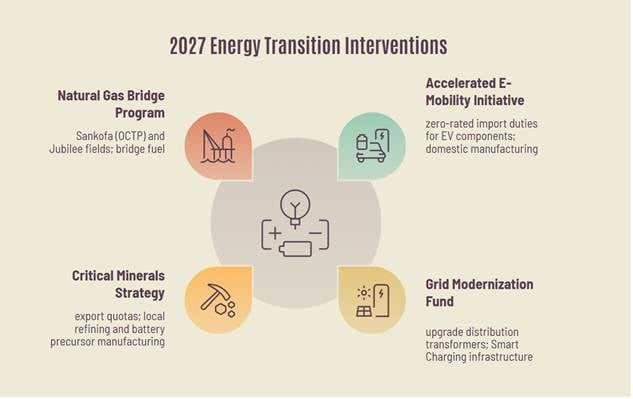
Critical Minerals Value Addition Strategy: In response to the new "Mineral Geopolitics," the budget introduces strict export quotas on raw lithium and other transition minerals. It provides tax holidays for multinational firms that establish local refining and battery precursor manufacturing plants in the Western and Central regions.
The Natural Gas Bridge Program: Recognizing that baseload power remains essential for industrialization, the budget ring-fences investments to optimize output from the Sankofa (OCTP) and Jubilee fields. Natural gas is explicitly categorized as a "bridge fuel" to ensure energy security while renewable capacity is scaled up.
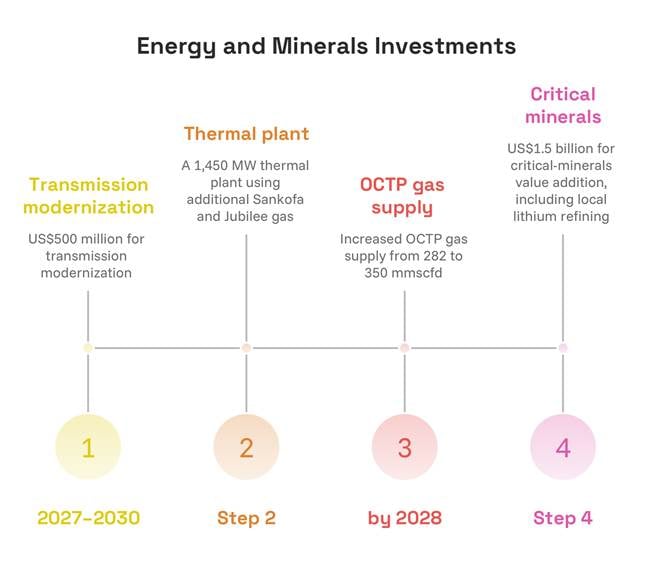
- US$2 billion for energy infrastructure
- US$500 million for transmission modernization from 2027–2030
- A 1,450 MW thermal plant using additional Sankofa and Jubilee gas
- Increased OCTP gas supply from 282 to 350 mmscfd by 2028
- US$1.5 billion for critical-minerals value addition, including local lithium refining
Alignment with the 'New Economy Budget'
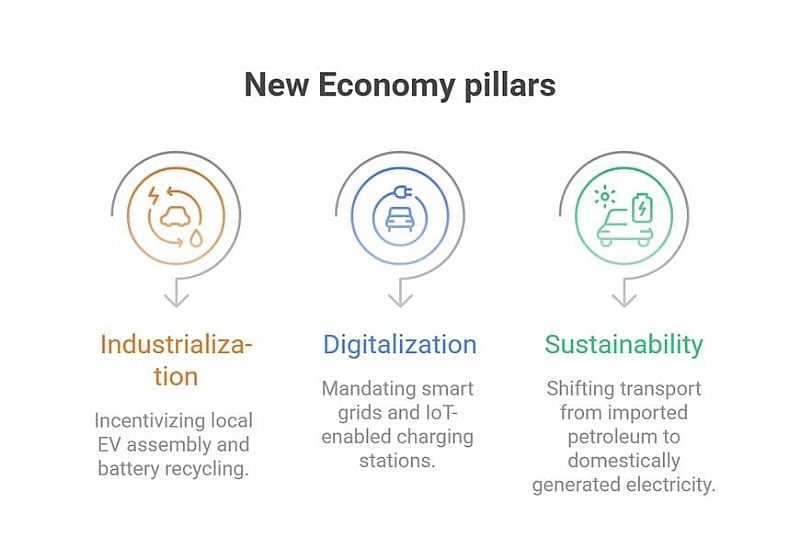
These 2027 initiatives do not exist in a vacuum; they are the operational arm of the government's overarching 'New Economy Budget' framework. The 'New Economy' paradigm is built on three pillars: digitalization, industrialization, and sustainability. The energy policies announced seamlessly weave these pillars together.
By incentivizing local EV assembly and battery recycling, the government is driving industrialization. By mandating smart grids and IoT-enabled charging stations, it accelerates digitalization. Also, by shifting the transport sector's reliance from imported petroleum to domestically generated electricity, it ensures macroeconomic sustainability. This alignment transforms the energy sector from a siloed utility provider into the foundational infrastructure of the New Economy, directly addressing the historical flaw in which Ghana has served merely as a site for green energy deployment rather than a center of production.
Expected Impact on Ghanaians
The macroeconomic brilliance of a budget means little if it does not translate into tangible benefits for the ordinary Ghanaian.
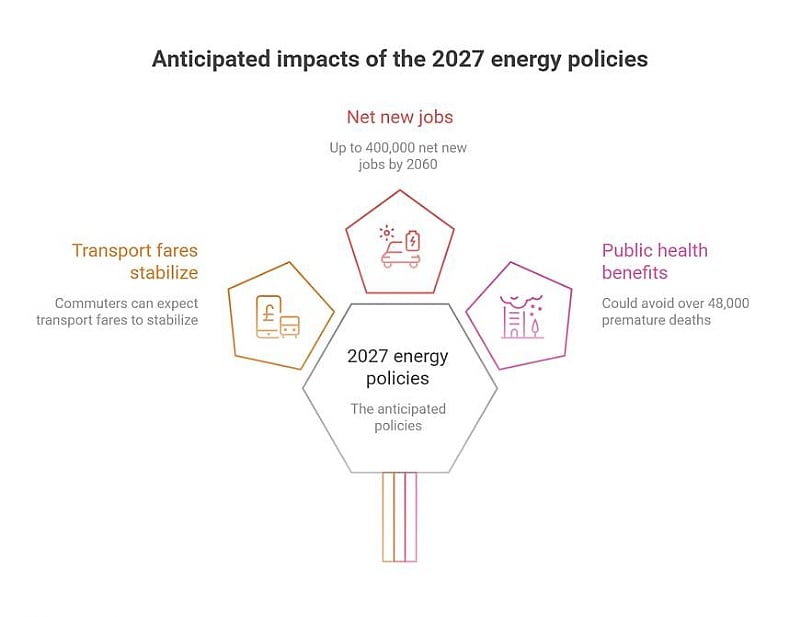
The anticipated impacts of the 2027 energy policies are profound:
Cost of Living and Transport: For the average commercial driver (trotro operator) transitioning to an electric minibus, the economics are compelling. Global data indicates that EV running costs yield annual savings of $550 to $1,000 compared to internal combustion engines. As these savings trickle down, commuters can expect transport fares to stabilize, which have historically been vulnerable to global crude oil price shocks.
Job Creation: The transition is projected to be a massive net job creator. While traditional petroleum downstream jobs may face creative disruption, the Ghana Energy Transition and Investment Plan (ETIP) projects up to 400,000 net new jobs by 2060. The 2027 budget kickstarts this by funding technical and vocational education and training (TVET) in EV diagnostics, solar installation, and battery maintenance.
Health and Environment: The push for clean cooking technologies and reduced vehicular emissions in urban centers like Accra and Kumasi will have immediate public health benefits. The National Framework estimates that minimizing energy-related indoor air pollution could avoid over 48,000 premature deaths over the transition period.
Inter-Sectoral Linkages: Powering the Broader Economy
The true genius of the 2027 energy budget lies in its multiplier effect across other critical sectors of the Ghanaian economy:
Cross-Sector Synergies
- Health Sector: The budget allocates funds for decentralized renewable energy solutions (mini-grids and off-grid solar) tailored for rural healthcare facilities. This ensures reliable power for maternal care units and vaccine cold chains, directly supporting the Africa Health Strategy's goals.
- Agriculture: The expansion of rural mini-grids provides the necessary power for solar-powered irrigation systems and cold chain logistics, reducing post-harvest losses and boosting food security.
Ultimately, the 2027 budget presents a closing window of opportunity. Whether Ghanaian policymakers, energy-sector institutions, and regulatory bodies navigate this transition with the requisite rigour will determine if 2027 is remembered as the year Ghana finally seized control of its energy destiny, or simply another milestone on a road to green dependency.
Prof.Ernest Ofori Asamoah | Email: [email protected]


 Nsuta Circuit Court remands Aduman SHS Chaplain, ICT teacher over alleged sodomy
 If NPP doesn’t win power in 2028, we have to find somewhere sleep and forget com...
 The Judge was defending her own judgement—Atta Akyea faults court after Wontumi ...
 Ato Forson met a ladder in 2025, NPP met a hole in 2017 – Gideon Boako on 2027 b...
 ‘Your cash is ready, come for it’ – Ato Forson announces GH¢29bn early payment t...
 Bawku oldest school still without roof after 10 years
 2027 Budget: NDC has habit of recycling projects without tangible results - PNP ...
 Court rejects Wontumi's bail application pending appeal in Samreboi mining case
 University students suffer skin irritation, itching as illegal mining activities...
 Boako questions Ato Forson's claim to Ghana's economic recovery, cites foundatio...


