




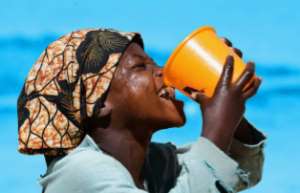
The scale. Water may not make the loudest headlines in West Africa, but it sits beneath most of them: health, food, schooling, migration and conflict. UN data from World Water Day 2026 show only 24 per cent of people in sub-Saharan Africa have safely managed drinking water, meaning water on the premises, free from contamination and available when needed.
The International Water Management Institute says over 400 million Africans in West and Central Africa lack safely managed drinking water. Some of these figures cover the whole continent or region, not West Africa alone, so check each one before you quote it.
Disease follows unsafe water. In August 2026, UNICEF reported cholera outbreaks in six West and Central African countries, along two major transmission corridors. Nigeria had the region's largest outbreak, with over 50,000 cases and 338 deaths since 1 January. UNICEF said flooding was contaminating water sources and damaging sanitation infrastructure. The pattern is familiar. Rains arrive, wells and rivers are contaminated, and children are hit first.
The Sahel's special burden. A 2026 reference guide says less than a third of the rural Sahel population has access to a resilient water service. Niger shows the gap: in 2024, 47 per cent of its people lacked basic drinking water services, 84 per cent lacked basic sanitation, and 79 per cent had no handwashing facility with soap and water at home. Climate change makes this worse by reducing water availability and degrading its quality.
Pollution in the coastal states. In Ghana, experts warn that illegal mining continues to pollute major rivers and threaten access to safe drinking water. That makes galamsey a water issue as well as an environmental one, because treatment becomes costlier and rural communities with no alternative are exposed. In Liberia, residents of Monrovia's Slipway community have relied for years on sachet water and untreated wells, with funding limits and land disputes complicating a lasting fix.
Citizens notice. Afrobarometer found water outranks all other problems in Guinea and Benin, among other countries. Only 39 per cent of citizens give their government passing marks on water and sanitation provision. Rural and poor households suffer most.
What it will take. The IWMI representative called for at least US$440 billion a year in blended finance, climate funds and sovereign wealth mechanisms.
That is a continental figure and an advocacy target, not a West African budget line. Practical priorities for the sub-region are:
Protect catchments by tackling mining pollution and open defecation upstream.
Fund rural water points with maintenance plans, since broken boreholes are a hidden failure.
Build cross-border cholera surveillance, since outbreaks move with trade and floods.
Make tariffs and subsidies fair, so that poor households don't pay the most for the least safe water.
The other side. Is water the sub-region's most challenging problem? Some would rank insecurity, debt or jobs higher, and governments face competing demands. The case for water is that it underpins all of those: unsafe water drains health budgets, keeps girls out of school and hits farm output. The two aren't rivals, since conflict also destroys water infrastructure.
Mustapha Bature Sallama
Medical/ Science Communicator,
Private Investigator, Criminal Investigation and Intelligence Analysis,
International Conflict Management and Peacebuilding. (USIP)
[email protected]
+233555275880
References
UNICEF/UN News, "Cholera spreads across borders in West and Central Africa," Aug 2026. https://news.un.org/en/story/2026/08/1168125
"Experts push urgent action on Africa's water and sanitation crises at African Academic Heritage Fair 2026," ModernGhana. https://www.modernghana.com/news/1496381/experts-push-urgent-action-on-africas-water-and.amp
"Access to Drinking Water in Africa: Where We Stand in 2026," Life-ONG (citing UN data, March 2026). https://life-ong.org/en-us/actualites/acces-eau-potable-afrique-2026
"Water and Sanitation in the Sahel and Adaptation Strategy in the Context of Climate Change," Reference Guide RG/01/2026 (UNICEF Clearinghouse). https://clearinghouse.unicef.org/download-ch-media/0cbbfc8f-7172-4eb1-bc70-671b407f5f73
"Water security for people's livelihoods in Africa," SDC Water Network brief (Niger JMP 2024 figures). https://www.sdc-water.ch/dam/en/sd-web/FT5hGJOAIF0i/reseau-brief10-water-security-africa-2026_EN.pdf
Afrobarometer Dispatch No. 1153, March 2026. https://www.afrobarometer.org/wp-content/uploads/2026/03/AD1153-PAP7-Water-supply-high-on-Africans-policy-agenda-Afrobarometer-22march26.pdf
"Liberia: Safe Water Crisis Persists in Slipway," allAfrica, 10 Nov 2026. https://allafrica.com/stories/202611110069.html


 SHC defends planned Sandbox demolition, denies political motivation
 Agbodza condemns vote-buying in NDC elections, says ‘this is not the Rawlings pa...
 Mahama congratulates newly elected NDC regional executives, urges party unity
 EC Divisional Union demands suspension of planned vehicle auction
 Afenyo-Markin accuses Mahama-led NDC of erasing Big Six from Ghana's new banknot...
 Weakening NAIMOS operations won't keep NDC in power – Ken Ashigbey tells Dr Amoa...
 Galamsey: Ken Ashigbey urges Mahama to consider state of emergency in worst-hit ...
 Who is this Sankwas, iconoclast illiterate clown little boy NPP appointed to be ...
 My government will justify the trust Ghanaians have placed in NDC – Mahama
 Yemen's Houthis advance on Aden as government forces retreat to defend their cap...


